
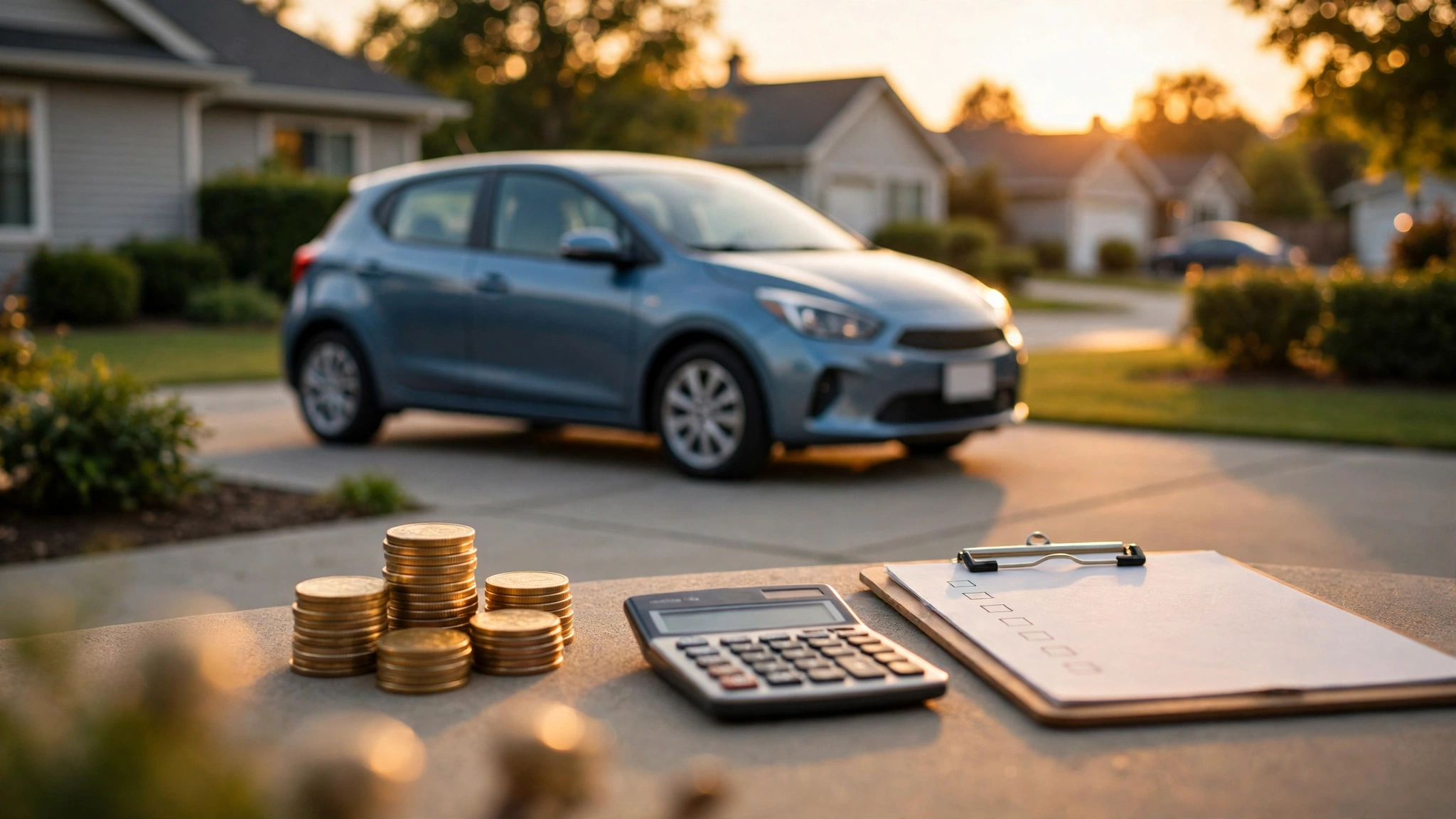
A $20,000 car does not cost $20,000. Not even close.
The sticker price is just the entry ticket. Over the years you own a car, you'll also pay for financing, insurance, fuel, maintenance, repairs, registration — and quietly lose thousands to depreciation, the cost nobody writes a check for.
How much, really? AAA's 2026 Your Driving Costs study found that owning and operating an average new vehicle costs $12,863 per year — about $1,072 a month — measured over five years and 75,000 miles. That's a national average, not your exact number. Your number could be lower or much higher, depending on the car, how much you drive, where you live, and your insurance rate.
The good news: you don't need a finance degree to figure out your number. There's a simple formula, and once you learn it, you can compare any two cars honestly — before you sign anything.
The simple formula for total cost of ownership
Write this down:
Total cost of ownership = out-the-door purchase price + financing costs + insurance + fuel + maintenance & repairs + taxes & fees − expected resale value
A few notes on each piece:
- Out-the-door purchase price means the full number, not the advertised one: vehicle price + sales tax + title and registration + dealer documentation fees + anything else required to drive it home.
- Financing costs means the interest and loan fees only — NOT the loan principal. This is the mistake almost everyone makes: the purchase price already represents the car itself, so adding the full loan amount on top counts the car twice.
- Resale value is subtracted at the end because it's money you get back when you sell or trade the car in. If you plan to drive the car until it dies, set this to zero.
Now let's unpack each cost bucket so you can actually estimate yours.
The 6 cost buckets (and how to estimate each)
1. Depreciation — usually the biggest one
Depreciation is the difference between what you pay for the car and what you can sell it for later. It's invisible — no monthly bill arrives — which is exactly why beginners ignore it. But AAA found depreciation is the single largest ownership cost on new vehicles: a weighted average of $4,422 per year in its 2026 study.
To estimate it, look at what similar cars of different ages sell for. If a 3-year-old version of the car you're eyeing sells for $14,000 and a 7-year-old one sells for $9,000, that car loses roughly $1,250 per year. Cars that hold their value can be cheaper to own overall even when their sticker price is higher.
2. Financing — count the interest, not the payment
Your monthly payment is not your financing cost. Add up the total interest you'll pay over the life of the loan (your lender's loan estimate or any loan calculator shows this). Shorter loan terms mean much less interest — a 36-month loan at the same rate costs far less in interest than a 72-month loan.
3. Insurance — get a real quote before you buy
Insurance is one of the most variable costs, and it's especially painful for young or new drivers. Never guess this number: get an actual quote for the exact car you're considering before you buy it. Two cars with the same price can have wildly different premiums. (New to car insurance? Start with our car insurance basics for first-time owners.)
4. Fuel — the easiest bucket to calculate
This one is pure arithmetic:
(miles you drive per year ÷ the car's MPG) × price per gallon = annual fuel cost
Example: 12,000 miles a year in a car that gets 30 MPG = 400 gallons. At $3.60 a gallon, that's $1,440 a year. Small changes in MPG add up fast over five years. (See our fuel-efficiency tips for new drivers to keep this number down.)
5. Maintenance & repairs — budget a reserve, don't hope
Routine service (oil changes, tires, brakes) is predictable; surprise repairs aren't. A common budgeting guideline is to set aside roughly $50–75 per month for an older used car, less for a newer one under warranty. Keep a separate repair reserve so one bad month doesn't wreck your budget — and learn when a repair needs a mechanic vs. when it's a DIY job so you stop overpaying for simple work.
6. Taxes, registration & fees — the forgotten bucket
Annual registration, inspections, and property taxes (in states that have them) add up. So do parking, tolls, and garage costs if they apply to you. These vary hugely by location — check your state's DMV fee schedule rather than guessing.
Worked example: a beginner's $18,000 used car over 5 years
Let's put it all together. This is an illustrative example with round numbers — your numbers will differ, but the method is exactly what you'd use.
- Out-the-door price: $18,000 + $1,200 tax & fees = $19,200
- Financing: interest on the loan (about) = $3,000
- Depreciation: bought for $18,000, sell for $8,000 = $10,000
- Insurance: $1,800/yr × 5 = $9,000
- Fuel: 12,000 mi/yr, 30 MPG, $3.60/gal → $1,440/yr × 5 = $7,200
- Maintenance & repairs: $900/yr × 5 = $4,500
- Registration & fees: $250/yr × 5 = $1,250
- Minus resale value: expected sale price after 5 years = −$8,000
- Total ownership cost: $36,150
Now the useful conversions:
- Per year: $36,150 ÷ 5 = $7,230/year
- Per month: $7,230 ÷ 12 = ~$603/month
- Per mile: $36,150 ÷ 60,000 miles = ~$0.60/mile
Notice what happened: the "$18,000 car" actually costs about $36,000 over five years — double the sticker price. And the monthly payment would only have told you part of the story.
5 mistakes beginners make when estimating ownership cost
- Forgetting depreciation. It's the biggest cost on most cars and the only one that never sends you a bill. Always include purchase price minus expected resale.
- Counting the car's price twice. Never add (monthly payment × loan term) AND the full purchase price. The purchase price counts once; financing adds only interest and fees.
- Treating the monthly payment as "the cost." One popular calculator shows a $30,000 car with a $489 monthly payment actually costing $645 a month all-in. The payment is less than half the story.
- Skipping the insurance quote. Insurance can swing your total by thousands. Quote the exact car before you buy, not after.
- Comparing cars over different time frames. Always compare over the same ownership period and mileage — otherwise you're measuring your assumptions, not the cars.
Your quick ownership-cost worksheet
Copy this checklist and fill in your own numbers for any car you're considering:
- Out-the-door price (ask the dealer for the full number, not the advertised price)
- Loan details: amount financed, APR, term → total interest
- Annual insurance quote (for that exact car)
- Annual miles, the car's MPG, and your local fuel price
- Expected annual maintenance + a repair reserve
- Annual registration, inspection, and taxes
- Expected resale value at the end of your ownership plan
Then: add everything up, subtract the resale value, divide by the number of years for your annual cost, divide by 12 for monthly, and divide by total miles for cost per mile. Run the same worksheet for a second car and the cheaper-looking option often loses.
FAQ
What is the biggest cost of owning a car?
Depreciation — the value your car loses over time. AAA's 2026 Your Driving Costs study puts it at a weighted average of $4,422 per year on new vehicles, larger than fuel, insurance, or finance charges. It's the cost most beginners completely overlook because it never appears as a bill.
How do I calculate cost per mile?
Divide the total ownership cost by the total miles you'll drive in the same period. In our example: $36,150 ÷ 60,000 miles = about $0.60 per mile. Cost per mile is the fairest way to compare two cars, because it puts purchase price, running costs, and resale on equal footing.
Should I include my down payment in the calculation?
No. Your down payment is part of the purchase price, which is already in the formula — adding it again would double-count. Count the purchase price once, and for financing add only the interest and loan fees.
Is a cheaper car always cheaper to own?
Not necessarily. A cheap car with poor fuel economy, expensive insurance, and frequent repairs can cost more over five years than a pricier, efficient, reliable one. That's exactly what the formula is for — run it for both cars instead of trusting the sticker price.
How accurate is AAA's $12,863-a-year figure for me?
It's a useful benchmark, not a personal quote. AAA's number is a five-year, 75,000-mile average across 34 top-selling new vehicles in its 2026 study — and the study notes methodology updates make it not directly comparable to prior years. Your number depends on your car, mileage, location, and driving record, so run your own worksheet.
The bottom line
The sticker price is the least informative number on the lot. Before you buy, spend twenty minutes with the formula: out-the-door price, plus financing, insurance, fuel, maintenance, and fees, minus what you'll get back at the end. The car that looks expensive might be the bargain — and the "deal" might be the most expensive choice you make all year. (And once it's yours, keep the maintenance bucket small with our monthly car maintenance checklist for beginners.)