
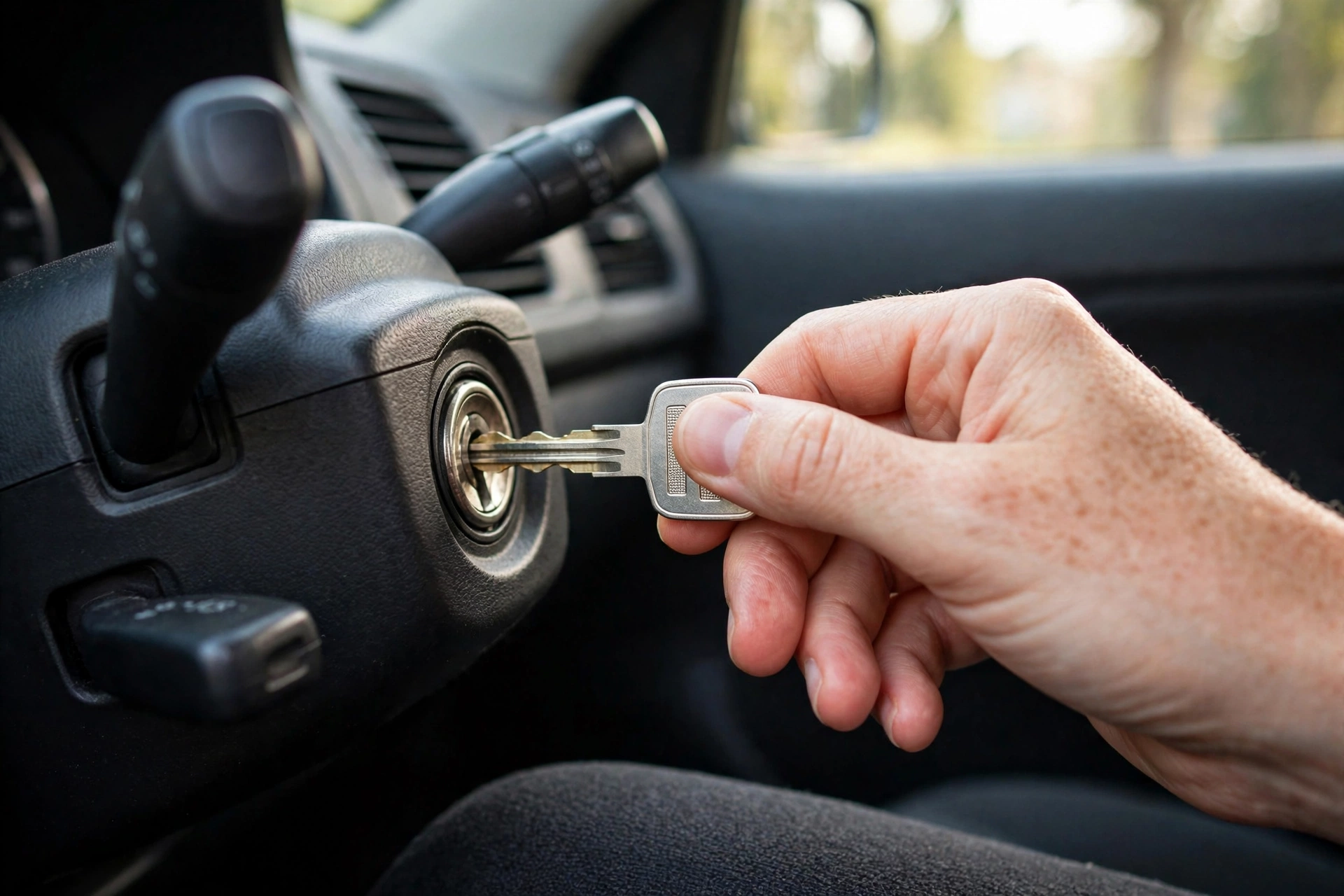
You're in a hurry, you turn the engine off, and your key refuses to come out of the ignition. It wiggles a little, but it won't pull free. Take a breath — this is one of the most common small dramas a car owner faces, and most of the time the fix takes about a minute and costs nothing.
What you should not do is yank it. A forced key can snap off inside the cylinder, and that turns a free fix into a locksmith bill. This guide walks you through the seven most common causes, in plain English, plus the safe order of things to try. Work through them from easiest to hardest — the first two fix the vast majority of cases.
The 60-Second Checklist: Try This First
Before reading anything else, run through these four quick steps. They solve most stuck-key situations:
- Check the gear selector. Confirm the shifter is fully in Park (automatic). If it looks like it's in Park, press the brake firmly and shift through Neutral and back into Park with a deliberate click. A shifter sitting a hair off the Park position is the single most common cause.
- Wiggle the steering wheel. While gently turning the key, slowly rock the steering wheel left and right. If the steering lock engaged when you shut off the engine, this releases the tension on the ignition cylinder.
- Push the key slightly inward. Some ignitions have an Accessory position one click away from OFF. Push the key gently inward and rotate it all the way to the true OFF position before pulling.
- Look at your key. If the blade is bent, cracked, or the teeth look worn smooth, the key itself may be binding in the tumblers. Try your spare key if you have one.
If the key came out — great, you're done. If not, read on: the cause is one of the seven below, and each has a safe fix.
7 Reasons Your Key Is Stuck in the Ignition
1. The steering wheel lock is engaged
Almost every car has a steering-wheel lock as an anti-theft feature. If you nudged the wheel after switching the engine off, the lock clicked into place and put pressure on the ignition cylinder. The key feels jammed even though nothing is broken. This is the most common cause by far, and the fix is the steering-wheel wiggle from the checklist above.
2. The car isn't fully in Park
Automatic cars use a safety interlock: the key can't come out unless the transmission is confirmed to be in Park. This prevents the car from rolling away with the key removed. If the shifter is even slightly off its detent — or the shift-interlock switch is sticky — the car thinks it's still in gear and holds the key. Parking on a steep hill makes this worse, because pressure on the parking mechanism can keep the shifter from seating fully.
3. Weak or dead battery
On many newer cars, a small electric solenoid has to release before the key can be pulled out. With a weak or dead battery, that solenoid never triggers, so the key stays trapped. Clues: dashboard lights are dim or dead, the engine cranks slowly or not at all, or the radio and interior lights cut out. A jump-start often frees the key immediately — here's how to jump-start a car safely if you've never done it. (Don't confuse this with a dead key-fob battery — that's a different part; here's what to do if your key-fob battery dies.)
4. Worn, bent, or damaged key
Keys live a rough life: years of twisting, rattling in pockets with coins, being used as a box opener. Bent blades and worn-down teeth don't line up the ignition's internal pins correctly, so the cylinder can't rotate back to the release position. Hold the key up to eye level and look down its length — any curve or twist is a problem. A locksmith or dealer can cut a fresh key from your VIN; for most everyday cars this is cheaper than people expect, and having a spare is always worth it.
5. Worn ignition cylinder
The ignition cylinder contains tiny spring-loaded pins (tumblers) that read your key's shape. Over hundreds of thousands of turns, those parts wear out: tumblers collapse, springs weaken, and the cylinder stops returning cleanly to the release position. Warning signs: the key has felt stiff or gritty for a while, you sometimes have to jiggle it to start the car, or the cylinder feels loose and wobbly. This one is a mechanic or locksmith job — don't try to rebuild it yourself.
6. The key isn't in the true OFF position
Most ignitions have several detents: OFF, Accessory (one click), and ON/Start. If you stopped at Accessory, the electronics stay live and the release mechanism won't let the key go. This is easy to miss because the dash lights may look "off" at a glance. Push the key gently inward, rotate it firmly one more click to OFF, and try again.
7. Dirt or debris in the keyway
Dust, pocket lint, and sticky residue (tape, glue, food) build up on key blades and inside the ignition over time, gumming up the tumblers. If the key feels gritty going in, this is likely your culprit. A short burst of compressed air can clear loose dust; for sticky residue, clean the key blade itself with a cloth and a little rubbing alcohol, then try again.
How to Get the Key Out Safely
Match your fix to what you found above:
- Steering lock: rock the wheel gently left-right while turning the key with light pressure. No muscle — let the lock release on its own.
- Not in Park: press the brake, engage the parking brake, and re-seat the shifter firmly into Park. Try the key again.
- Dead battery: get a jump-start from another car or a portable jump pack. Once power returns, the solenoid releases and the key slides out.
- Worn or bent key: try the spare key. If only the worn one fits, gentle wiggling (not force) may coax it out, then get a fresh key cut before it happens again.
- Gritty keyway: compressed air first. If that fails, a small amount of dry graphite lubricant on the key blade — work it in gently, then pull.
One more trick for stubborn-but-not-broken situations: with the key in, gently tap the end of the key head with the handle of a screwdriver while pulling lightly. The vibration can settle a sticky tumbler. If it doesn't work after a couple of tries, stop and move on to professional help.
What NOT to Do
- Don't yank or twist hard. A snapped key blade inside the cylinder turns a free fix into a locksmith visit. If it doesn't move with gentle pressure, it won't move with force — it will only break.
- Don't spray WD-40 or oil into the ignition. Oil-based sprays attract dust and gum up the lock worse over time. Graphite (a dry powder lubricant) is the right choice for locks.
- Don't dig at it with pliers, tweezers, or a paperclip — especially if the key has already broken off. You'll push the piece deeper and scratch the tumblers.
- Don't keep driving indefinitely with a key that jams every time. Ignition cylinders fail progressively. The day it jams and truly won't release is the day you're stranded.
When to Call a Mechanic or Locksmith
Call a professional if any of these are true:
- The key won't come out after trying every fix above.
- The key comes out but jams again every time you park.
- The ignition cylinder feels loose, spins freely, or the key turns with almost no resistance.
- The key broke off inside the ignition.
- You see a dashboard warning light related to the anti-theft or ignition system.
A mobile locksmith can usually extract a stuck or broken key and, if needed, replace the ignition cylinder on the spot. If the problem is electrical (dead battery, faulty interlock switch), your regular mechanic is the right call.
How to Keep It From Happening Again
- Straighten the wheel before switching off. Rolling the wheels straight and letting go of the wheel before you turn the key prevents the steering lock from binding.
- Always end in Park with a firm click — don't rush the shift when you're in a hurry.
- Keep your key clean and light. Wipe the blade now and then, and don't load your keyring with a dozen heavy fobs and loyalty cards — the weight wears the ignition cylinder over its life.
- Get a spare key now, not later. A spare turns a stuck-key crisis into a two-minute test of whether the problem is the key or the car.
- Replace a worn key early. If the teeth are visibly smoothed down, get a fresh key cut before it becomes the key that won't come out.
Frequently Asked Questions
Why does my key get stuck in the ignition?
The most common reasons are a locked steering wheel, the gear selector not fully in Park, a weak or dead battery, or a worn key or ignition cylinder. Work through them in that order before assuming anything expensive is wrong.
Can a dead battery cause my key to get stuck?
Yes, on many newer cars. An electric solenoid has to release before the key can come out, and with low voltage it never triggers. If your dashboard lights are dim or nothing powers on, a jump-start may free the key.
Should I spray WD-40 into the ignition?
Skip it. Oil-based sprays attract dust and gum up the lock over time. If the keyway feels gritty, a small puff of dry graphite lubricant is the better choice, then gently work the key.
Is it safe to drive if my key keeps getting stuck?
An occasional stuck key with an obvious cause (steering lock, not in Park) is not an emergency. But if the key jams repeatedly, the cylinder feels loose, or you ever have to force the key, see a mechanic soon — a failing ignition cylinder can leave you stranded.
What should I do if the key breaks off in the ignition?
Don't dig at it with pliers or tools — you'll push the broken piece deeper. Call a locksmith or roadside assistance; they have extraction tools made for exactly this.
The Bottom Line
A key stuck in the ignition feels like a crisis, but it's usually your car doing its job: the steering lock, the Park interlock, and the key-release solenoid are all safety systems. Check Park, wiggle the steering wheel, and make sure the key is fully in OFF — those three steps fix the overwhelming majority of cases. Gentle always beats force, and a fresh spare key is the cheapest insurance against it happening again.
For more on keeping your car out of trouble, the AutoZone DIY guide on stuck ignition keys and the CarParts.com systems-based breakdown are solid next reads from the parts world.