
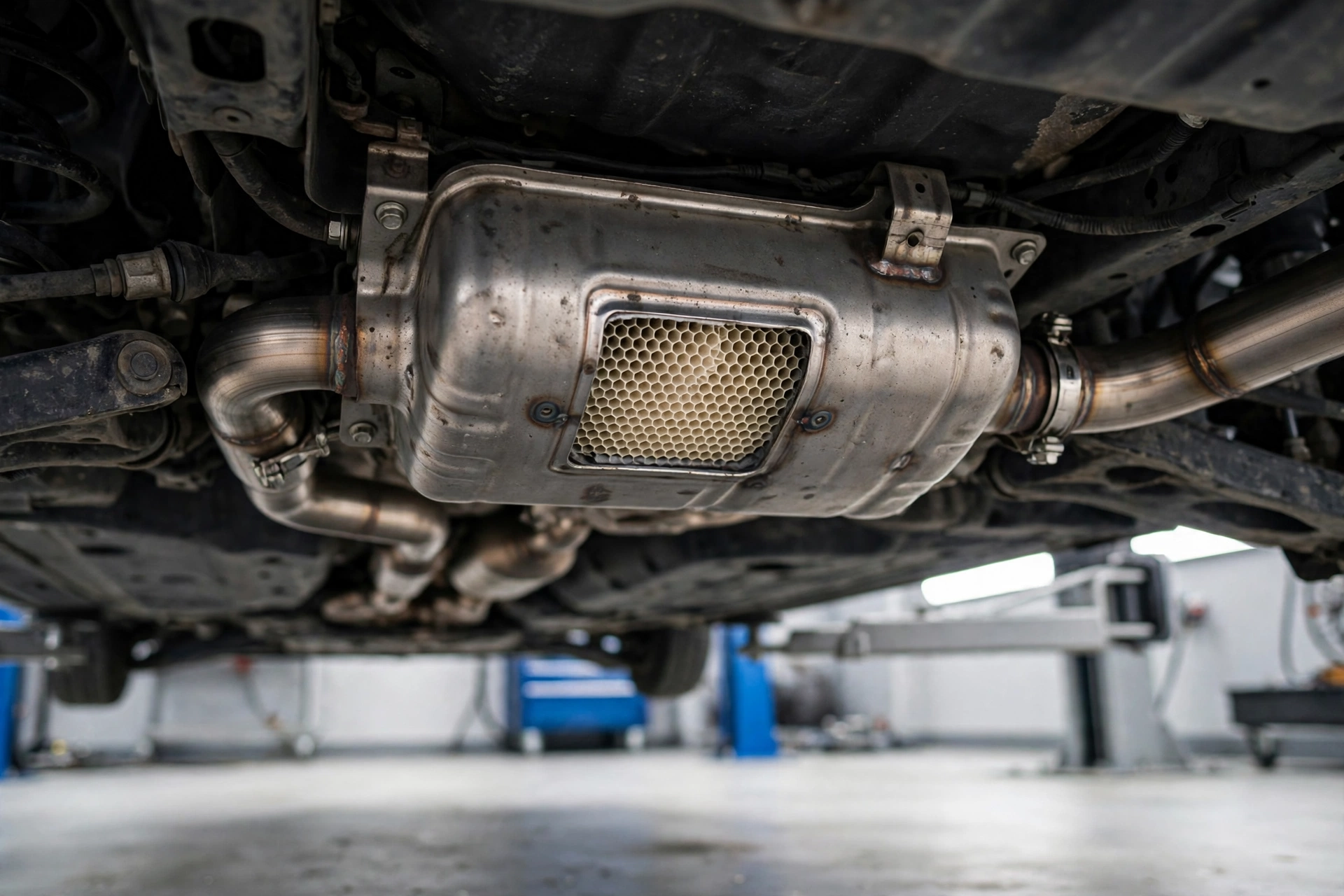
Short answer: Yes — your engine will still run and the car will physically move. But driving without a catalytic converter is illegal under federal law, your car will almost certainly fail inspection, it will be loud, and it can hurt fuel economy and performance. If yours was stolen, drive only as far as absolutely necessary — then get it replaced.
The catalytic converter is a small box-shaped part in your exhaust pipe, under the middle of the car. Inside it is a ceramic honeycomb coated with precious metals that chemically scrub harmful pollutants out of your exhaust before they leave the tailpipe. It's there for emissions, not for the engine itself — which is exactly why the car keeps running without one.
5 Things That Change the Moment It's Gone
1. Your car gets loud — immediately. The converter's dense honeycomb structure muffles a lot of exhaust sound. Without it, the exhaust takes a straight path through, and the result is a raw, harsh roar. Many drivers describe it as startling. That noise can also get you a ticket under local noise ordinances.
2. The exhaust smells terrible. Without the chemical cleaning step, raw unburned fuel and toxic gases exit the tailpipe directly. Expect an acrid, sulfur or rotten-egg smell — and because exhaust can drift into the cabin, keep your windows up and drive with the ventilation set to recirculate until you're fixed.
3. The check engine light comes on. Your car has two oxygen sensors — one before and one after the converter. The second one checks the converter's work. With the converter gone, both sensors read the same thing, so the car's computer (the ECU) assumes the converter has failed and stores a trouble code — usually P0420 or P0430 — and lights up the check engine light. If you're not sure which light you're looking at, our dashboard warning lights guide explains every symbol in plain English.
4. Performance and fuel economy can suffer. Your engine was calibrated for the converter being there. When the ECU sees the sensor mismatch, it may run the engine in a less efficient mode — rough idling, weaker low-end power, worse gas mileage. Some cars even enter a reduced-power "limp mode." (You won't gain power by removing it — that myth only ever applied to old carbureted engines, not your modern car.) If your car is running but the light stays on, our guide on what the check engine light usually means explains how urgent different situations are.
5. You can't pass inspection. Emissions inspections (smog checks) are required for registration renewal in many states and regions. With the check engine light on for a catalyst code and the missing hardware, you will fail — which means you can't legally keep the car registered until it's fixed.
Why It's Illegal (Yes, Even If Your State Has No Inspection)
The U.S. Clean Air Act makes it illegal to remove or disable any emissions control device on a street-driven vehicle — a practice the EPA calls "tampering" (see the EPA's exhaust system repair guidelines). This is federal law (42 U.S.C. § 7522), so it applies everywhere, whether or not your state runs emissions tests. Federal civil penalties run into the thousands of dollars per violation (breakdown of the EPA rules and penalties here), and repair shops are also prohibited from installing a straight pipe or "delete" in place of a converter.
What the law does allow: installing a certified aftermarket replacement when the converter is missing (including after theft), damaged, or failing. That's the fix to aim for — legal, clean, and the only one that turns the check engine light off.
One important note for used-car buyers: if you bought the car from a previous owner who deleted the converter, you can still be on the hook for driving it. Check that the converter is present before you register the car, especially in an emissions-testing area.
Your Catalytic Converter Was Stolen? Do This Right Now
Converter theft is one of the most common reasons beginners end up searching this topic. The sudden loud exhaust on startup is usually the giveaway. Stay calm and follow these steps:
- Don't drive it to work or school. Drive only to a safe parking spot or directly to a repair shop if it's close. Long drives expose you to exhaust fumes and legal risk.
- Confirm it's theft, not something else. Look (don't crawl under a running car) for a cleanly cut section of exhaust pipe with a gap where a box-shaped part used to be. Thieves cut, so the ends look sawn, not rusted.
- File a police report. It takes a few minutes, and you need the report number for an insurance claim.
- Call your insurer. Comprehensive coverage usually covers converter theft, minus your deductible.
- Have it towed to a shop if the shop isn't nearby. The exhaust may be dragging and the fumes are unhealthy — a tow is safer than a long drive. As always with confusing car situations, knowing when a job is a mechanic job, not a DIY job will save you money and stress.
- Tell the mechanic you need a certified replacement converter. Mention your car's exact year, make, and model so they order the right part — and ask for the quote in writing before work starts.
Protecting the replacement: park in well-lit areas or a garage when you can, ask your mechanic about a converter shield or cage (a bolt-on theft deterrent), and consider etching your VIN onto the new converter.
What a Replacement Involves (So Nobody Can Take Advantage of You)
A catalytic converter replacement is a straightforward shop job: cut out the damaged section, weld or bolt in the new converter, reconnect the sensors, and clear the trouble code. Expect it to cost several hundred dollars or more installed, depending on your vehicle — luxury and hybrid models tend to cost more because of the converter design.
Ask these questions before you approve the work:
- "Is this an EPA-certified replacement for my car's year and model?" (In California and other CARB states, it must also be CARB-certified.)
- "Does the quote include the oxygen sensors, or are mine still good?"
- "Will you clear the check engine light and confirm the code is gone?"
- "What's the warranty on the part and the labor?"
FAQ
How far can I drive without a catalytic converter?
As far as you strictly need to — a short trip to the nearest shop, ideally. Every mile adds exhaust fumes, noise violations, and legal exposure. If the exhaust is dragging or the smell is strong inside the car, have it towed instead.
Will driving without one damage my engine?
A short drive won't destroy your engine, but it's not harmless. The ECU can run the engine inefficiently, fuel economy drops, and in some cars reduced-power mode engages. The bigger risks are legal (fines, no registration) and health (raw exhaust fumes).
Does a missing catalytic converter void my warranty?
Tampering with emissions equipment can void portions of your emissions warranty and give a dealer reason to deny related claims. Theft is different — that's an insurance claim, not tampering — so file the police report and keep your records.
Can I just put a straight pipe where the converter was?
No — not for a street-driven car. Installing a bypass pipe is tampering under the same federal law as removing the converter. The only legal fix is a certified replacement converter.
The Bottom Line
Your car can physically drive without a catalytic converter, but it shouldn't — it's illegal, it will fail inspection, it pollutes heavily, and it runs worse. If yours was removed or stolen, treat it like an urgent-but-simple repair: short trip or tow to a shop, certified replacement, light off, done. Want to understand the warning lights involved? Start with our dashboard warning lights guide, and check our guide on what the check engine light usually means for next steps on any engine light.