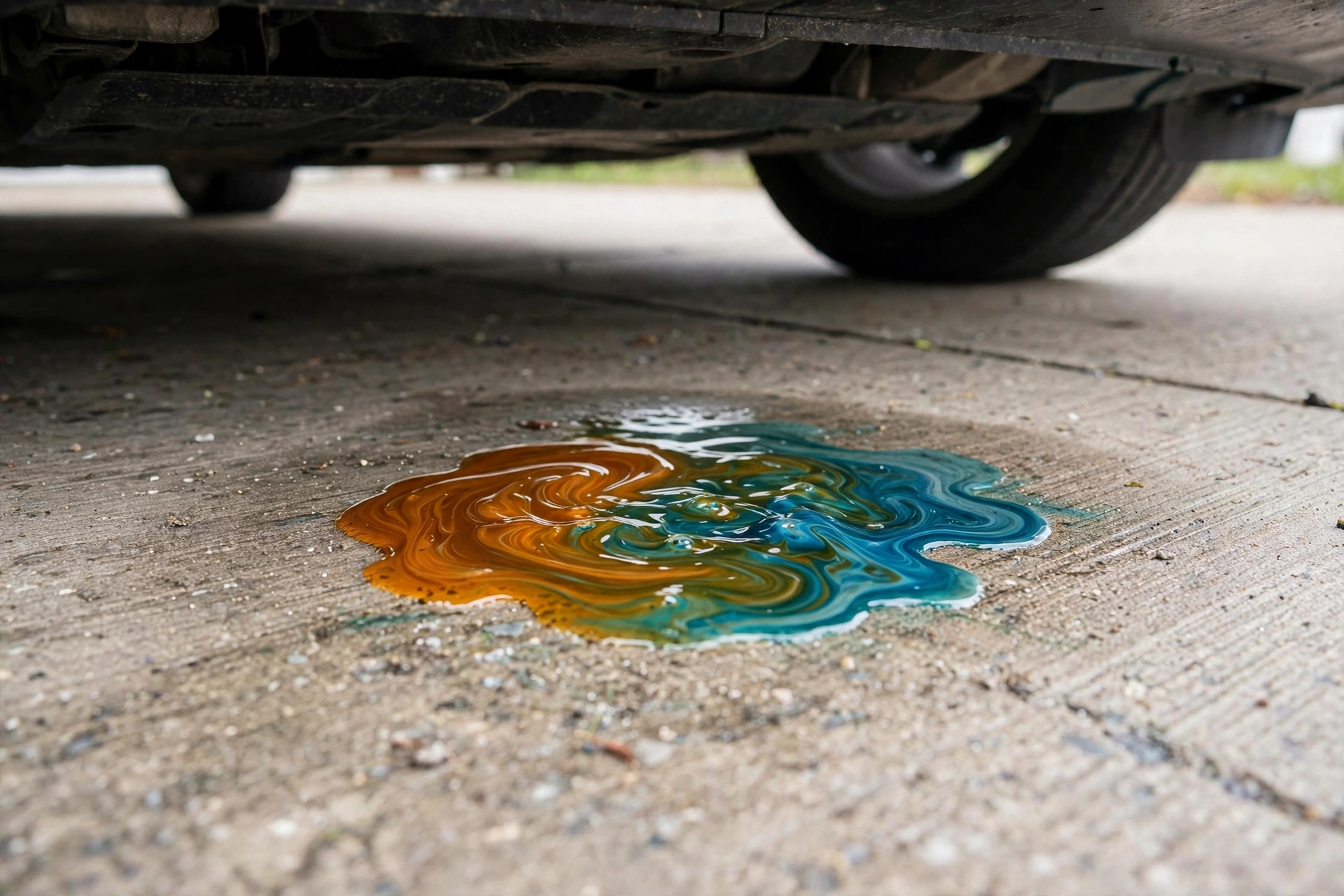
You walk out in the morning, coffee in hand, and there it is: a dark spot on the driveway under your car. Your stomach drops. Is the car dying? Is it safe to drive to work? How much will this cost?
Take a breath. That puddle is actually one of the most useful clues a car can give you. Cars run on several different fluids, and every one of them has a signature color, smell, and favorite parking spot. With ten minutes and zero tools, you can usually identify exactly what's leaking — and, more importantly, know whether it's a "clean it up and watch it" situation or a "call a tow truck" situation.
This guide is written for first-time car owners. No jargon, no tools, no getting under the car. Just look, note, and decide.
First things first: the 30-second urgency triage
Before identifying anything, answer one question: is it safe to drive? Sort the leak into one of these three buckets.
STOP — don't drive, get it towed:
- Any fluid that smells strongly of gasoline
- Brake fluid (clear-to-yellowish, very slippery, near a wheel) — your brakes could fail
- A large, fast-growing puddle of anything — especially bright-colored coolant
SOON — drive carefully to a mechanic within a day or two:
- Engine oil (amber to black, thick)
- Coolant (green, orange, pink, or blue — sweet smell)
- Transmission or power steering fluid (red or reddish-brown)
WATCH — usually harmless, but confirm:
- Clear, odorless water under the passenger side after using the AC (normal condensation)
- Bright blue watery fluid at the front (windshield washer fluid — harmless)
When in doubt, treat an unidentified leak as urgent. A quick tow is always cheaper than the damage from driving on a bad leak.
The overnight cardboard test (your best diagnostic tool)
Forget crawling under the car with a flashlight. The simplest, most reliable test costs nothing:
- Slide a piece of clean, light-colored cardboard (a flattened box works) under the car, roughly where you saw the spot.
- Write today's date on it with a marker, and mark which end points toward the front of the car.
- Leave it overnight — don't drive over it or move it.
- In the morning, read it like a doctor reads a lab result. Note:
- The exact color (compare it against white cardboard, not stained concrete)
- The texture — touch it with a gloved fingertip. Oily? Watery? Slippery? Sticky?
- The smell — sweet, petroleum-like, sulfurous (rotten egg), or nothing
- The size — a coin-sized spot, a dinner-plate puddle, or a wide stain
- The position — front, middle, or rear; under which side
- Take a photo of the cardboard next to a ruler or your hand for scale. You'll want this later.
This one test answers the three questions every mechanic asks: what color, how much, and where.
The fluid ID chart: match what you see
Now match your sample to the most common car fluids. Work through the list by color first.
Clear, thin, odorless water
Almost always: air conditioning condensation. Completely normal — it's just moisture the AC drained from the cabin air. It usually appears under the passenger side near the front on warm days, evaporates quickly, and leaves no stain. No action needed. (One exception: on a hot day with the AC off, a large amount of clear water could be very diluted coolant — smell it; coolant is sweet.)
Amber to dark brown or black, thick and greasy
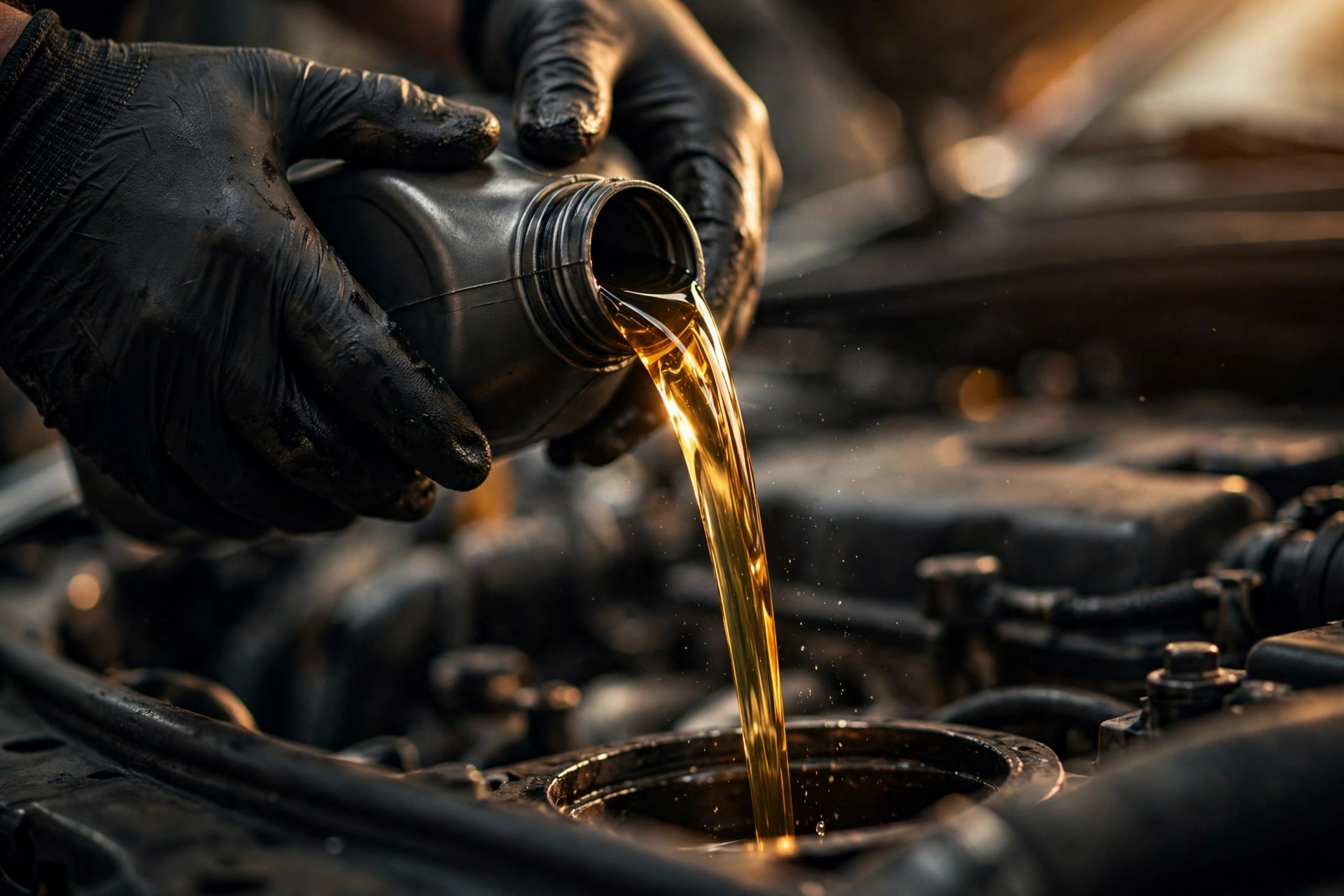
Engine oil. Fresh oil is honey-colored; used oil turns dark brown to nearly black. It feels thick and greasy, smells faintly of petroleum, and typically drips from the front-center of the car, under the engine. A few drops mean "check your oil level and watch it." A real puddle means check the level before driving and top it up if it's low.
Green, orange, pink, or blue, watery with a sweet smell
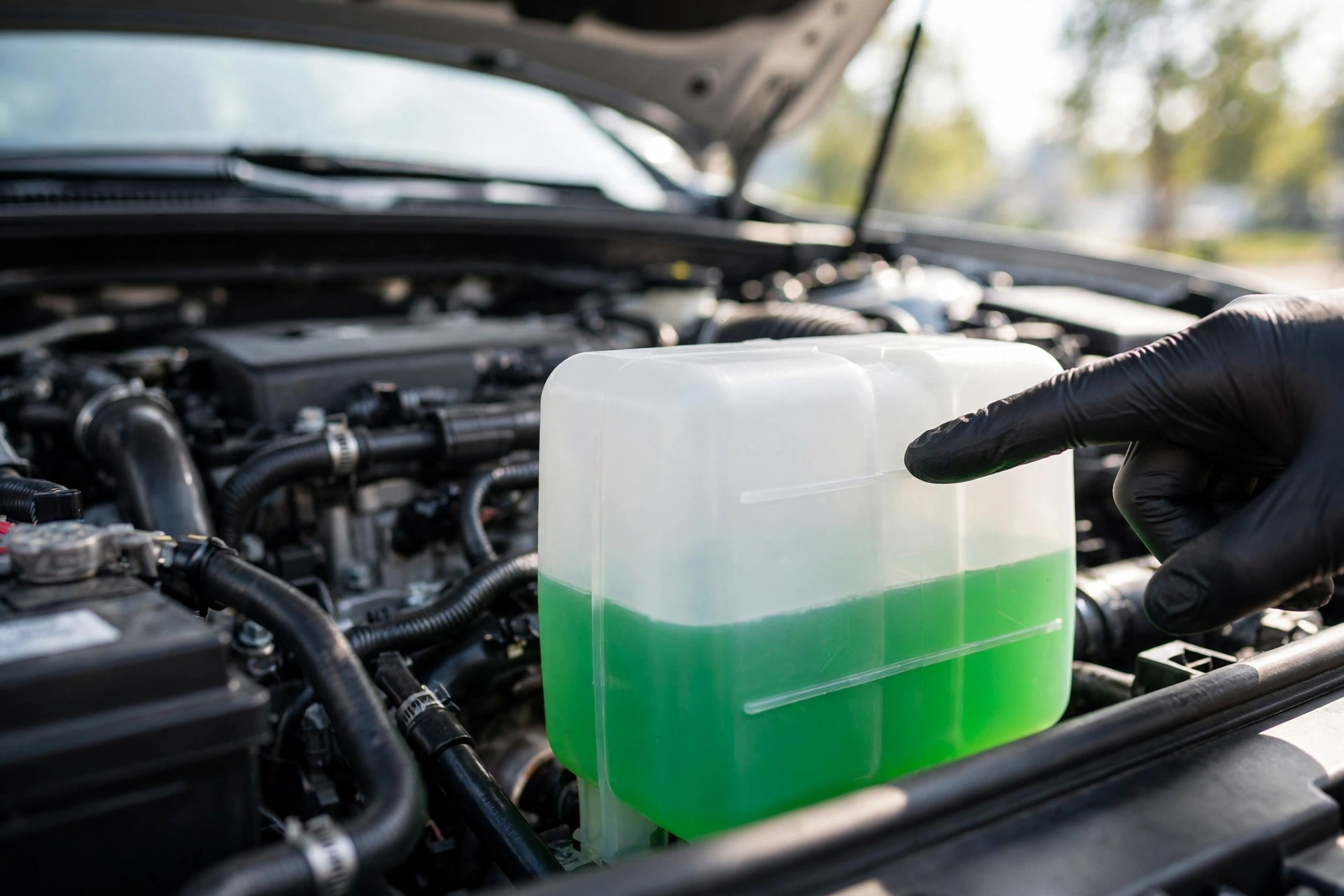
Coolant (antifreeze). The giveaway is the sweet, almost maple-syrup smell and the watery texture. The color depends on your car's manufacturer — green, orange, pink, or blue are all common — so don't wait for one specific color. Coolant usually appears under the front of the car, near the radiator. Your cooling system is sealed and doesn't consume coolant, so a falling level always means a leak. Our full guide covers what coolant leak symptoms look like so you can catch them early.
Important: coolant is toxic, and its sweet smell attracts pets and children. Clean up any spill with cat litter or sand, rinse the area well, and keep animals away from it.
Red or reddish-brown, thin and slippery
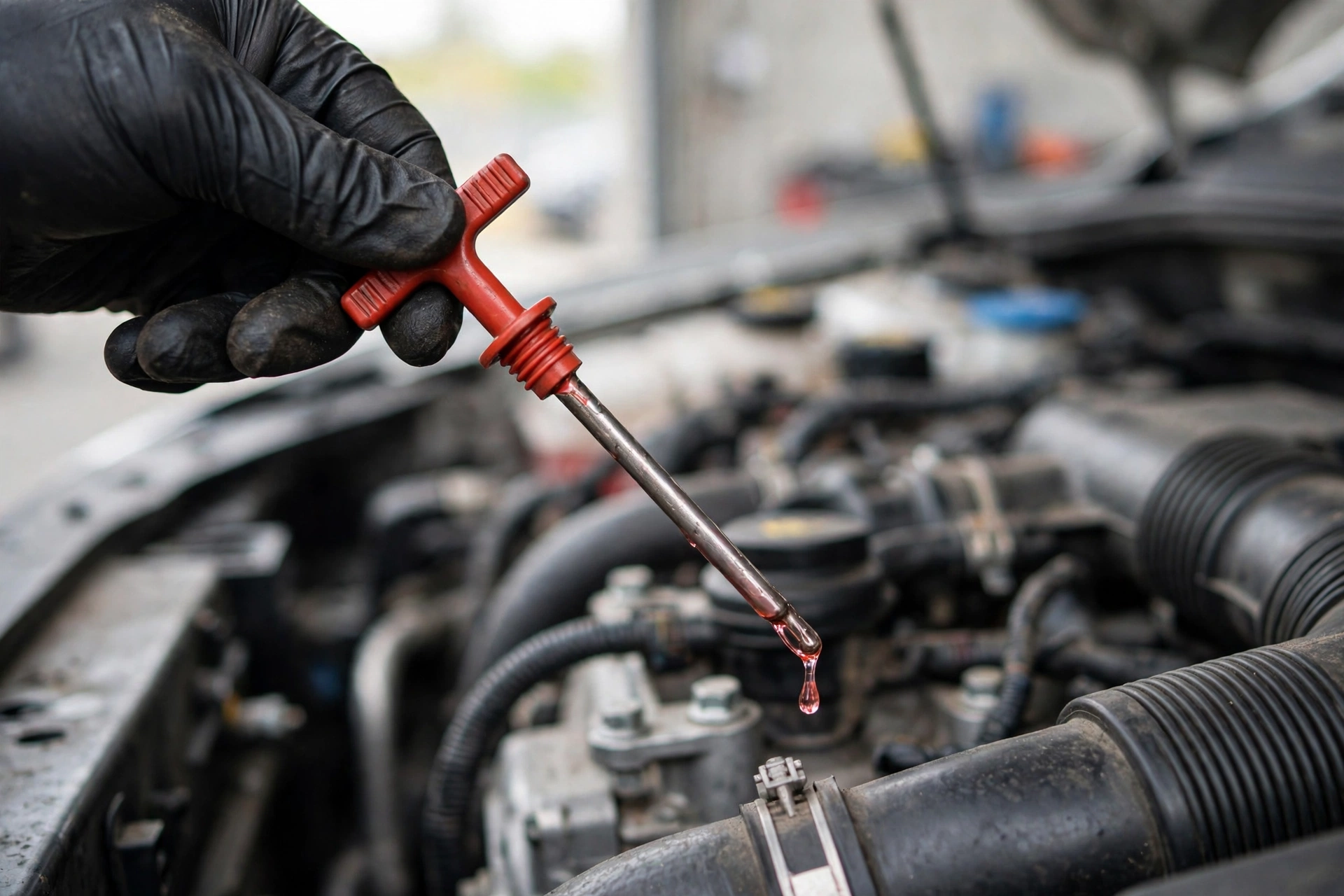
Transmission fluid or power steering fluid. Both are often red when new and turn brownish with age, so color alone can't separate them — position can. Transmission fluid pools near the middle of the car, under the transmission. Power steering fluid lands further forward, near the front or on the driver's side. Both deserve a mechanic visit soon: automatic transmissions are sensitive to low fluid and can be damaged quickly. Learn how to check your transmission fluid — and our power steering fluid guide explains what it does and how to check its level.
Clear to yellowish, very slippery, near a wheel
Brake fluid. New brake fluid is nearly clear with a yellow tint and darkens with age. It feels extremely slippery, may lift paint off the driveway, and appears near a wheel, at a brake line, or under the master cylinder at the back of the engine bay. This is the stop-driving leak. If your brake pedal feels soft or spongy too, do not drive the car. Here's how to check and top up brake fluid safely — and call a mechanic before driving.
Bright blue and watery, with a soapy smell
Windshield washer fluid. Harmless — usually a cracked reservoir or split hose near the front of the car. Top up the washer fluid and watch; if it drains again quickly, a shop can replace the reservoir cheaply.
Thick, dark, rotten-egg smell
Gear oil from the differential or a manual transmission. The sulfur smell is unmistakable. Have a mechanic check it soon.
Any liquid with a strong gasoline smell
Fuel. Fuel evaporates fast and stains rather than pooling, so even a strong smell with little liquid counts. Stop driving and have the car towed. Fuel leaks are a fire risk — not a "wait and see" item.
Where it landed tells you the rest
Position narrows things down fast. One caveat: the drip is rarely directly under the source — fluid runs along the underside, follows crossmembers, and drips off the lowest point, and driving pushes it toward the back. Still, as a rough guide:
- Front, under the engine: engine oil, coolant, power steering fluid, or AC condensation
- Middle, under the cabin: transmission fluid
- Behind a front wheel: brake fluid (caliper or hose)
- Rear: differential gear oil, fuel, or rear brake lines
- Passenger side, near the firewall: almost always AC condensation
If two spots appear (for example, oil in front and a wet patch behind a wheel), you may have two separate leaks — note both on your cardboard.
How much is leaking? Read the volume, not just the color
A mechanic cares about rate as much as type:
- A few drops (coin-sized): a seep. Note it, check the relevant fluid level weekly, watch whether it grows. Many older cars seep slightly for years.
- A palm-sized or dinner-plate puddle: an active leak. Check the fluid level before your next drive and book a mechanic within days.
- A puddle that's bigger every morning: a leak that's getting worse. Top up the fluid to the proper level, minimize driving, and get it looked at this week.
- A spreading puddle under a parked car with the engine running: stop driving and tow it.
Always re-check the fluid level a few days after topping up — if it's dropping again, the leak is confirmed and active.
What to tell your mechanic (so you don't get upsold)
Walk in with facts, and you'll get facts back. Say or show:
- "Here's a photo of the leak on cardboard" — color, size, and position in one picture.
- "It smells [sweet / like petroleum / like rotten eggs / like nothing]"
- "It's under the [front / middle / rear], [driver's / passenger's] side"
- "It's been there [X days] and the spot is [staying the same / growing]"
- "I checked the [oil/coolant/transmission] level — it was [normal / low]"
A mechanic who hears this knows you're paying attention — and you'll get a straight answer about what's actually wrong.
FAQ
Is it safe to drive with a fluid leak?
It depends entirely on the fluid. Brake fluid leaks and fuel leaks: no, do not drive — tow it. Coolant, oil, transmission, and power steering leaks: usually okay for a short, careful drive to a mechanic if fluid levels are correct, but get it checked within a day or two. AC condensation and washer fluid: completely safe. When you can't identify the fluid, treat it as urgent until a mechanic rules it out.
How do I tell engine oil from coolant?
Color and smell. Oil is amber-to-black, thick, and greasy with a petroleum smell. Coolant is bright (green, orange, pink, or blue), watery, and sweet-smelling. If it's sweet and bright, it's coolant — and it needs attention soon, because cooling systems shouldn't lose fluid.
How do I tell transmission fluid from power steering fluid?
Both are often red, so use position: transmission fluid pools under the middle of the car, while power steering fluid lands further forward, near the steering rack or pump. Power steering fluid may also feel slightly less slippery than transmission fluid. If you're unsure, check both reservoirs (your owner's manual shows where they are).
Is clear liquid under my car normal?
Usually, yes. Clear, odorless water under the passenger side after running the air conditioning is just condensation — completely normal. But clear fluid that feels slippery or oily near a wheel could be brake fluid, and any clear liquid with a gasoline smell is a fuel problem. Touch it (with gloves) and note where it is.
Can I just top up the fluid and keep driving?
Topping up buys you time, not a fix. A leak that needs repeated top-ups is getting worse, and running low on transmission fluid, oil, or coolant causes expensive damage fast. Top up to the correct level, then treat it as a countdown: get to a mechanic before the level drops again.
The bottom line
A puddle under your car isn't a disaster — it's information. Identify it by color, texture, smell, and location using the overnight cardboard test, sort it by urgency (stop / soon / watch), and act accordingly. The ten minutes you spend tonight can save you hundreds tomorrow — and when you do visit a mechanic, you'll walk in as the rare customer who already knows what's wrong.
Sources & further reading:
- Allstate's guide to identifying car fluids and leaks
- Federal Way Automotive's guide to identifying car fluid leaks by color and location