
Checking your coolant level is one of the easiest under-hood checks a new car owner can learn — it takes about five minutes, needs no tools, and it can save you from one of the most expensive breakdowns a car can have: an overheated engine. Yet many first-time owners never open the hood until a warning light appears, by which time the damage may already be done.
In this guide, you will learn exactly where to find your coolant reservoir, how to read the MIN and MAX lines correctly, what the level actually tells you, and how to top it up safely when it is low. No mechanical experience needed.
What Coolant Does (and Why the Level Matters)
Coolant — also called antifreeze — is the brightly coloured liquid (usually green, orange, pink or blue) that circulates through your engine and radiator. It does two jobs at once: it carries excess heat away from the engine so it does not overheat, and it stops the liquid in the cooling system from freezing in cold weather. It also contains additives that protect the inside of your engine and radiator from rust and corrosion.
When the coolant level drops too low, there is not enough liquid to carry the heat away. The temperature gauge starts climbing, and if you keep driving, the engine can overheat badly enough to warp metal parts or blow a head gasket — repairs that can cost far more than the car is worth. A quick monthly level check catches a slow drop long before it becomes a crisis.
If your car has already overheated, stop and read our step-by-step guide on what to do when your car overheats before you do anything else.
The One Safety Rule: Only Check on a Cold Engine
Before you touch anything under the hood, remember this: never open the cooling system while the engine is hot. When the engine runs, the cooling system is under pressure, and hot coolant can spray out and cause serious burns.
Always check the level when the engine is completely cold — ideally first thing in the morning, or at least a few hours after the car was last driven. A simple test: place your hand on the top radiator hose. If it feels even slightly warm, wait longer. A hot-engine reading is also unreliable, because coolant expands as it heats up and the level rises — a warm reading can look fine when the cold level is actually low.
How to Check Your Coolant Level in 5 Steps
All you need is a torch (your phone flashlight works fine) and a clean rag. Park on a flat, level surface so the reading is accurate.
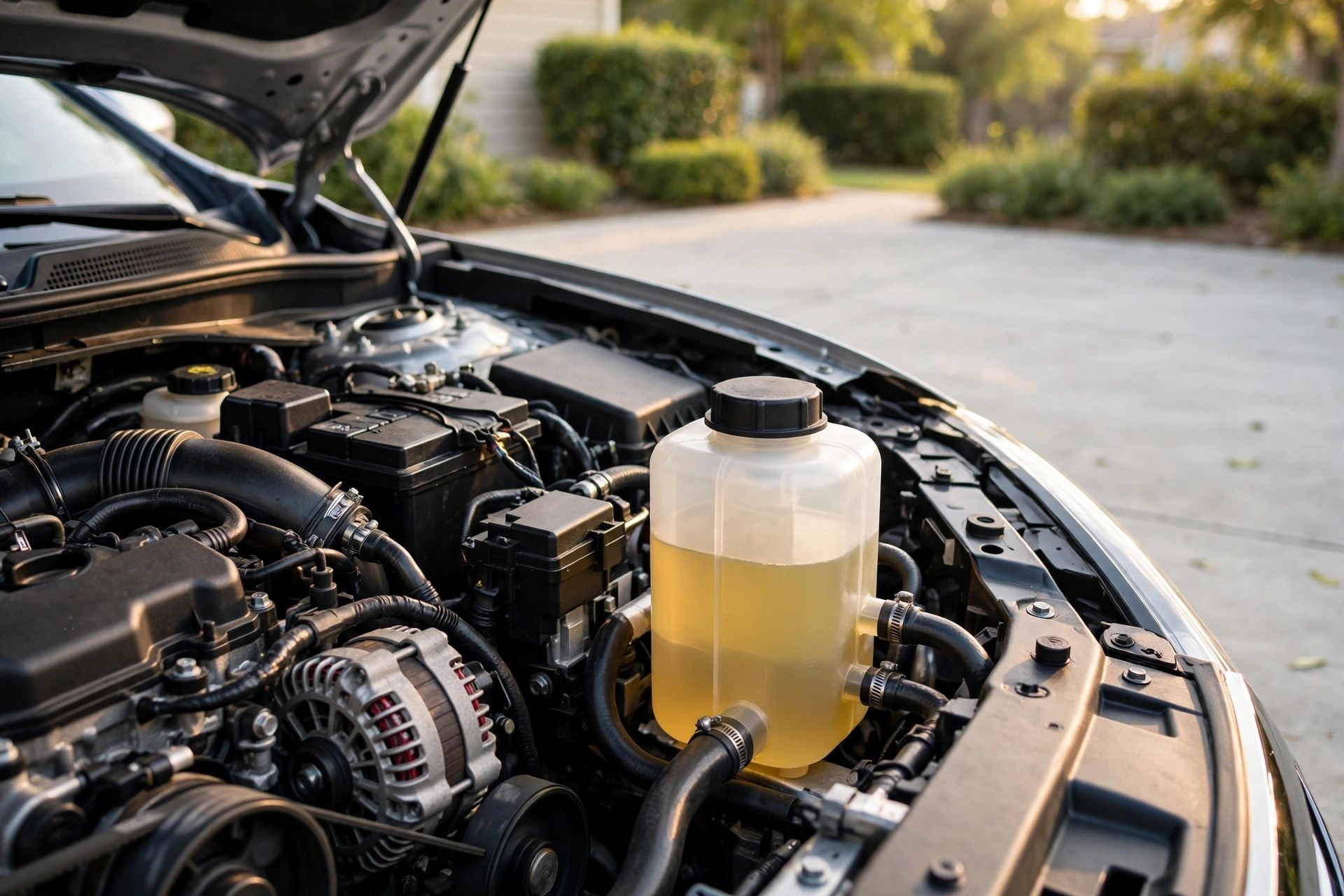
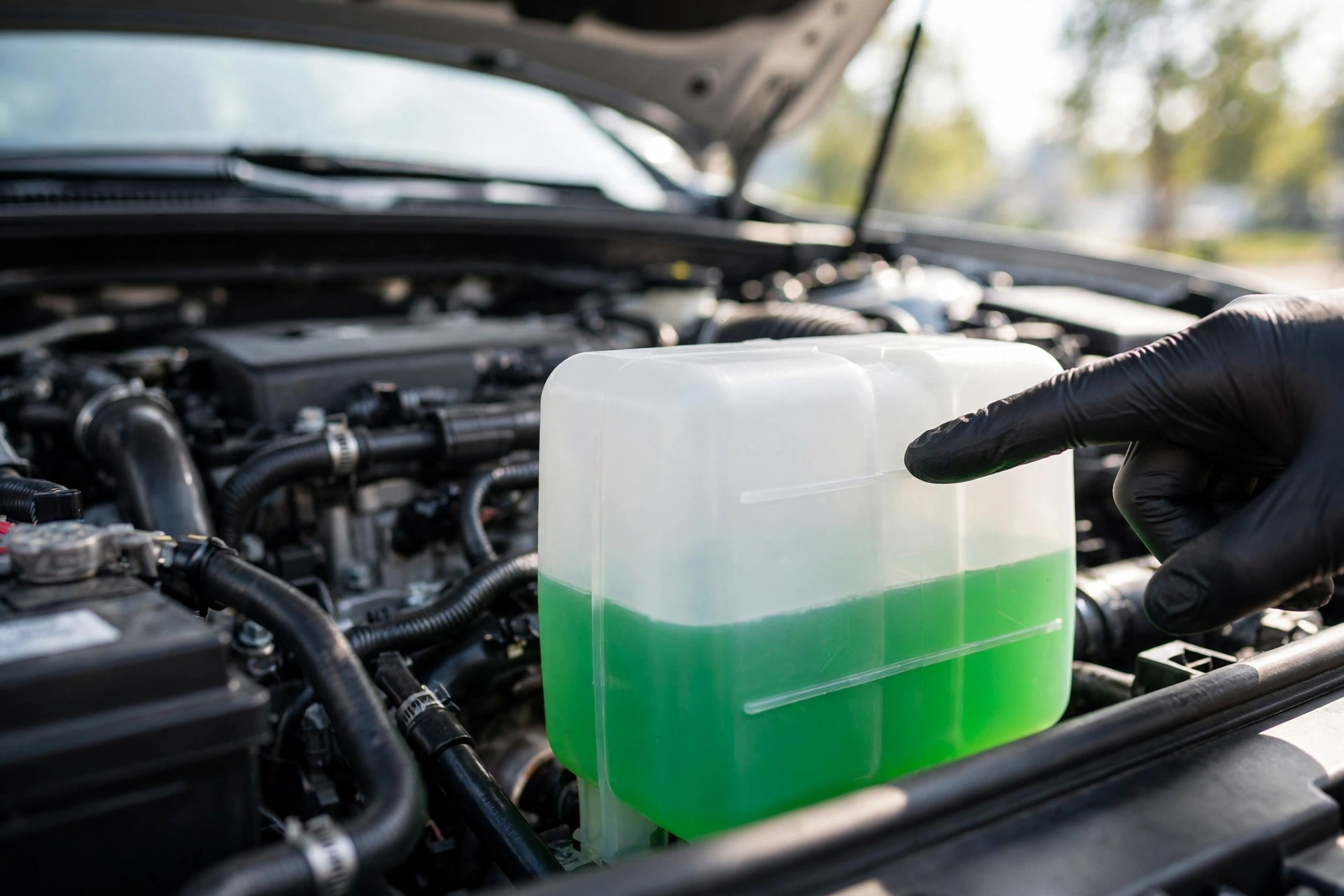
- Open the hood and find the reservoir. Look for a translucent white plastic tank near the radiator, usually on one side of the engine bay. It is often marked with a cap showing a thermometer symbol or the words "Engine Coolant" or "Never Open When Hot". Your owner's manual has a diagram of the engine bay if you cannot spot it.
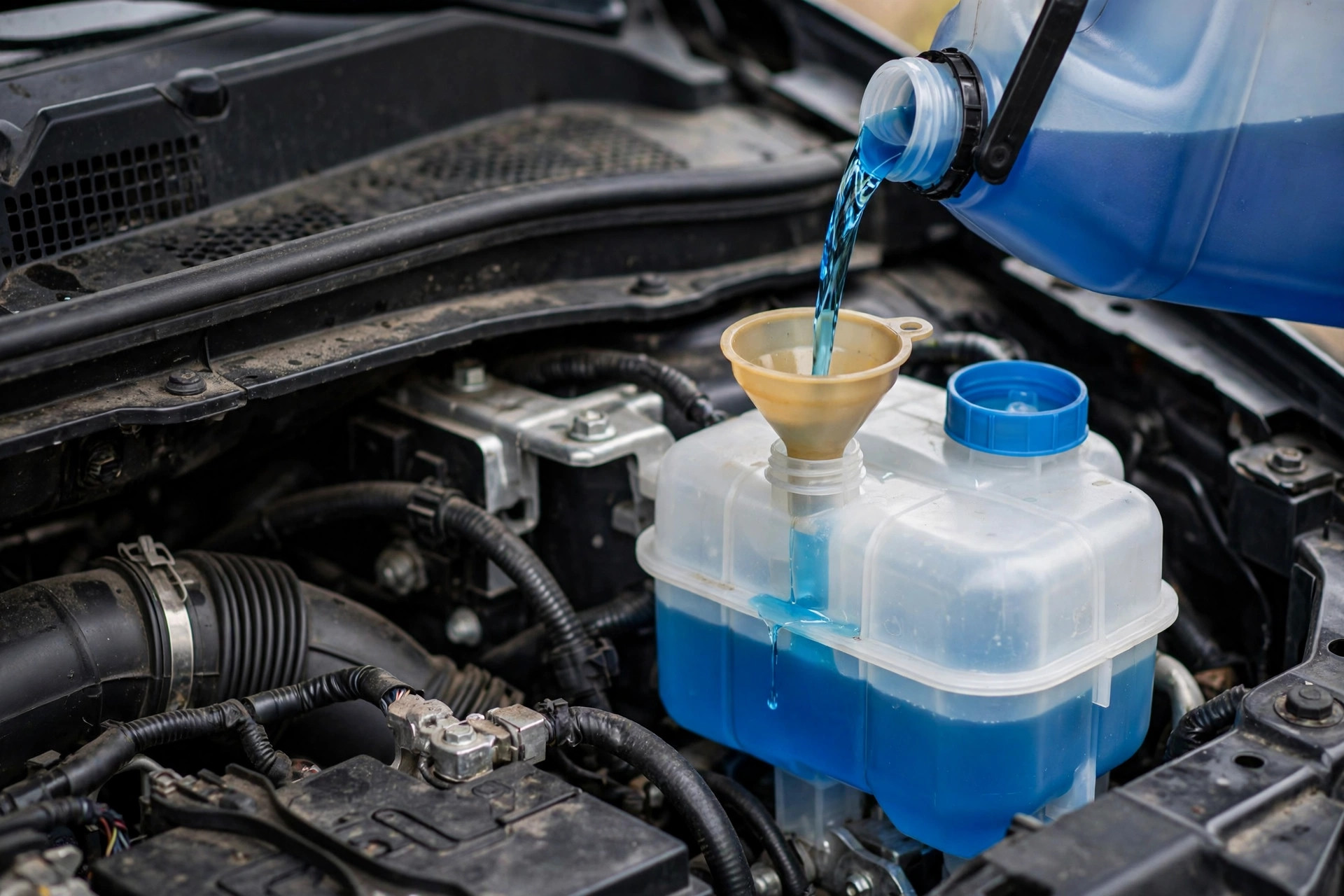
- Do not confuse it with the washer fluid tank. The two tanks look similar. The coolant reservoir connects to the radiator by a hose and holds brightly coloured liquid; the washer fluid tank usually has a windscreen-wiper symbol on its cap and holds blue or clear fluid.
- Read the level against the lines on the side. The reservoir has two lines moulded into the plastic, usually labelled MIN (or LOW / COLD) and MAX (or FULL / HOT). You can read the level through the translucent plastic without opening anything. Shine your torch behind the tank if the liquid is hard to see.
- Check the colour and condition. Healthy coolant is a clean, bright colour and slightly translucent. If it looks rusty brown, murky, or has particles floating in it, the coolant is old or contaminated and needs a flush — book a mechanic rather than just topping up.
- Note the result. A level sitting between MIN and MAX on a cold engine is correct. A level at or below MIN needs topping up, and a reservoir that is completely empty is a warning sign of a leak — do not just refill it and drive on.
Reading the Result: What the Level Tells You
- Between MIN and MAX: All good. No action needed. Check again next month.
- Exactly on or just above MIN (cold engine): Still safe to drive, but top it up soon — the level will only fall further.
- Below MIN: Top up before your next longer drive, then watch the level over the next few days.
- Reservoir empty: Do not drive far. The system has lost a significant amount of coolant, which usually means a leak. Top it up, check underneath the car for puddles, and get the car inspected promptly.
- Level keeps dropping after every top-up: There is almost certainly a leak somewhere — a hose, the radiator, the water pump or a gasket. This is a mechanic's job. See our guide to coolant leak symptoms to know what to look for.
How to Top Up Coolant Safely
If the level is below MIN, topping up is simple — but use the right fluid. The steps below follow the same method most professional guides recommend — see Fleetio's step-by-step coolant refill guide for a second opinion on the process.
- Confirm the engine is cold. This is the same rule as checking. Never remove any cooling-system cap on a warm engine.
- Find the correct coolant for your car. Check your owner's manual for the exact type and colour. Coolants are not universal — green, orange and pink formulas use different chemistry, and mixing the wrong types can cause sludge and corrosion. For a detailed breakdown of coolant types and how to match them, see Engineer Fix's guide to checking antifreeze levels. When in doubt, buy a pre-mixed coolant that matches your manual, or ask at an auto parts store with your car's make, model and year.
- Remove the reservoir cap slowly. Unscrew the cap on the reservoir tank (not the metal radiator cap) and set it aside.
- Pour slowly to just below the MAX line. Use a funnel to avoid spills. On a cold engine, fill to around the MIN line or a little above it — never above MAX, because the coolant needs room to expand as it heats up.
- Refit the cap tightly and wipe up spills. Coolant is toxic to pets and wildlife, so clean any drips with water and a rag. Wash your hands afterwards.
- Recheck after a short drive. Once the engine has cooled again, look at the level. If it has dropped noticeably, the system may have had air trapped in it — or there may be a leak. Keep an eye on it for a week.
A note on water: in a genuine emergency, plain water can get you to a mechanic, but it is not a substitute for coolant. Water alone boils sooner, freezes in winter and offers no corrosion protection, so replace it with the proper coolant mix as soon as possible. If you buy concentrated coolant rather than pre-mixed, mix it 50/50 with distilled water unless your manual says otherwise.
How Often Should You Check the Coolant Level?
Once a month is a good habit for a beginner, and always check before a long trip. Add it to your monthly car maintenance checklist alongside the engine oil and tyre pressure. It takes five minutes, and a level that slowly falls month after month is the earliest warning of a developing leak — the kind of warning that costs nothing to notice and a fortune to ignore.
Also check it any time you notice the temperature gauge sitting higher than usual, a sweet smell under the hood, steam, or coloured puddles under the car. Those are the classic signs of a coolant problem, and the sooner you look, the cheaper the fix tends to be.
Common Beginner Mistakes to Avoid
- Opening the radiator cap while hot — the most dangerous mistake in this whole job. Always cold, always.
- Topping up with the wrong coolant colour — different colours usually mean different chemistry. Match your manual, not the bottle on sale.
- Filling above the MAX line — the extra fluid has nowhere to go when it expands and will be forced out.
- Ignoring a level that keeps falling — topping up a leaking system is like refilling a punctured tyre. Find the leak.
- Using tap water for the mix — minerals in tap water can leave deposits inside the cooling system. Use distilled water.
Frequently Asked Questions
Can I check the coolant level when the engine is warm?
No — always check it cold. A warm engine gives a falsely high reading because the coolant has expanded, and opening the system while it is pressurised risks scalding burns. Wait until the engine is completely cool, ideally overnight.
Is it normal for the coolant level to drop a little over time?
A very small drop over many months can be normal as tiny amounts evaporate, but a noticeable drop within weeks is not. If you need to top up more than once between services, have the system checked for a leak.
What colour should my coolant be?
It depends on your car: green, orange, pink, red or blue are all normal for different manufacturers. What matters is that it is clean and bright. Rusty brown, milky or murky coolant means it is old or contaminated and needs a flush.
Can I just use water instead of coolant?
Only as a short-term emergency fix to reach a mechanic. Water does not protect against freezing or corrosion and boils at a lower temperature than a proper coolant mix. Replace it with the correct coolant as soon as you can.
How much does it cost to top up coolant?
Usually very little — a bottle of pre-mixed coolant typically costs a few dollars or pounds, and the job takes five minutes. A full coolant flush at a garage costs more, but it is a routine service item, far cheaper than repairing an overheated engine.
Conclusion
Checking your coolant level is a five-minute habit that protects one of the most expensive parts of your car. Remember the essentials: check it cold, read the level between the MIN and MAX lines on the reservoir, use the exact coolant type your owner's manual specifies, and never ignore a level that keeps falling — that is a leak asking to be found.
Make it part of your monthly routine, and your engine will thank you with years of trouble-free running. If anything about your cooling system ever feels beyond your comfort level, there is no shame in it — a mechanic's inspection is always cheaper than an overheated engine.