



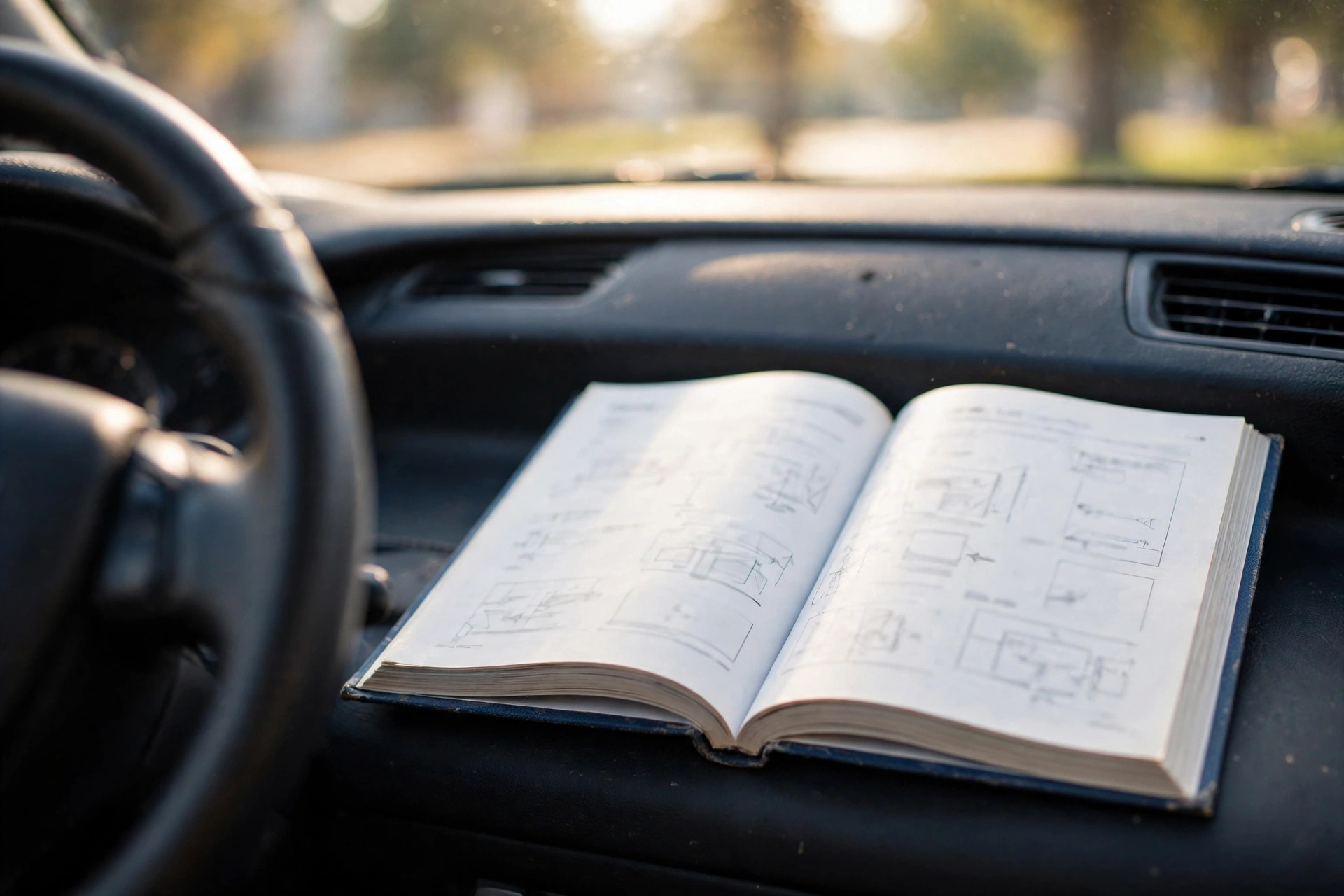
If you have never opened your car's owner's manual, you are not alone — most drivers leave theirs untouched in the glove box. But your owner's manual is the one piece of advice written for your exact car, your exact engine, and your exact model year. No blog post or video can match that.
This guide shows you how to read it the smart way — which sections actually matter, which pages you can skip, and how to find any answer in under a minute.
Why Your Owner's Manual Beats Every Car Blog
General car advice is useful, but your manual is written by the people who designed your car. It tells you the exact engine oil grade your engine needs, the correct tire pressure for your car (not a generic number), which fuse protects which circuit, and how your specific safety features work.
Getting even one of these details wrong can cost real money. Using the wrong oil grade or overfilling fluids can cause engine damage — and a dealer can refuse warranty work if you ignored the maintenance schedule. That 400-page book is worth your time, but you do not need to read all of it.
The 15-Minute Tour: How to Skim Your Manual
Do not try to read the manual cover to cover. Treat it like a reference book instead. Here is a simple 15-minute method that makes the whole thing manageable:
- Start with the table of contents. Spend five minutes scanning every chapter heading. This builds a mental map of where things live — so when a warning light appears at 11 PM, you know roughly where to look.
- Read the safety section first. It is usually near the front. It covers airbags, seat belts, child seats, and your car's driving-assistance features. This is the one section worth reading fully.
- Find the dashboard section. Learn what each warning light and gauge means on your dashboard. For a deeper explanation of the most important ones, see our beginner's guide to dashboard warning lights.
- Locate the maintenance schedule. This is usually a table listing what to service at each mileage. Highlight or photograph the next two or three service points.
- Bookmark the emergency pages. Find the pages for jump-starting, changing a tire, and locating the fuse box. In a real emergency you will not want to search.
Read These Sections First (The Priority List)
If you read nothing else, read these six sections. They cover nearly every question a new car owner ever has:
1. Dashboard warning lights and controls
This section decodes every light, gauge, and button on your dashboard and explains what to do when one comes on. Some lights mean "check soon"; others mean "stop the car now." Knowing the difference in advance is invaluable.
2. Maintenance schedule
This is the heart of the manual — a table showing exactly what your car needs at each mileage: oil changes, fluid replacements, filters, inspections. Follow this schedule and you will avoid most expensive surprises. It also answers questions like how often to change your engine oil, with the intervals for your exact model.
3. Fluids, capacities, and specifications
Here you will find the exact oil grade and capacity your engine takes, the correct coolant type, transmission fluid specs, and the recommended tire pressures. Bookmark this page — you will check it every time you buy supplies. Our guide on how to check your engine oil level covers the hands-on part.
4. Emergency procedures
How to jump-start the battery, how to change a flat tire, where the fuse box is and which fuse does what, where the jack points are. Read this section calmly at home so you are not reading it for the first time on a dark roadside.
5. Safety features
How your airbags deploy, how to fit a child seat correctly, and how driver-assistance features (lane warnings, automatic braking) actually behave — including their limits. Many owners never learn what their car's safety systems can and cannot do.
6. Warranty and roadside assistance
What your warranty covers, for how long, and what voids it. Many new cars also include free roadside assistance for a few years — the manual tells you the phone number to call. That alone can be worth its weight in gold.
How to Use the Digital PDF Version
Almost every manufacturer now offers the owner's manual as a free PDF on their official website. The PDF is dramatically easier to use than the paper book, and here is why:
- Use search (Ctrl+F / Cmd+F). Instead of flipping through 400 pages, search for keywords like "tire pressure," "oil," "Bluetooth," or "fuse" and jump straight to the answer.
- Bookmark key pages. Create bookmarks in your PDF reader for warning lights, the maintenance schedule, fluid specs, and fuses — the pages you will open most.
- Keep it on your phone. Save the PDF to your phone so the manual is in your pocket whenever something comes up — at a gas station, in a parking lot, or on the roadside.
- Make sure it matches your car. Download the manual for your exact year, model, and trim — the wrong model year can list different specs and features.
What You Can Safely Skip
Not every page deserves your attention. Here is what most beginners can skim or skip:
- Repeated legal disclaimers. Manuals repeat warranty and liability warnings in several sections. Once you have read the safety section and the warranty summary, the repeats add nothing.
- Full infotainment tutorials. If you do not use a feature (say, a built-in navigation system you never touch), skip its 20-page walkthrough. Learn it later if you ever need it.
- Other trims and options. Manuals cover every trim of a model. If a section is clearly marked "if equipped" for a feature your car does not have (sunroof, tow package), skip it.
- Duplicate translations. Some manuals repeat content in multiple languages — just find your language's section and ignore the rest.
- The index itself. The index is a tool, not reading material. Use it when you need to find something, not as a study chapter.
One page you should never skip, though: the tire pressure page that lists the correct pressures for your specific car. It is often the most-used page in the entire book.
Lost Your Manual? How to Get a Free Replacement
If your car did not come with a manual — common with used cars — you can almost always get the exact one for free:
- Go to your car manufacturer's official website, find the "Owners" or "Support" section, and enter your car's year, model, and trim (some sites ask for the VIN, found on your dashboard or registration).
- Download the PDF and save it to your phone.
Dealerships can also order a paper copy for you, though there may be a charge. If the manufacturer's site does not have your older car, a dealer can usually point you to a correct copy. This guide to finding your car's manual online walks through the process in more detail.
Build Your Own Quick-Reference Cheat Sheet
Here is a trick that turns your manual into a two-minute tool:
- Stick a colored tab on the tire pressure page, the oil spec page, and the maintenance schedule.
- Circle your car's key numbers on one page: oil grade and capacity, tire pressure (normal and loaded), coolant type, and the next service mileage.
- Write the roadside assistance phone number on the inside cover.
Once you have done this, you will rarely need to "read" the manual again — you will just open it straight to the answer. Many experienced owners say this simple step is why the manual deserves a read in the first place.
FAQs
Do I really need to read my car's owner's manual?
You do not need to read every page, but read the safety section, the dashboard warning lights, and the maintenance schedule. Those three cover almost everything that protects your safety, your warranty, and your wallet.
Where can I download my car's manual for free?
Visit your car manufacturer's official website, find the Owners or Support section, and enter your year, model, and trim. Most brands offer the full manual as a free searchable PDF — always prefer the official site over random download sites to make sure you get the correct version.
What is the most important page in the owner's manual?
For most beginners, the maintenance schedule table is the single most important part: it tells you exactly what your car needs and when. Close behind are the warning light decoder and the fluid specification page with your oil grade and tire pressures.
My manual covers features my car doesn't have. Why?
Manufacturers print one manual per model, not per individual car. Sections marked "if equipped" describe optional features and trims. If your car does not have that feature, you can safely skip those pages.
Will skipping scheduled maintenance void my warranty?
It can. Manufacturers can deny warranty claims if required maintenance was not performed on schedule, so keep your receipts and follow the intervals in the manual. If you ever sell the car, a complete service history also increases its resale value.
Conclusion
Your owner's manual is not a novel — it is a toolbox. Spend 15 minutes skimming it, learn the six key sections above, save the PDF to your phone, and tab the pages you will use most. The next time a warning light pops on or you need the right oil grade, you will have the exact answer for your exact car in seconds.