Your car's transmission is the part that shifts gears for you in an automatic. The fluid inside it keeps those gears shifting smoothly, lubricates moving parts, and cools everything down. Checking it takes less than five minutes and can save you from one of the most expensive repairs a car can need — a failed transmission often costs several thousand dollars to fix. Here's exactly how to do it.
What You'll Need
- A clean, lint-free rag or a few paper towels
- Gloves (optional, but the fluid stains)
- Your car's owner's manual (to confirm the correct procedure and fluid type)
Step 1: Warm Up the Car
Drive the car for about 10–15 minutes so the transmission reaches its normal operating temperature. Transmission fluid expands as it heats, so a cold reading will look misleadingly low. Checking it properly warmed up is the only way to get an accurate reading.
Step 2: Park on a Level Surface
Park on flat ground and pull the parking brake firmly. An uneven surface tilts the fluid and gives you a false reading, so this step matters more than it sounds.
Step 3: Keep the Engine Running
Unlike engine oil, transmission fluid is checked with the engine ON. With the engine running, the fluid is circulating, which is the state the dipstick markings are designed for. Put your foot on the brake, slowly shift through every gear — Park, Reverse, Neutral, Drive, then back to Park — pausing a second or two in each. This fills every circuit with fluid before you measure. Always check your owner's manual first: a few models require the engine off or the shifter in Neutral instead.
Step 4: Find the Transmission Dipstick
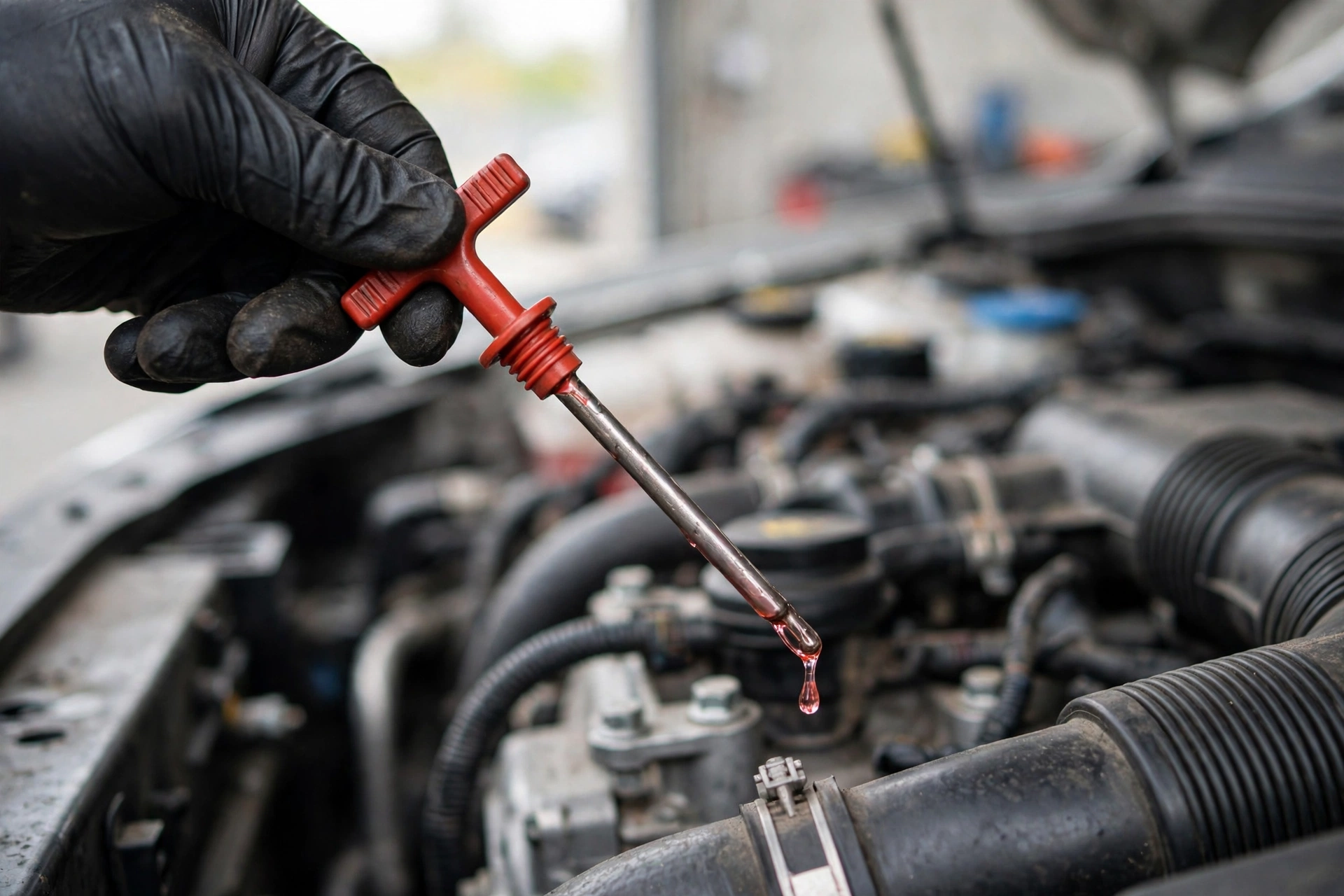
Pop the hood and look toward the back of the engine bay (near the firewall). The transmission dipstick usually has a bright red, pink, or yellow handle to distinguish it from the engine oil dipstick, and it's often labeled "TRANS" or "ATF." Important: many cars built from about 2015 onward have a "sealed" transmission with no dipstick at all. If you can't find one after checking the manual, your fluid can only be checked by a mechanic with special tools — don't improvise.
Step 5: Pull, Wipe, Reinsert, Read
Pull the dipstick all the way out and wipe the measurement end completely clean with your rag. The first pull is never the real reading — fluid splashes up the tube while you drive, so this step just clears it. Now push the clean dipstick fully back in until it seats, wait a few seconds, and pull it out a second time. Hold it horizontally and look at where the fluid line sits against the markings, typically "FULL" and "ADD" or MIN/MAX. Use the HOT marks (some sticks also have COLD marks — the HOT range is the accurate one when the engine is warmed up). If one side of the stick looks smeared, trust the lowest point of the fluid line.
What the Color and Smell Tell You
The level is only half the story — the fluid's appearance and smell reveal its condition:
- Bright, translucent red or pinkish-red: healthy fluid. This is what new automatic transmission fluid looks like.
- Light brown or maroon: aging but still working. Start thinking about a fluid service at your next scheduled maintenance.
- Dark brown or black with a burnt smell: the fluid is degraded from heat and worn clutch material. Book a fluid change soon — don't keep driving on it.
- Milky pink or foamy ("strawberry milkshake"): water or coolant is contaminating the fluid. See a mechanic right away; this can cause serious damage fast.
- Visible particles or metal flakes: possible internal wear. Get a professional diagnosis before it gets worse.
What to Do If the Fluid Is Low
If the level sits below the ADD mark, top it up slowly with a funnel through the dipstick tube, using ONLY the exact fluid type your owner's manual specifies (ATF types are not interchangeable). Add a little at a time and recheck — overfilling can cause foaming and damage, too. Then ask the key question: where did it go? Low transmission fluid usually means a leak. Look for reddish spots where you park, and get the leak found and fixed rather than just topping up forever. If you're unsure whether a repair is something you can handle yourself, here's how to decide between DIY and a mechanic.
If Your Car Has No Dipstick
Cars with sealed transmissions are checked from underneath through a fill plug, and only at the correct temperature with the car level on a lift — this is genuinely a job for a mechanic. Add this to your regular service visits instead, and never let anyone talk you into a "lifetime fluid" meaning "never check it."
How Often Should You Check?
Once a month, or whenever you check your engine oil. Make it part of your monthly car maintenance routine. As for replacing it, most manufacturers recommend a fluid change every 30,000–60,000 miles — but your owner's manual has the final word for your exact car.
Frequently Asked Questions
Can I check transmission fluid when the engine is cold?
You can get a rough idea from the COLD marks if your dipstick has them, but it isn't reliable — cold fluid reads low even when the level is correct. Always warm the car up for the real check.
Can I use any transmission fluid to top up?
No. Automatic transmission fluid comes in different formulations (ATF, CVT fluid, DCT fluid), and using the wrong one can damage your transmission. The correct type is printed in your owner's manual and sometimes on the dipstick itself.
Does burnt-smelling fluid always mean trouble?
A strong burnt smell means the fluid has overheated and broken down. The transmission itself may still be fine if caught early — but it's a clear signal to get a fluid service done promptly.
Is it safe to drive with low transmission fluid?
Not really. Low fluid causes slipping gears, delayed shifting, and overheating, and running too long this way can destroy the transmission. Top it up if you can do so correctly, then get the leak repaired.
How much does a transmission fluid change cost?
It varies by car and region, but a standard drain-and-fill service is a fraction of what a transmission rebuild or replacement costs. That's exactly why catching problems with a 5-minute check is worth the habit.
Conclusion
Checking your transmission fluid is one of the simplest maintenance jobs you can learn as a new car owner: warm the car up, shift through the gears, pull the dipstick, wipe, reinsert, and read the HOT marks. Pay attention to the color and smell as much as the level, and never top up with the wrong fluid type. Five minutes a month can be the difference between a cheap fluid service and a transmission replacement — and that habit alone puts you ahead of most drivers on the road.