
You press the unlock button and nothing happens. You press it again, closer this time — still nothing. If your car's key fob has died on you, don't panic: you are not locked out, and you are not stranded. Almost every modern car has built-in backup methods that let you unlock the doors and start the engine even with a completely dead fob battery. Here's exactly what to do, in order.
First, recognize the warning signs of a dying fob battery
A fob battery rarely dies with zero warning. Catching the signs early means you can replace the battery at home instead of dealing with a dead fob in a parking lot. Watch for:
- Shorter range: you have to stand much closer to the car than usual for the buttons to work.
- Multiple presses needed: unlock only works on the second or third try.
- A dashboard warning: many cars display a "key battery low" or "key not detected" message.
- Weak or inconsistent locking: the doors sometimes lock, sometimes don't.
Fob batteries typically last 2–4 years depending on how often you use the buttons. If yours is in that age range and showing any of these signs, replace the battery before it quits entirely — the replacement takes a few minutes and costs very little.
Step 1: Get into the car with the hidden mechanical key
Nearly every key fob hides a small metal key blade inside its case. This is your physical backup, and it needs no battery at all.
- Look at the back or side of your fob for a small release button, latch, or sliding switch.
- Press or slide it and pull the metal key blade out of the fob.
- Find the keyhole on the driver's door. On many modern cars it's hidden under a small plastic cap on the door handle — gently pry the cap off with the key blade itself (your owner's manual shows where it is).
- Insert the key, turn, and open the door manually.
Expect the alarm to go off. When you unlock with the physical key instead of the remote, many cars trigger the security alarm. This is normal — it stops once you start the car in the next step.
Step 2: Start the car with the backup method
Here's the part most beginners don't know: your fob contains a passive transponder chip that works without any battery power. The car can read it at very close range, and that's all you need to start the engine.
For push-button start cars: press the brake pedal, then hold the dead fob flat against the start button and press the button. The car's antenna reads the passive chip through the fob and authorizes the engine to start.
For some cars: instead of the start button, the backup reader is a dedicated slot or marked spot — often in the center console, a cup holder, or on the steering column, sometimes with a small key icon. Check your owner's manual if touching the start button doesn't work; the exact backup location varies by make and model.
If the car starts, the fob battery was the whole problem. If nothing happens at all — no dashboard lights, no crank — the issue may be your car's 12-volt battery instead. See our guide on what to check when your car won't start to tell the difference.
Step 3: Replace the fob battery (a 5-minute job)
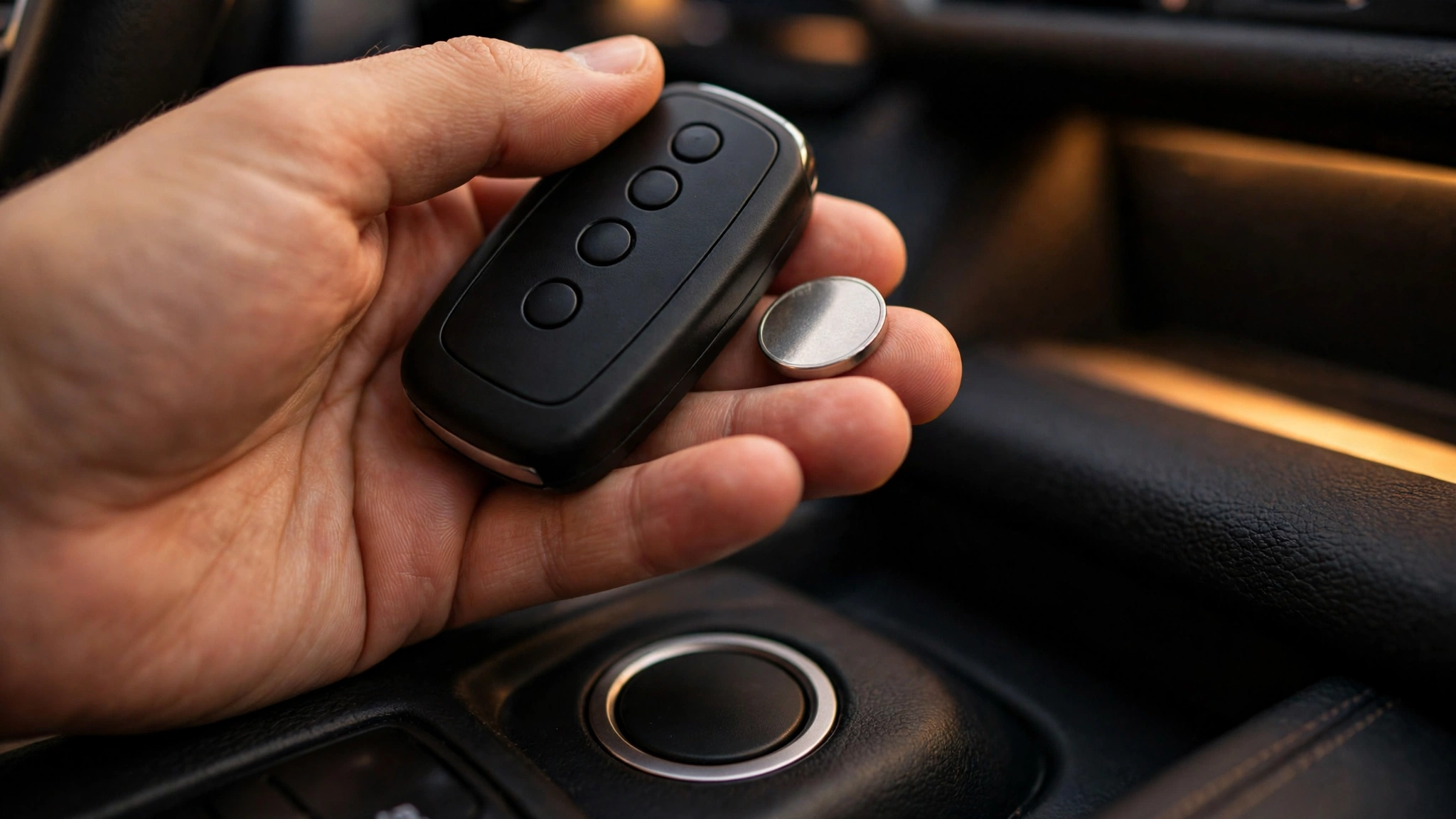
Once you're driving, pick up a replacement coin-cell battery — most auto parts stores, supermarkets, and pharmacies carry them. The correct battery number (commonly CR2032, but CR2025, CR2016, and others are used too) is printed on the old cell itself, so match it exactly.
- Open the fob. Find the seam or notch along the edge of the case and gently pry it apart with a small flathead screwdriver, a coin, or a plastic trim tool. Use light pressure — forcing it can crack the case.
- Note the orientation. Before touching the old battery, take a quick photo of how it sits. Many fobs have no polarity markings inside, and installing the new cell backward is the most common mistake.
- Swap the battery. Lift the old coin cell out, wipe the contacts with a dry cloth if they look dirty, and set the new battery in the same orientation (+ side facing the same way as before).
- Snap the fob closed and test all the buttons from a normal distance before you rely on it.
For a detailed walkthrough with model-specific tips, AAA's guide to fixing a dead key fob covers the process step by step, including how to avoid damaging the delicate contacts inside.
Prevent this from happening again
- Keep a spare battery in the glove box. A coin cell costs a few dollars and takes up almost no space. Check your fob's battery number today so you buy the right one.
- Replace proactively every 2–3 years, not when the fob dies. Mark the date on your emergency kit checklist.
- Know your backup method before you need it. Practice finding the hidden key blade and the backup start spot once, in your driveway — not in a dark parking lot.
- Keep your spare fob working too. If you have a second fob, test it occasionally. If the spare works fine, you know any problem is with the primary fob, not the car.
FAQs
Can a dead key fob battery drain my car's battery?
No. The fob battery and the car's 12-volt battery are completely separate systems. A dead fob only affects the remote functions — it can't drain the car itself.
Will I need to reprogram the fob after changing the battery?
Usually not. Swapping the coin cell normally preserves the fob's pairing with the car. Some models do require a re-sync procedure after the battery has been out for a while — your owner's manual will say if yours does.
What if a new battery doesn't fix the fob?
Then the problem may be lost pairing, water damage, or worn-out electronics rather than the battery. Try the spare fob first to rule out a car-side problem, and see this key fob troubleshooting guide for the full check order before visiting a dealer or locksmith.
Can I start the car if the fob is lost entirely, not just dead?
No — the backup methods need the physical fob (or its hidden key blade) to work. If the fob is lost, you'll need the spare or a replacement fob, which usually requires dealer or locksmith programming.
Why did the alarm go off when I used the hidden key?
The car treats a manual door unlock as a possible break-in, so the alarm sounds as a normal security response. Starting the engine with the backup method tells the car it's you, and the alarm stops.
Conclusion
A dead key fob battery feels like an emergency, but it's really a minor inconvenience with built-in solutions: the hidden mechanical key gets you in, the passive chip backup gets the engine running, and a fresh coin cell — costing a few dollars and five minutes — restores everything. Learn the backup steps now, keep a spare battery in the glove box, and this is one breakdown you'll never have to worry about.