Picture this: you're running late, you turn the key, and all you get is a sad little click-click-click. A dead battery can strand anyone, anywhere — but as a beginner driver, the worst part isn't the dead battery. It's not knowing what to do next, and having to flag down a stranger or wait an hour for roadside help.
A portable jump starter solves this completely. It's a small rechargeable box that lives in your trunk and can start your car all by itself — no second car, no jumper cables, no stranger's help needed. Below are the 5 best portable jump starters for beginners: models that are genuinely easy to use, safe (even if you've never jumped a car before), and strong enough to start the cars most new drivers actually own. Every pick below also earns its place with a full explanation of who it's for — and who should skip it.
Quick picks — in a hurry?
- Best overall for beginners: NOCO Boost Plus GB40 — foolproof safety tech, glovebox-sized.
- Best value: AstroAI 2000A 8-in-1 — double the peak power at a budget price.
- Best for bigger engines: GOOLOO New GP2000 — starts up to 8.0L gas engines, case included.
How a portable jump starter actually works
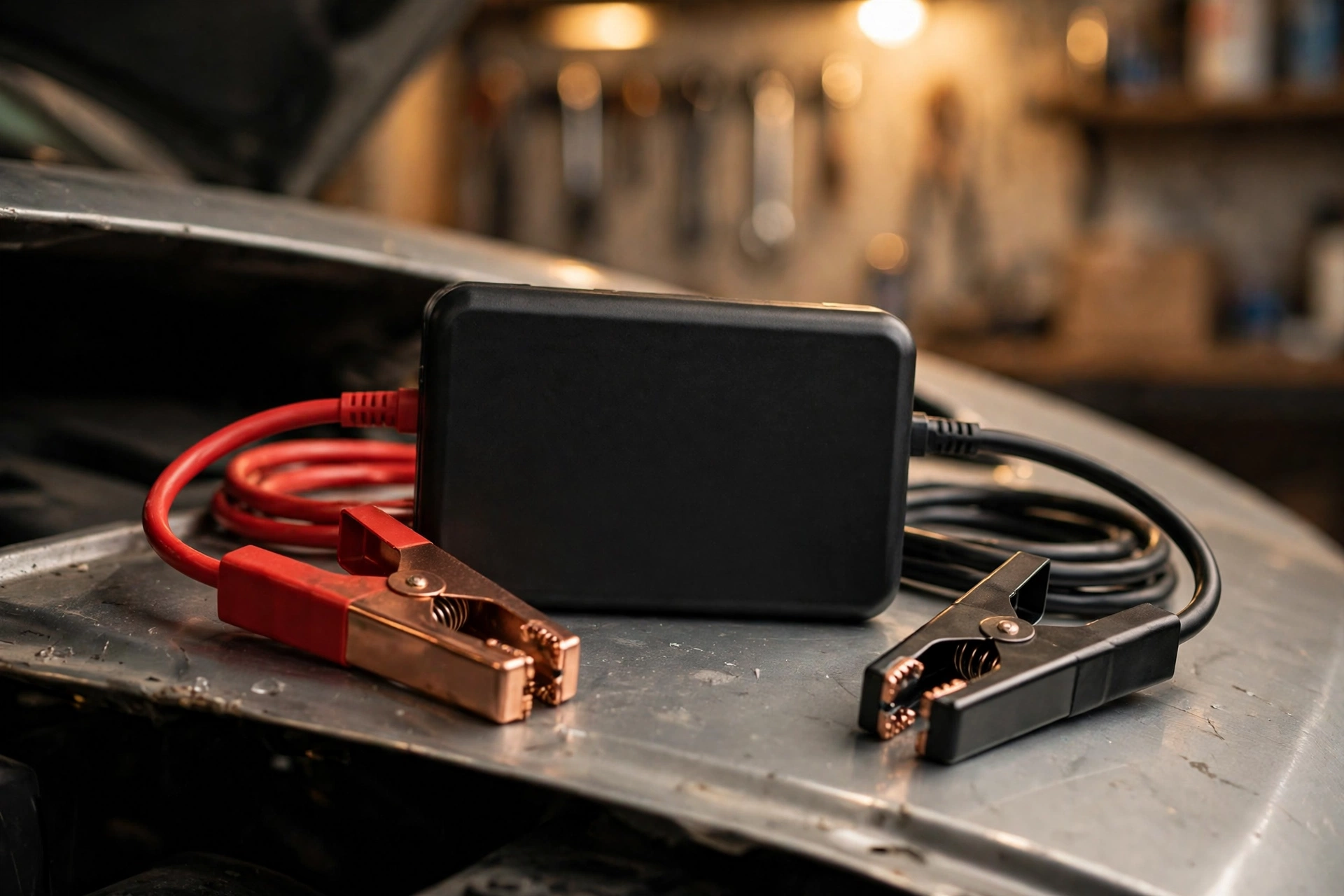
Your car's battery doesn't run the engine — it gives the starter motor one big burst of power to start the engine. When the battery is too weak to deliver that burst, a portable jump starter steps in: its lithium battery sends a short, powerful surge through the included smart clamps, your engine catches, and your alternator takes over from there.
The clamps that come with modern jump starters are "smart" — they watch for reversed connections, short circuits, and sparks, and many simply won't send power until everything is connected correctly. That's exactly why these devices are safer for beginners than old-fashioned jumper cables, where one wrong connection could fry your electronics.
What actually matters when buying one (spec decoder)
Most roundups throw around "peak amps" and "mAh" without explaining them. Here's the plain-English version:
- Peak amps vs. your engine: Match the unit's engine rating (e.g. "up to 6.0L gas") to your car, not just the amp number. A 1000A unit handles most 4-cylinder cars fine; large SUVs and diesels need 2000A. Peak amps is a burst rating — marketing numbers inflate it, engine coverage is the honest spec.
- Safety protections: Non-negotiable for beginners. Look for reverse-polarity protection (clamps on backwards = no damage) and spark-proof technology. Every pick below has both.
- Capacity (mAh): Bigger numbers mean more jump attempts per charge and better performance as a phone power bank. 18000mAh+ is plenty.
- Standby time: This box may sit in your trunk for months. Units with long standby times are far more likely to actually work when you need them.
- Extras you'll actually use: A USB port for charging your phone and an LED flashlight are genuinely useful on a dark roadside. A clear display showing charge level removes guesswork.
When a jump starter WON'T save you: no unit can fix a battery that is cracked, swollen, or leaking, or a car whose alternator has failed (the car starts, then dies minutes later). Those need a mechanic, not a bigger battery pack. See why your car battery keeps dying overnight to tell the difference.
The 5 best portable jump starters for beginners (2026)
#1 — Best overall for beginners
NOCO Boost Plus GB40
4.8/5 · from ~70,000 Amazon ratings
- 1000A peak — rated for up to 6.0L gas / 3.0L diesel engines
- UltraSafe spark-proof technology + reverse-polarity protection (nearly impossible to connect wrong)
- Doubles as a USB power bank and LED flashlight; glovebox-sized
- Huge owner base means setup help and answers are everywhere
Pros: the most foolproof safety tech in this price range; compact enough to live in a glovebox; the best-selling jump starter on Amazon for a reason. Cons: 1000A won't turn over big diesel trucks — know your engine size; premium pricing compared to clones.
Best for: most beginners driving a sedan, hatchback, or small SUV who want the safest, simplest option. Skip it if: you drive a large truck or diesel — pick the GOOLOO instead.
#2 — Best value
AstroAI 2000A 8-in-1
4.7/5 · from ~20,000 Amazon ratings
- 2000A peak — rated for up to 7.0L gas / 4.0L diesel engines
- 18000mAh capacity with Quick Charge 3.0 power bank + 12V DC output
- Informative LCD screen shows battery level — no guessing
- 8-in-1 functions: jump starter, power bank, compass, 4-mode emergency torch
Pros: double the peak current of most budget peers at a budget price; the screen tells you exactly how much charge is left. Cons: bulkier than the NOCO; the brand has a shorter track record for warranty support.
Best for: budget shoppers who want maximum power per dollar and a mid-size engine. Skip it if: trunk space is extremely tight — the NOCO is smaller.
#3 — Best for bigger engines
GOOLOO New GP2000
4.6/5 · from ~15,000 Amazon ratings
- 2000A peak — the widest coverage here: up to 8.0L gas / 6.0L diesel
- SuperSafe protections (reverse polarity, over-current, short-circuit)
- USB quick-charge ports for phones and tablets
- Hard storage case included in the box — clamps stay organized
Pros: starts the largest engines of any pick on this list; the included case is genuinely useful. Cons: heavier and larger than the others; the red colorway isn't for everyone.
Best for: owners of large SUVs, trucks, or anything with a big V8. Skip it if: you drive a small car — you're paying for power you'll never use.
#4 — Most beginner-proof
HULKMAN Alpha 1000A
4.7/5 · from ~10,000 Amazon ratings
- 1000A peak — rated for up to 6.5L gas / 3.0L diesel engines
- Clear LED display walks you through the connection
- Up to 24-month standby — likely to be charged when you need it
- 45-minute full recharge; IP65 dust/water resistance
Pros: the standby time is a standout — this is the unit most likely to actually work after months in your trunk; the display makes first use painless. Cons: 1000A ceiling, similar to the NOCO at comparable money; fewer long-term reviews than the top rivals.
Best for: nervous first-timers who want the most guided, confidence-building experience. Skip it if: you need 2000A power — the AstroAI or AVAPOW do more for less.
#5 — Best for "dead-dead" batteries
AVAPOW A18
4.6/5 · from ~20,000 Amazon ratings
- 2000A peak — rated for up to 8L gas / 6.5L diesel engines
- Force-start (boost) mode for batteries too drained for a normal jump
- Up to 40 jump starts per charge; dual USB QC3.0 ports
- IP65 rating and 24-month warranty
Pros: the boost mode tackles batteries that other units give up on; strong power per dollar. Cons: the biggest unit of the five; remember no boost mode can fix a physically failed battery.
Best for: older cars whose batteries fully drain overnight or after sitting for weeks. Skip it if: you want the smallest possible unit — look at the NOCO or HULKMAN.
Side-by-side comparison
| Model | Peak amps | Engine coverage | Standout feature | Best for |
|---|---|---|---|---|
| NOCO Boost Plus GB40 | 1000A | 6.0L gas / 3.0L diesel | Foolproof UltraSafe protection | Most beginners |
| AstroAI 2000A 8-in-1 | 2000A | 7.0L gas / 4.0L diesel | LCD charge screen, best power-per-dollar | Budget shoppers |
| GOOLOO New GP2000 | 2000A | 8.0L gas / 6.0L diesel | Widest engine coverage, case included | Large SUVs/trucks |
| HULKMAN Alpha 1000A | 1000A | 6.5L gas / 3.0L diesel | 24-month standby, guided display | Nervous first-timers |
| AVAPOW A18 | 2000A | 8L gas / 6.5L diesel | Boost mode for fully drained batteries | Older cars |
How to use a portable jump starter safely (first-timer walkthrough)
- Check the battery first. If it's cracked, swollen, or smells like rotten eggs, do NOT jump it — call for help or a tow. (AAA's safety guide explains when a battery should never be jumped.)
- Turn everything off. Ignition, headlights, radio — all off, on the dead car.
- Connect red to dead. Red clamp → positive (+) terminal of the dead battery.
- Connect the unit. Plug the smart-clamp cable into the jump starter (it will confirm the connection — green light on most models).
- Connect black to metal. Black clamp → an unpainted metal bolt or bracket on the engine block, away from the battery. This keeps any spark away from battery gases.
- Start the car. Try for no more than about 30 seconds of cranking; if it doesn't catch, wait a couple of minutes and try once more.
- Remove in reverse. Black clamp off the metal first, then unplug from the unit, then red clamp off. Drive for at least 20–30 minutes so the alternator recharges the battery.
That's it — the whole process takes about two minutes once you've done it once. For the traditional two-car method, see how to jump start a car safely.
3 mistakes beginners make with jump starters
- Buying one and never charging it. Recharge every 3–6 months, even if you never use it. Put a reminder in your phone.
- Ignoring a battery that keeps dying. If you need the jump starter more than once or twice a month, the battery (or alternator) needs attention — read why your car battery keeps dying overnight.
- Skipping it from the emergency kit. A jump starter belongs next to the flashlight and first-aid kit — see the full emergency kit every first-time driver should keep.
The verdict
If you only buy one thing for your trunk this year, make it a portable jump starter. For most beginner drivers, the NOCO Boost Plus GB40 is the safest bet — it's the one I'd hand to a friend who's never touched a battery terminal. On a tight budget, the AstroAI 2000A gives you more power for less money, and big-engine owners should go straight to the GOOLOO GP2000. Charge it twice a year, and a dead battery becomes a two-minute inconvenience instead of a ruined day.
For more on keeping your battery healthy year-round, AAA's car battery maintenance guide is worth a read.
FAQs
Can a portable jump starter damage my car?
Not if you use one rated for your engine and follow the clamp order (red to dead-battery positive, then black to bare metal on the dead car — never both clamps on the dead battery's terminals). Modern units add reverse-polarity and spark-proof protection, which is why they're safer for beginners than old-school jumper cables.
How long does a portable jump starter hold its charge?
Anywhere from 3 to 12 months depending on the model, but don't trust the full claim — recharge yours every 3–6 months so it's ready when you need it. A dead jump starter helps nobody.
Is 1000A enough to start my car?
For most 4-cylinder cars, hatchbacks, and small SUVs, yes — 1000A peak is plenty. If you drive a large SUV, truck, or diesel, step up to a 2000A unit so you're not underpowered on a cold morning.
Can a jump starter revive a completely dead battery?
Usually yes, especially models with a boost/force-start mode. But it cannot save a battery that is cracked, swollen, or leaking acid — that battery must be replaced, not jumped. If the car starts then dies again within minutes, the problem is usually the battery or alternator, not the jump starter.
Are cheap no-name jump starters safe?
Stick to brands with thousands of verified reviews and real safety protections (reverse-polarity, over-current, spark-proof). Ultra-cheap no-name units sometimes skimp on protections — the five picks in this guide all include them.