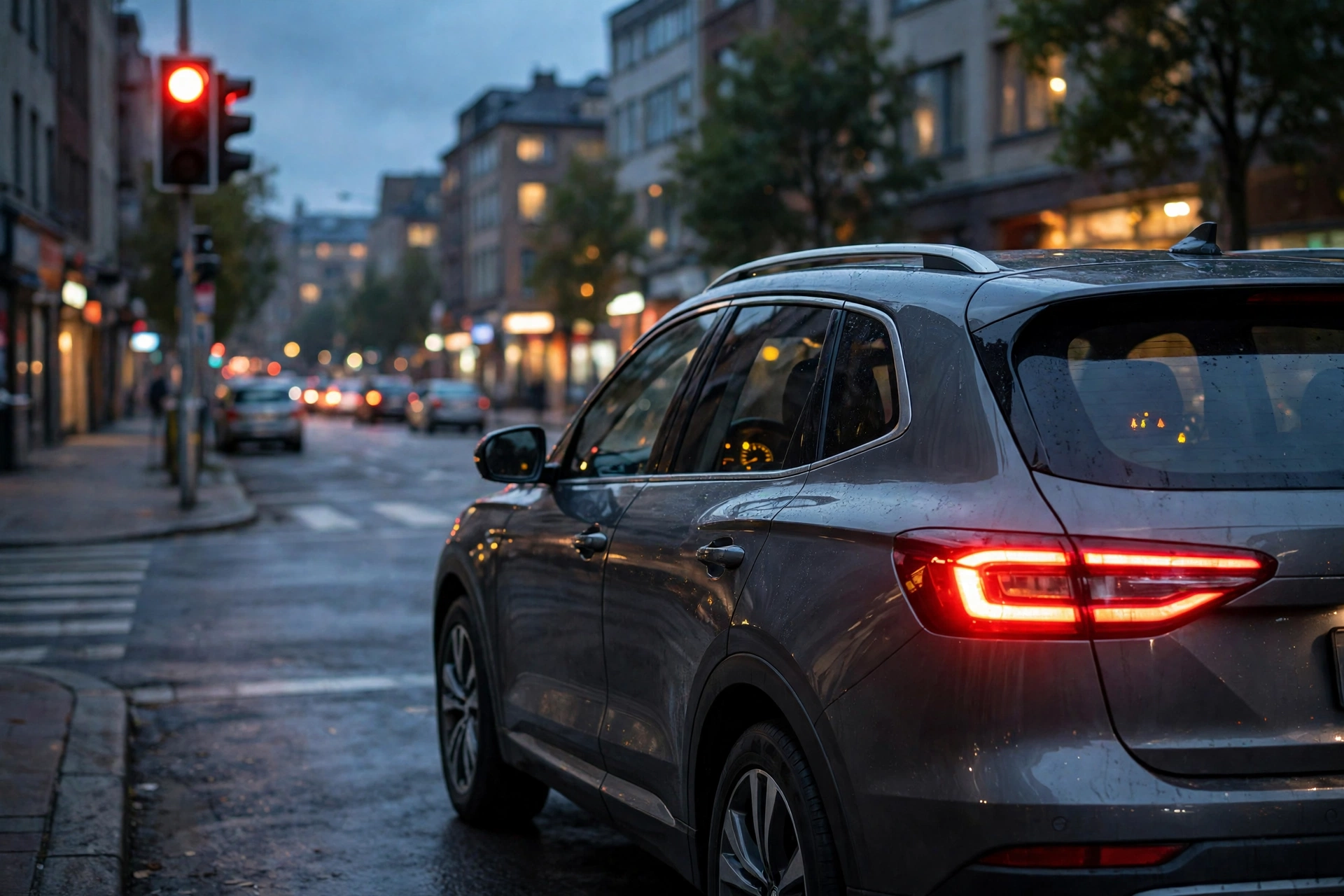
Your engine just died at a red light. Cars are honking behind you, your heart is pounding, and you have about three seconds to decide what to do. Take a breath: a stall at a red light is frightening, but it is rarely an emergency if you handle the next minute correctly — and in many newer cars, it is not a stall at all.
This guide walks you through exactly what to do right now, how to tell a real stall from your car's normal auto stop-start feature, and the most common causes a beginner can actually check. No tools needed.
First: Is It Actually Stalling — or Is That Auto Stop-Start?
Before you worry about repairs, rule out the feature. Many cars built in the last decade have auto stop-start (sometimes called idle stop). It deliberately shuts the engine off when you stop at a red light to save fuel, then restarts the instant you lift your foot off the brake. It is completely normal — and it catches a lot of new owners by surprise.
It is probably auto stop-start if:
- The engine switches off smoothly and quietly, with no shaking or sputtering first.
- A small dashboard icon lights up — usually the letter "A" inside a circular arrow.
- No warning lights come on, and the radio, lights, and air conditioning keep working.
- The engine restarts immediately and smoothly the moment you release the brake.
- Your car has a button near the gear shifter marked with the same "A" arrow symbol — that is the stop-start off button.
It is a real stall if:
- The engine sputters, shakes, or shudders before dying, or cuts out suddenly with a jolt.
- The check engine light (or battery light) comes on, or was already on.
- The engine is slow or difficult to restart, or will not restart at all.
- The steering suddenly feels heavy and the brake pedal feels hard — you have lost power assist.
- It happens in a car you know does not have auto stop-start, or while the engine is still cold.
If it is auto stop-start, you can relax — and if you dislike the feature, pressing the off button disables it for that trip (it switches back on the next time you start the car). If it is a real stall, keep reading: the next section is what to do right now.
What to Do Right Now: The First 60 Seconds
A stall in traffic is a safety situation first and a car problem second. Do these in order:
- Switch your hazard lights on immediately. This is the single most important step. It tells every driver behind you that you have a problem.
- Keep your foot on the brake and stay calm. Your steering and brakes still work without the engine — they just need a much firmer push. Do not pump the brake pedal; press it steadily.
- If you can, steer gently to the side of the road or the nearest safe spot. Only move if you can do so safely. If you are in the middle of a junction, stay put with your hazards on.
- Turn the key (or push-button) fully off, wait ten seconds, then try to restart. A full off-and-on resets the car's computer. If it restarts and idles smoothly, drive to the nearest safe place — a parking lot, not home across town — and read the rest of this guide before driving further.
- Note what happened. Was there a warning light? Did the engine sputter first, or die silently? Did it stall only when the air conditioning was on? These details are your best diagnostic clues, and your mechanic will ask for them.
- If it will not restart, or it stalls again within a minute, call for a tow. Do not keep cranking the engine, and never try to push-start an automatic car — you can damage the transmission. A tow is cheaper than a second breakdown in moving traffic.
What Happened Just Before It Died? (Your Best Clue)
Mechanics diagnose stalling by pattern, and you can do the same. What happened in the seconds before the engine died points straight at the system that is failing:
- It sputtered and shook, then died. Usually a fuel or air problem — a clogged fuel filter, a weak fuel pump, or a dirty throttle body starving the engine at idle.
- It died suddenly, with no warning at all. Usually electrical — a failing crankshaft position sensor or a charging problem. The engine computer loses a signal and shuts the fuel off to protect itself.
- It only stalls when the air conditioning or headlights are on. The extra electrical load is too much for a weak battery, a failing alternator, or an idle system that cannot compensate. Note whether the battery light came on first.
- It only stalls when the engine is cold. A sensor or idle valve that works once the engine warms up — common with a dirty idle air control valve or a faulty temperature sensor.
- It idles roughly all the time and finally dies at lights. A vacuum leak or a dirty mass airflow sensor is upsetting the air-fuel mixture, and idle is where the engine is least able to cope.
Write down the pattern before you forget it. "It sputters, then dies, and only when the A/C is on" is worth more to a mechanic than an hour of guessing.
The 8 Most Common Causes of Stalling at Red Lights
At a red light your engine is idling — running at its lowest speed, around 600 to 1,000 RPM, with the smallest margin for error. Anything that upsets the balance of air, fuel, and spark shows up here first, even if the car drives fine at speed. These are the usual suspects, from most to least common for beginners.
1. Dirty Throttle Body
The throttle body is the flap that controls how much air enters the engine. At idle it is nearly closed, so even a thin layer of carbon buildup can choke off the air the engine needs to stay alive. This is one of the most common causes of stalling at stops, and it creeps up gradually — the idle gets rougher over weeks before the first stall. Beginner check: a rough idle that smooths out once you are moving. Fix: a mechanic can clean it in under an hour; it is not a beginner DIY job on modern electronic throttles.
2. Faulty Idle Air Control Valve (Older Cars)
Many older fuel-injected cars have a small valve whose only job is to let extra air in while the engine idles. When carbon clogs it, the engine cannot hold its idle speed and dies the moment you take your foot off the gas. Beginner check: the car stalls at every stop but runs fine once moving, and the problem is worse when the engine is cold. Fix: cleaning or replacement by a mechanic. Newer cars control idle electronically instead, so this mostly affects older models.
3. Vacuum Leak
Your engine needs a sealed intake system. If a rubber vacuum hose cracks or a gasket shrinks, extra air sneaks in that the computer did not measure, and the fuel mixture goes lean — worst at idle, where the leak can be enough to kill the engine. Beginner check: a high-pitched hissing sound from under the hood, a check engine light, or an idle that surges up and down. Fix: a mechanic finds leaks with a smoke test.
4. Dirty or Failing Mass Airflow (MAF) Sensor
The MAF sensor measures how much air is entering the engine so the computer can add the right amount of fuel. When it gets dirty, it reports the wrong number, and the engine gets the wrong fuel mixture — usually worst at idle. Beginner check: rough idle plus poor fuel economy and a check engine light together. Fix: a mechanic can clean or replace the sensor; the part is small and the job is quick.
5. Fuel Delivery Trouble: Clogged Filter or Weak Pump
The fuel filter traps dirt before it reaches the engine, and the fuel pump pushes fuel at steady pressure. When either one weakens, pressure drops most when the engine slows to idle at a light. The car often sputters or hesitates before it dies, and it may struggle to restart. Beginner check: sputtering or a loss of power when accelerating, not just at stops. Fix: filter replacement is routine; a failing pump is a mechanic job. Never let a shop replace a fuel pump on a guess — ask them to test fuel pressure first.
6. Worn Spark Plugs or Weak Ignition Coils
Spark plugs ignite the fuel in each cylinder, and coils supply the voltage. Worn plugs with wide gaps and tired coils struggle most at idle, when combustion pressures are lowest — one cylinder misfires, the engine shakes, and if enough cylinders miss, it stalls. Beginner check: shaking or jerking at idle, worse under load like the A/C, often with a flashing check engine light. Fix: spark plug replacement is one of the most common routine services; coils are replaced as needed.
7. Failing Crankshaft Position Sensor
This sensor tells the computer how fast the engine is spinning. When it fails, the computer loses track of the engine entirely and cuts the fuel — so the engine dies instantly, with no sputter and no warning. The classic pattern: the car stalls, refuses to restart, then starts fine after it cools down for twenty minutes, only to stall again later. Beginner check: sudden silent cut-out, a check engine light, and a restart that only works after a cool-down. Fix: sensor replacement by a mechanic, guided by the diagnostic code.
8. Weak Battery or Failing Alternator
At idle the alternator spins slowly and produces the least power, while the battery covers the gap. If the battery is old or the alternator is failing, the voltage drops too low to run the ignition and fuel systems — and the engine quits. Beginner check: the battery warning light came on before the stall, the headlights dim at idle, or the engine cranks slowly when you try to restart. Fix: most auto parts stores will test your battery and charging system for free. Also read our guide to why your car shakes at idle — many of the same parts are involved.
Red Flags: Don't Drive It — Call a Tow
Most single stalls are a warning, not a catastrophe. But do not keep driving if any of these apply:
- The check engine light is flashing, not just on. A flashing light means an active misfire that can damage the engine.
- The engine stalls again within a minute of restarting, or stalls while you are moving rather than stopped.
- The temperature gauge is in the red, or you see steam or smell burning.
- The oil pressure light is on, or the engine makes knocking or grinding noises.
- The car stalls every single time you stop — you will not make it through the next junction safely.
If the car restarts and idles smoothly, you may drive it slowly to the nearest mechanic — not on a long trip, and not in heavy traffic if you can avoid it. If you are unsure, a tow is always the safer and usually the cheaper choice. For more on what that warning light means, see check engine light flashing vs solid.
What to Tell Your Mechanic (So You Don't Pay for Guessing)
Walk in with a clear report and you will save time, money, and repeat visits. Say something like this:
"My car stalls at red lights. It sputters for a few seconds first, then dies. It restarts right away, but it only happens when the air conditioning is on. The check engine light came on yesterday. It has happened four times this week, and the idle feels rough even when it doesn't stall."
That one paragraph tells a mechanic the pattern (sputtering stall), the trigger (A/C load), the warning (check engine light), the frequency, and the idle quality. Also mention the mileage, the last service date, and whether anything changed recently — a new battery, a recent fill-up, or work done under the hood. Before your visit, read how to use an OBD2 scanner for the first time — a cheap scan tool can tell you the fault code before you arrive, and how to find a trustworthy mechanic if you do not have one yet.
How to Prevent Stalling at Red Lights
- Follow your service schedule. Spark plugs, air filters, and fuel filters all have replacement intervals in your owner's manual — most stalling causes start as overdue maintenance.
- Do not ignore a check engine light. It is the car's way of reporting a problem before it becomes a stall. Get the code read early; a free scan at a parts store takes five minutes.
- Use good fuel and keep the tank above a quarter full. Running near empty stirs up sediment and makes a weak fuel pump work harder.
- Listen to the idle. A new roughness, surge, or dip at idle is an early warning. Mention it at your next service instead of waiting for the first stall.
- Keep the battery healthy. Clean terminals, and replace an aging battery before it gets weak — batteries usually last three to five years, and a failing one causes more than just slow starts.
- Fix small leaks early. A cracked vacuum hose is a cheap part; the stall it causes in traffic is not.
Frequently Asked Questions
Is it dangerous if my car stalls at a red light?
It can be. You lose power steering and brake assist, so the car is harder to control, and you are stopped in traffic. Switch your hazards on, restart if you can, and get to a safe spot. A single stall that never repeats may be a one-off; repeated stalling is a safety problem — get it checked before your next drive.
Why does my car stall only at red lights and not while driving?
At a red light the engine is idling at its lowest speed, with the smallest margin for error. Problems with air, fuel, or spark that the engine can hide at higher speeds show up at idle first. That is why a dirty throttle body, a vacuum leak, or a weak fuel pump usually causes stalling at stops long before it affects driving.
My car turns off at every red light but restarts instantly. Is something broken?
Probably not — that is auto stop-start, a fuel-saving feature on many modern cars. Look for the "A" inside a circular arrow on the dashboard, and check for an off button near the gear shifter. If the shutdown is smooth, silent, and restarts the moment you lift off the brake, it is working as designed.
Can I drive my car after it stalls once?
If it restarts easily, idles smoothly, and no warning lights are flashing, you can usually drive it carefully to the nearest mechanic. If it stalls again quickly, the check engine light is flashing, or the temperature gauge is high, do not drive it — call a tow instead.
How much does it cost to fix a car that stalls at idle?
It depends entirely on the cause, which is why a diagnosis comes first. A throttle body cleaning or a spark plug change is routine maintenance; a fuel pump or a sensor replacement costs more. Ask for a written estimate before approving any repair, and be wary of any shop that wants to replace an expensive part without testing it first — a diagnostic scan and a fuel pressure test are cheap and they name the problem.
The Bottom Line
A car that stalls at red lights is telling you something, and the message is usually readable: what happened in the seconds before it died, whether it sputters or cuts out silently, and whether it restarts easily. Start with the 60-second safety steps, rule out auto stop-start, match the pattern to the causes above, and get a diagnostic scan before anyone replaces a part. Most stalling is fixed by routine maintenance or a single small repair — the expensive mistake is ignoring it until the car quits somewhere worse than a red light.
Sources: Pulscar — Car Stalls While Driving: 10 Causes + What to Do Right Now; EngineerFix — Why Does My Car Automatically Shut Off When Stopped?