You press the gas pedal to pull away from a light or merge onto a faster road — and instead of smooth power, the car stumbles. It jerks, lags for a second, then surges forward as if it changed its mind. That brief stumble has a name: acceleration hesitation. It is one of the most common drivability complaints new owners notice, and it is also one of the most useful early warnings your car can give you.
The good news: hesitation is rarely a mystery, and it is almost never random. It happens when the engine cannot deliver power in proportion to what your right foot asks for — because of fuel, air, spark, or the information the engine computer is working with. This guide explains what hesitation feels like, what is normal and what is not, the checks you can do yourself in five minutes with no tools, the most common causes in plain English, and exactly when to stop driving and call a mechanic.
What "hesitation" actually feels like
Drivers describe it in different words, but the feeling is the same:
- A brief stumble or jerk the moment you press the accelerator, then the car catches up.
- A flat spot — you press the pedal and almost nothing happens for a second, then power arrives all at once.
- A surging or bucking feeling under steady acceleration, as if the car is hiccuping.
- A lag from a stop that is worse when the engine is cold, or worse when you accelerate hard uphill.
One important distinction first: hesitation is an engine problem in most cases. The engine is producing less power than it should, for a moment. That is different from a transmission problem, where the engine revs freely but the car does not speed up — we cover a simple test for telling the two apart below.
First: is it normal, or is it a fault?
Not every delay is a problem. A few kinds of hesitation are normal behaviour, and knowing them saves you a needless garage visit:
- Turbo lag. If your car has a turbocharged engine, a slight delay at low revs is normal physics — the turbo needs exhaust gases to spin up before it can add boost. A delay of around half a second at low RPM is typical, especially in larger-turbo or diesel engines. The key question is whether it has changed. If your car always felt like this, it is probably normal. If the lag suddenly got worse, or it now comes with warning lights or strange noises, treat it as a symptom.
- Cold engine. In the first few minutes after a cold start, the engine runs on a richer fuel mixture and the idle sits higher while everything warms up. A mild stumble at low speed when cold is common — some engines are even known for it (Volkswagen, for example, released a software update in 2020 for its 1.5 TSI engine's cold-start "kangarooing"). If the hesitation disappears completely once the engine is warm, note it and mention it to your mechanic at the next service rather than panicking.
- Air conditioning load. With the AC compressor running, the engine carries extra load at low revs, which can make pull-away feel slightly softer. This is normal if it is mild and consistent.
- CVT automatics. Many modern cars use a continuously variable transmission (CVT). A CVT can feel like the engine revs up before the speed catches up — drivers sometimes call it "rev hang". Again, if it has always felt that way, it is the transmission's character, not a fault.
The rule of thumb: a delay that is new, getting worse, or paired with a warning light, a smell, smoke, or a noise is a fault. A delay that has been there since day one, is mild, and never changes is usually just how your car behaves.
The 5-minute beginner check (no tools needed)
Before you read about causes, spend five minutes gathering clues. A mechanic will ask you these exact questions, and your answers can save diagnostic time — and money. Do this on a quiet road or in a car park, never in moving traffic.
- Notice exactly when it happens. Only when cold? Only when warm? Only under hard acceleration, or even gently? Only uphill? Write it down — patterns point straight at causes.
- Watch the rev counter (tachometer) while it hesitates. Do the revs struggle to rise while the engine stumbles? That points to the engine (fuel, air, spark). Do the revs shoot up while the speed stays the same? That points to the transmission slipping — a different problem, covered below.
- Check the dashboard. Is the check engine light on — solid or flashing? A flashing check engine light means an active misfire: ease off the gas, avoid hard acceleration, and get the car checked promptly. A solid light means a stored fault code a mechanic (or a basic OBD2 scanner) can read.
- Listen and smell. A hissing sound under the bonnet can mean a vacuum leak. A rotten-egg smell can point to the catalytic converter. A strong petrol smell after starting can mean a fuel-system leak — do not keep driving with that one.
- Think about what changed recently. Did you just fill up with fuel from an unfamiliar station? Did the car sit unused for weeks? Was any work done recently? Bad fuel, a long sit, or a disturbed hose after servicing are all real triggers.
- Check the simple things. Is the fuel tank nearly empty? (A very low tank can starve the pump on hills and corners.) Is the air filter obviously filthy? Pop the bonnet and look — a filter caked in dust is a clue, not a diagnosis, but it is worth knowing.
If you can answer "when, hot or cold, revs up or down, light on or off", you have already done the hardest part of the diagnosis.
The 8 most common causes, in plain English
Every cause below falls into one of three groups: not enough fuel, weak spark, or wrong information reaching the engine computer. They are listed roughly in the order a mechanic would check them — cheapest and most common first.
1. Worn or dirty spark plugs
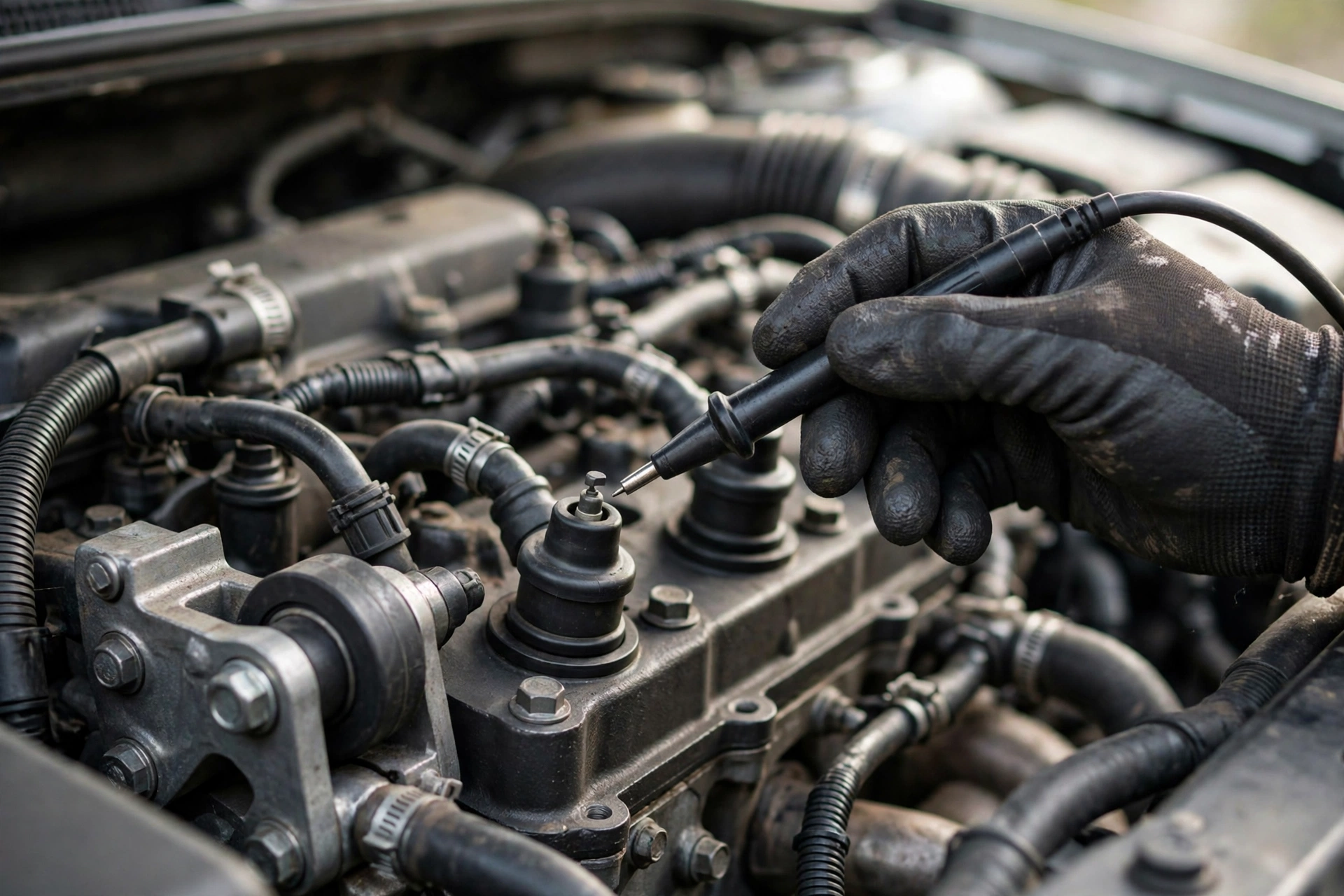
The single most common cause. Spark plugs ignite the fuel-air mixture in each cylinder, and they wear out: copper plugs typically degrade by around 30,000 miles, iridium plugs by around 100,000. As the electrode gap widens, the spark gets weaker — and under hard acceleration, when cylinder pressure is highest, a weak spark can fail outright. The result is a misfire you feel as a stumble or jerk. If your plugs are overdue by mileage, this is the first suspect.
2. Clogged fuel filter
The fuel filter traps dirt before it reaches the engine, and over time it fills up. At idle the engine needs little fuel, so a partly clogged filter goes unnoticed — but the moment you accelerate, the engine demands a sudden surge of fuel the filter cannot pass. Hesitation that appears first under hard acceleration and later spreads to normal driving is the classic fuel-filter pattern.
3. Weak fuel pump
A fuel pump can be healthy enough to hold pressure at idle yet unable to keep up when the engine is under load. The symptom is very specific: the car idles fine and drives gently without complaint, but hesitates or sputters when you ask for real power — hard acceleration, motorway merging, climbing a hill. A fuel-pressure test at a garage confirms it.
4. Dirty or clogged fuel injectors
Injectors spray a fine mist of fuel into each cylinder. Varnish and carbon deposits — accelerated by ethanol-blend fuels — can clog the tiny injector tips or distort the spray pattern, so one cylinder gets less fuel than the others. The engine then stumbles unevenly under load. This one needs professional cleaning or replacement; pour-in fuel additives are not a reliable fix for a genuinely clogged injector.
5. Dirty mass airflow (MAF) sensor
The MAF sensor measures how much air is entering the engine and tells the computer how much fuel to add. Dust, oil vapour and debris can contaminate its delicate wire, so it reports the wrong airflow — and the computer then injects too little or too much fuel. The mixture goes lean or rich, and the engine hesitates exactly when you open the throttle. A dirty MAF often also causes rough idling and worse fuel economy.
6. Carbon-fouled throttle body
The throttle body is the valve that controls how much air enters the engine when you press the pedal. Carbon deposits build up on its plate and bore, physically restricting airflow at partial throttle — precisely where hesitation is most noticeable during gentle-to-medium acceleration from a stop. Cleaning it is routine maintenance, but it must be done correctly, as the throttle plate and its sensor are delicate.
7. Vacuum leak
Rubber hoses and gaskets carry vacuum around the engine. When one cracks or comes loose, extra air sneaks into the intake without passing the MAF sensor — the computer does not know it is there, so the fuel mixture goes too lean. Listen for a faint hissing under the bonnet, especially at idle. A vacuum leak often causes hesitation together with a rough or high idle.
8. Severely clogged air filter
Often overlooked because it is so simple. An engine needs a huge volume of clean air, and a filter choked with dust starves it — the mixture runs rich, combustion gets sloppy, and the car stumbles when you accelerate. If your air filter looks grey or black and you cannot remember when it was last changed, it is overdue. This is the cheapest fix on this whole list.
Less common, but worth knowing
A failing throttle position sensor can send erratic pedal-position signals, so the computer misjudges fuel delivery at the exact moment you press the gas. A restricted catalytic converter chokes exhaust flow and kills power mainly at high revs — sometimes with a rotten-egg smell. And low engine compression (worn piston rings, leaking valves) is a deeper engine problem a garage diagnoses with a compression test. If the eight causes above are all ruled out, these are next.
Hesitation vs. transmission slip: the RPM test
This one test saves beginners from chasing the wrong problem. Next time the car hesitates, glance at the rev counter:
- Revs struggle to rise and the engine stumbles or surges — the fault is in the engine: fuel, air, or ignition. Work through the causes above.
- Revs rise quickly but the car's speed does not increase — the engine is making power but the transmission is not passing it to the wheels. That is transmission slip, and it points to worn clutch packs, a failing torque converter, or low transmission fluid. Do not keep driving hard on a slipping transmission; get it checked soon, because slip gets worse fast and the repair bill grows with it.
Do not test this by flooring the pedal repeatedly — one or two observations are enough, and repeated hard acceleration on a faulty car only stresses it further.
Is it safe to keep driving?
Most mild, occasional hesitation is not an emergency — but some versions are. Stop driving and get help if you notice any of these:
- The check engine light is flashing (active misfire — unburnt fuel can damage the catalytic converter).
- The car stalls or nearly stalls in traffic, or hesitation happens while merging or overtaking at speed.
- You smell strong petrol, see smoke, or notice fluid leaking under the car.
- The engine makes loud knocking or metallic noises during hesitation.
- Hesitation appeared suddenly and severely, rather than building up over weeks.
If the hesitation is mild, happens only occasionally, and there is no warning light, it is usually safe to drive gently to a mechanic — avoid hard acceleration, motorway merging at full throttle, and long trips until it is checked. Hesitation has a habit of getting worse, not better, so "it still drives fine" is not a reason to ignore it for months. A worn spark plug today is a cheap job; the same misfire ignored for a season can damage the catalytic converter, which is not.
What to tell your mechanic (a 30-second script)
Mechanics diagnose faster — and charge you less diagnostic time — when you arrive with specifics. Say something like this:
"My car hesitates when I accelerate. It happens [only when cold / only when warm / all the time], mostly [from a stop / under hard acceleration / uphill]. The revs [struggle to rise / shoot up while speed stays the same]. The check engine light is [off / on solid / flashing]. It started about [two weeks ago / after my last fill-up]. The car has [mileage] miles and the spark plugs were last changed [never / at X miles]."
That one paragraph tells a mechanic more than "my car feels weird" ever will. If they suggest a diagnostic scan, ask them to note the fault codes — common ones for hesitation include misfire codes, lean-mixture codes, and underboost codes — and to explain what each one means before approving any repair.
How to prevent hesitation
You cannot prevent every cause, but the most common ones are maintenance items:
- Change spark plugs on schedule — follow your owner's manual interval, not a guess. This alone prevents the single most common cause.
- Replace the air filter and fuel filter on schedule — both are cheap, and both starve the engine when neglected.
- Do not run the tank to empty habitually. The fuel pump is cooled by the fuel around it, and the bottom of the tank is where sediment collects. Refuelling at a quarter tank is a good habit.
- Use the fuel grade your manual recommends and buy from busy, reputable stations — stale or contaminated fuel from a quiet station is a real (if uncommon) trigger.
- Do not ignore a solid check engine light. A code read early is a small repair; the same code ignored for months is often a bigger one.
- Service the car on time. Most of the parts in this article — plugs, filters, sensors — are checked or replaced during routine servicing before they fail.
Frequently asked questions
Why does my car hesitate when accelerating from a stop?
Low-speed, light-throttle hesitation most often points to a carbon-fouled throttle body, a dirty MAF sensor, worn spark plugs, or a vacuum leak — all of which show up first at partial throttle. If it only happens when the engine is cold, some turbocharged engines simply do this until warm, but mention it at your next service so it is on record.
Why does my car hesitate only when accelerating hard?
Hard acceleration demands maximum fuel flow and the strongest spark. A clogged fuel filter or a weak fuel pump often copes fine at gentle speeds and fails only under load — so hesitation that appears first during hard acceleration, merging, or hill climbs is a classic fuel-delivery pattern.
Can bad fuel cause hesitation?
Yes. Contaminated or stale fuel, water in the fuel, or the wrong octane can all cause stumbling — especially if the problem started right after a fill-up from an unfamiliar station. If you suspect bad fuel, note the station and the date, keep the receipt, and tell your mechanic; do not keep topping up in the hope it dilutes away.
Will an OBD2 scanner tell me why my car hesitates?
Often, yes — at least it narrows the search. A basic scanner reads stored fault codes (misfire, lean mixture, sensor faults) that point straight at the system involved. It will not name the exact part, but it turns a guess into a shortlist. Our beginner's guide to using an OBD2 scanner for the first time walks through the whole process.
How much does it cost to fix acceleration hesitation?
It depends entirely on the cause, which is why diagnosis comes first: an air filter or spark plugs are among the cheapest jobs on a car, while a fuel pump or catalytic converter costs far more. The honest order is: read the fault codes, confirm the cause, then get a written estimate before approving anything. If a garage quotes a repair without explaining which cause they found and how they confirmed it, ask — or get a second opinion from a mechanic you trust.
The bottom line
Acceleration hesitation is your engine telling you, in the clearest way it can, that the fuel-air-spark recipe is off at the exact moment you need it most. Start with the five-minute check — when it happens, what the revs do, whether a light is on — and you will already know whether you are looking at the engine, the transmission, or normal behaviour. Most causes are routine maintenance items (plugs, filters, sensors) that are cheap when caught early and expensive when ignored. And if the check engine light is flashing, the car stalls, or the hesitation hits while you are merging at speed, do not wait: get it checked now.
If your car has other symptoms too, these guides in the same series may help: a car that shakes at idle or stalls at red lights often shares causes with hesitation, and a flashing vs solid check engine light explains what that warning is really telling you. When you do visit a garage, our guide on finding a trustworthy mechanic can help you pick the right one.
Sources: EngineerFix, "Why Your Car Hesitates When Accelerating" (https://engineerfix.com/why-your-car-hesitates-when-accelerating/) and BandM Auto Care, "Why Your Car Hesitates During Acceleration: 2026 Guide" (https://blog.bandmautocare.com/why-your-car-hesitates-during-acceleration-2026-guide/). If anything here does not match what your car is doing, trust your senses and a qualified mechanic over any article — including this one.