You are stopped at a red light, foot on the brake, and your car is shaking. The steering wheel trembles, the seat buzzes, and the whole car feels unsteady — but the moment you pull away, it drives perfectly fine. If that sounds familiar, you are dealing with one of the most common beginner car problems: a shake at idle.
The good news is that most causes are routine maintenance items, not a dying engine. The bad news is that a few of them can damage your car if you ignore them for months. This guide explains what is normal, what is not, the six most common causes, a five-minute check you can do in your driveway with no tools, and exactly when to stop driving and call a mechanic.
First: Is a Little Shaking at Idle Normal?
Yes — a little. At idle your engine runs at low speed, usually around 600 to 1,000 RPM, and the pistons are still firing. A faint, steady vibration you barely notice is normal on most cars, especially older ones and small four-cylinder engines.
What is not normal is a shake you can clearly feel through the steering wheel, the seat, or the floor — especially if it is new, rhythmic, or getting worse. A shake that pulses, stumbles, or comes with a warning light, a strange noise, or a smell is your car asking for attention. If your car also shakes at highway speed, that is a different problem with different causes, and it is worth reading about separately.
- Normal: a faint, even hum you have to concentrate to notice.
- Not normal: a visible shake of the steering wheel, a pulsing or stumbling feel, or shaking that started suddenly.
- Act now: shaking plus a flashing check engine light, stalling, or a fuel or exhaust smell — see the red-flag list below.
The 5-Minute Driveway Check (No Tools Needed)
Before you spend money on parts or a diagnosis, spend five minutes noticing when the shake happens. The pattern is the biggest clue, and a mechanic will ask you these exact questions anyway.
- Park vs Drive. With your foot firmly on the brake, shift from Park to Drive and back. If the shake is much worse in Drive and nearly gone in Park, worn engine mounts or a low idle speed are the prime suspects.
- Air conditioning on vs off. Turn the A/C on, wait 30 seconds, then turn it off. If the shake gets clearly worse with the A/C on, the engine is struggling to hold a steady idle — often a dirty throttle body or an idle-control problem.
- Cold vs warm. Notice whether the shake is worst in the first minute after a cold start and then fades. A cold-start-only shake often points to a small vacuum leak or a misfire that clears as the engine warms up.
- Listen and feel. Is the engine note uneven, like it is missing a beat? Does the exhaust sound puffy or uneven? An uneven beat points to a misfire; a steady hum that just feels strong points to mounts.
- Check the dashboard. Is the check engine light on — steady or flashing? A steady light means the car has stored a fault code a scan tool can read. A flashing light means an active misfire: do not keep driving. Our guide to a flashing vs solid check engine light explains the difference in detail.
Write down what you found — "shakes in Drive, not Park, worse with A/C, light is steady" is exactly the kind of note that saves you diagnostic time at the shop.
6 Common Causes of a Car Shaking at Idle
1. Engine Misfire: Worn Spark Plugs or a Failing Ignition Coil
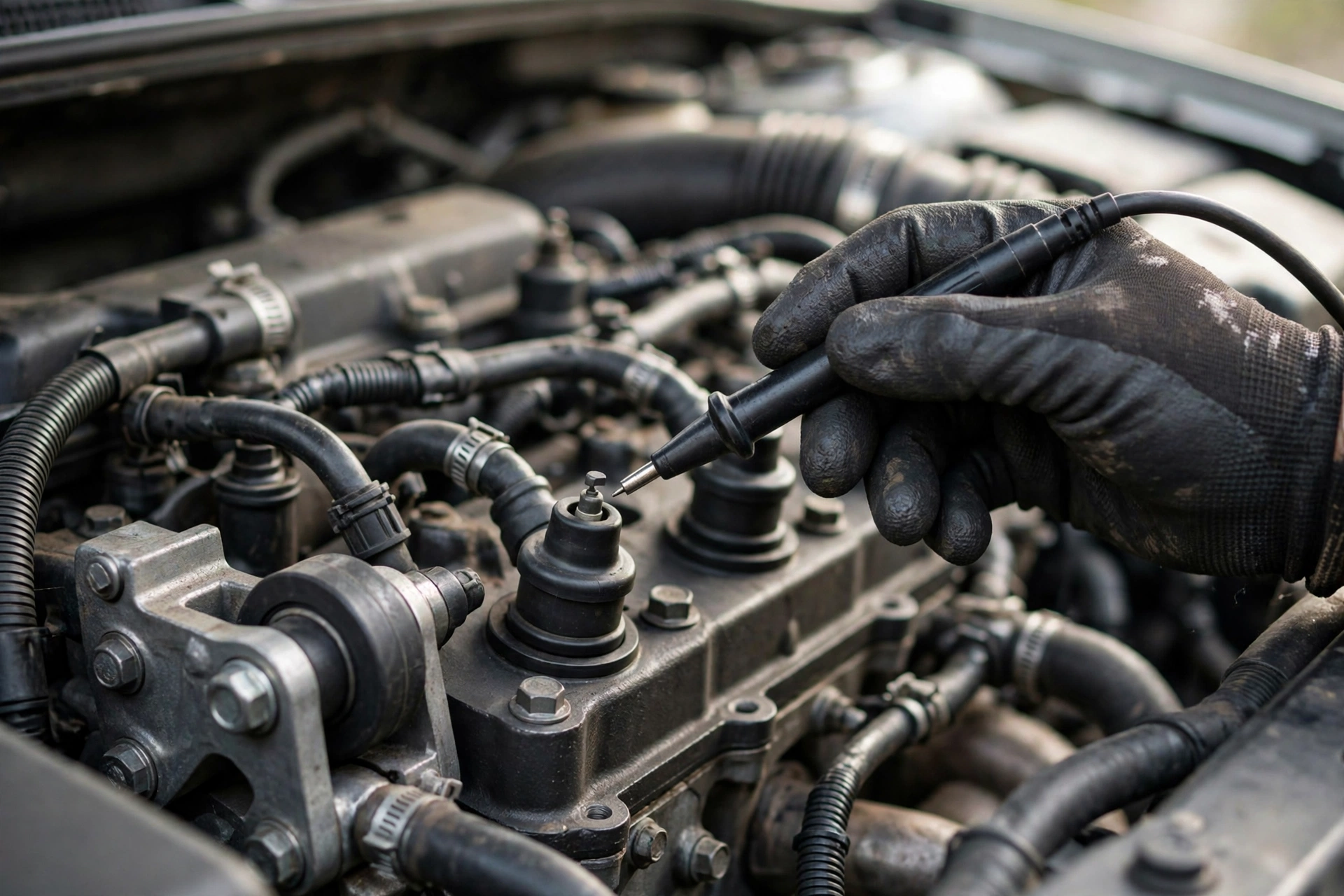
This is the single most common cause. A spark plug fires the fuel in one cylinder; an ignition coil supplies the voltage that makes it fire. When a plug wears out or a coil weakens, that cylinder stops contributing evenly, the engine loses its rhythm, and you feel it as a shake — worst at idle, when the engine is running slowest and has the least momentum to smooth things out.
Clues: uneven engine beat, a steady or flashing check engine light, the shake easing once you rev the engine. What to do: this is a maintenance item, not a mystery. Spark plugs are replaced at the interval in your owner's manual — typically every 30,000 to 100,000 miles depending on the plug type. A basic scan tool can often tell you which cylinder is misfiring; our beginner's guide to using an OBD2 scanner for the first time shows how.
2. Worn or Broken Engine Mounts
Engine mounts are rubber-filled brackets that hold the engine in place and soak up its normal vibration. Over years of heat and mileage the rubber cracks, sags, or separates — and vibration that used to be absorbed gets passed straight into the frame, the seat, and the steering wheel.
Clues: the shake is clearly worse in Drive at a stop than in Park or Neutral, and the engine itself runs smoothly — the problem is not how it runs, but how its shake reaches you. You may also hear a clunk when shifting between Drive and Reverse. What to do: mounts are a shop job. A mechanic checks how the mounts sit and whether the engine moves too much when shifting with the brake applied. Do not replace spark plugs first for a mounts problem — the engine is fine, the cushion is not.
3. Vacuum Leak
Your engine measures the air coming in and adds the right amount of fuel to match. A cracked hose or a bad intake gasket lets extra, unmeasured air in, which leans out the mixture — and the engine is most sensitive to that at idle, where the airflow is smallest. The result is a rough, uneven idle rather than one strong pulse.
Clues: a faint hiss under the hood, an idle that hunts or surges up and down, or a lean fault code. What to do: ask the shop for a smoke test — harmless smoke is pumped into the intake and shows exactly where air is getting in. Ask for this and a mount check before agreeing to replace any part.
4. Dirty Throttle Body or a Sticking Idle Air Control Valve
At idle, a small valve controls how much air bypasses the closed throttle so the engine keeps running. When carbon builds up in the throttle body or that idle valve sticks, the engine cannot hold a steady idle speed — so it shakes, surges, or nearly stalls, often worst with the air conditioning on because the A/C adds load.
Clues: idle speed wanders up and down, the shake gets worse with the A/C on, the engine sometimes feels like it might stall at a light. What to do: cleaning the throttle body is routine maintenance on many cars. This is a good one to mention by name at the shop, because it is often fixed without replacing parts.
5. Fuel Delivery Problem: Clogged Injectors or a Weak Fuel Pump
If a fuel injector is clogged or the fuel pump is weak, one or more cylinders do not get enough fuel, combustion becomes incomplete, and the engine shakes — again, most noticeably at idle, where there is no speed to mask it.
Clues: the shake comes with hesitation when you accelerate, poor fuel economy, or hard starting. What to do: keep up with fuel filter changes at the interval in your manual, and use the fuel grade your manual specifies. Injector and pump diagnosis belongs to a mechanic — do not pour in additives and hope, because a weak pump will only get worse.
6. Low Idle Speed or Outdated Engine Software
Sometimes nothing is broken — the idle is simply set too low, or the car's software needs the update the manufacturer released for exactly this complaint. With no warning light and an idle that just feels low, this is worth asking about.
Clues: no warning light, the shake disappears with the tiniest touch of the accelerator, and everything else checks out. What to do: ask the shop to check the idle speed against the manufacturer's specification and whether any software update or service bulletin applies to your car. On automatic cars, a failing torque converter can also transmit engine pulses to the drivetrain in gear at a stop — another reason a Drive-vs-Park comparison matters.
When to Stop Driving Right Away
Most idle shake is a "book an appointment this week" problem. It becomes a "stop now" problem when any of these are true:
- The check engine light is flashing — that means an active misfire that can overheat your exhaust and damage the catalytic converter. Pull over somewhere safe, switch the engine off, and call for help.
- The engine keeps stalling at stops, or the shake is so strong the car feels unsafe to control.
- You smell fuel or exhaust inside the car, see smoke, or the temperature warning light is on.
- The shake started suddenly and loudly after a bang, a clunk, or hitting something on the road.
With a steady light — or no light at all — and a shake that is annoying rather than alarming, driving gently to a shop is usually reasonable. When in doubt, the safe choice is always to stop and ask.
What to Tell Your Mechanic (So You Don't Pay for Guesswork)
A good mechanic diagnoses before replacing parts. Help them by arriving with facts, not a part name you found online. Say something like this:
"My car shakes at idle. It is worse in Drive than in Park, it gets worse with the A/C on, and the check engine light is steady. It started about two weeks ago and the engine note sounds uneven."
Then ask these three questions before approving any work:
- "Can you read the fault codes first and tell me which cylinder — if any — is misfiring?"
- "Can you check the engine mounts and do a smoke test for vacuum leaks before replacing parts?"
- "Can I get a written estimate before you start, and can you show me the worn part afterwards?"
If you do not have a shop you trust yet, our guide on how to find a trustworthy mechanic covers the test-job method and the red flags to watch for. As a rough guide only: spark plugs are usually the cheapest fix in this list, mounts and fuel-system work are more involved, and low compression is the most serious — but get a written estimate for your car rather than trusting any price you read online.
How to Prevent Idle Shake Before It Starts
- Replace spark plugs on schedule. Worn plugs are the single most common cause of idle misfire — the owner's manual interval exists for a reason.
- Keep up with air and fuel filter changes. A starved engine shakes; clean filters are cheap prevention.
- Have vacuum hoses checked at regular services, especially once your car passes 80,000 miles, when rubber hoses start to crack.
- Do not ignore a steady check engine light. A small misfire caught early is a spark plug; the same misfire ignored for months can become a damaged catalytic converter.
- Let the engine warm up for a few seconds before driving off on cold mornings — a cold engine idles rough by design, and gentle driving for the first minute helps.
Frequently Asked Questions
Why does my car shake at idle but drive fine?
At idle the engine runs at its slowest speed, so any uneven firing — a misfire, a vacuum leak, or a dirty idle valve — shows up clearly. Once you drive, the higher RPM and momentum smooth it out. Worn engine mounts do the opposite trick: the engine runs fine, but its normal vibration reaches the cabin because the rubber cushion has failed.
Is it safe to drive with a car that shakes at idle?
Usually yes, if the check engine light is steady or off and the car does not stall — drive gently to a shop within a few days. It is not safe to keep driving if the check engine light is flashing, the engine stalls at stops, or you smell fuel or exhaust. In those cases, pull over and call for help.
Can bad spark plugs cause shaking at idle?
Yes — worn spark plugs are the most common cause. When a plug cannot fire consistently, its cylinder misfires, the engine loses its even beat, and you feel it as a shake, especially at idle. A scan tool can usually identify which cylinder is misfiring, which makes the fix quick and cheap.
Why does my car shake more with the AC on?
The air conditioning adds load to the engine at idle. A healthy engine compensates by raising the idle slightly; an engine with a dirty throttle body, a sticking idle valve, or a weak cylinder cannot, so the shake gets worse. If the A/C test makes a clear difference, mention it to your mechanic — it narrows the diagnosis a lot.
How much does it cost to fix a car that shakes at idle?
It depends entirely on the cause, which is why a diagnosis comes first. Spark plugs are generally the least expensive fix; engine mounts, fuel injectors, and compression problems cost more because of parts and labour. Always get a written estimate for your specific car before approving work, and ask the shop to show you the worn part afterwards.
The Bottom Line
A car that shakes at idle is usually telling you something simple: a worn spark plug, a tired engine mount, a small air leak, or a dirty throttle body. Start with the five-minute driveway check — Park versus Drive, A/C on versus off, cold versus warm — and note whether the check engine light is on. That pattern tells you, and your mechanic, where to look first. Fix it this week rather than this season: a small misfire is cheap, but the catalytic converter damage it can cause is not.
Sources: Oil and Miles — Car Shaking When Idle and VehicleRuns — Engine Shakes at Idle.