
You are driving home when the tire pressure light comes on, or you hear that soft thump-thump of a flat. You pull over, and there it is: a nail in the tread of your tire. Your spare is buried under luggage, the nearest shop is 20 minutes away, and roadside help is an hour out. This is exactly when a tire repair kit earns its place in your trunk.
A good kit lets a beginner seal a small tread puncture in about 10 minutes and drive — carefully — to a shop for a proper repair. It costs less than one tow. Here are five beginner-friendly kits, how to choose, and the safety limits most guides bury in the fine print.
Affiliate disclosure: As an Amazon Associate, FirstCarCare earns from qualifying purchases made through the links in this article, at no extra cost to you. Our picks are based on published reviews, roundups, and hands-on tests by other reviewers — we do not claim to have tested these products ourselves.
Our Top 3 Picks at a Glance
- Best overall — Rhino USA 86-Piece: 60 plug strings and real steel tools.
- Best compact — Boulder Tools Compact with MOLLE Pouch: full-size tools in a pouch half the size of the next kit.
- Best budget — Slime 2040-A Deluxe: the classic 11-piece kit with pistol-grip tools.
Plug Kit vs Sealant: Which Type Should a Beginner Buy?
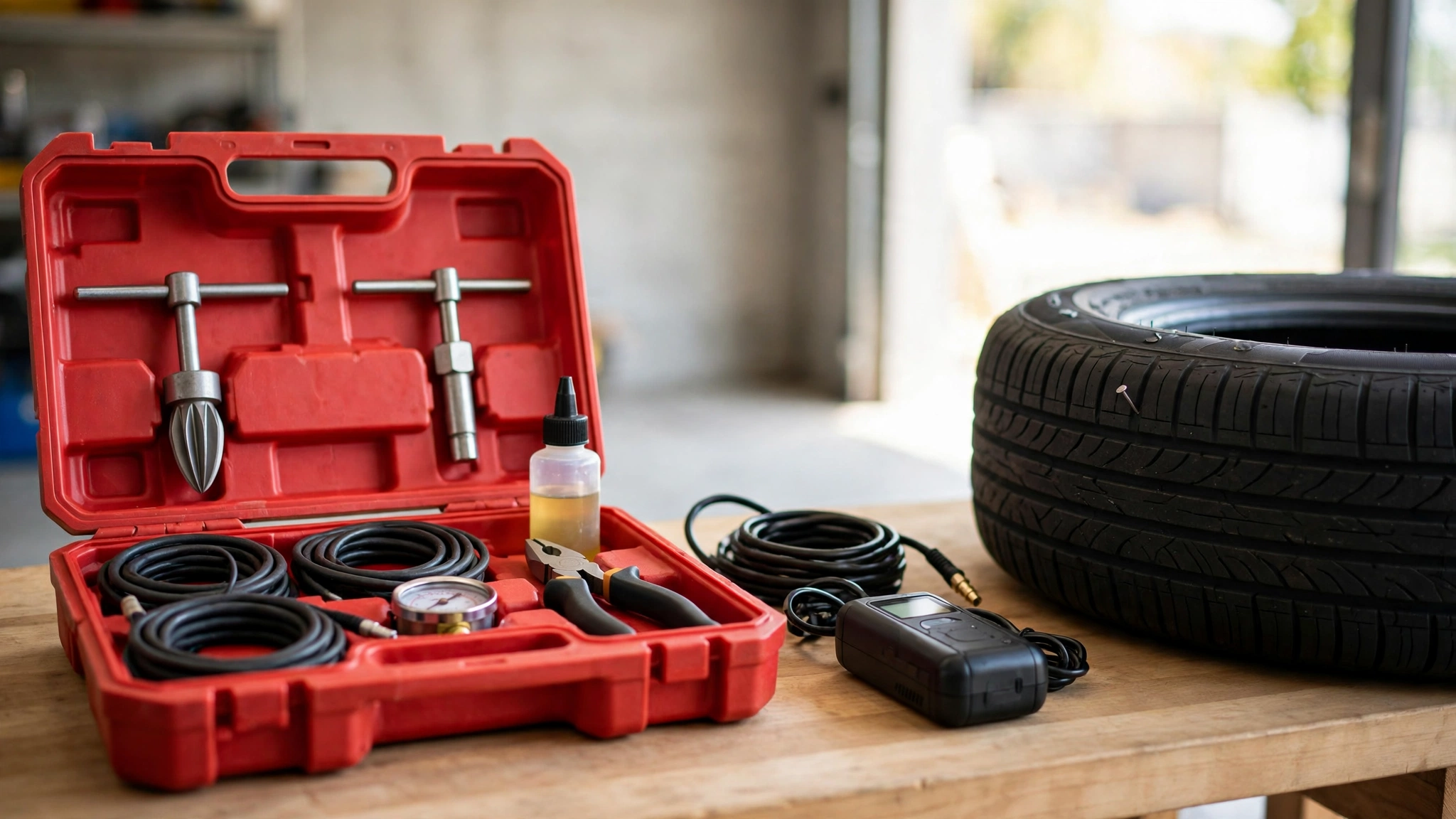
String plug kits (Rhino USA, Boulder Tools, AUTOWN, Slime 2040-A) work like this: pull the nail out, clean the hole with a reamer, thread a sticky rubber plug string through an insertion tool, push it in, and trim the excess. They handle nails and screws in the tread and are the most versatile option for a first-time owner.
Mushroom plug kits (Stop & Go 1000) use a small gun to push a mushroom-shaped rubber plug through the puncture. Its wide head sits inside the tire and air pressure holds it in place. The trade-off is a learning curve: if the nozzle is not pushed fully through the steel belts before you fire, the head can shear off and you waste a plug.
Sealant-and-inflator kits inject liquid sealant through the valve and inflate the tire in one step. They need no tools, but they only seal very small leaks and make a mess inside the tire. For a beginner who wants one kit that actually fixes a nail puncture, a string plug kit is the right default.
What to Look For in Your First Tire Repair Kit
Steel tools, not stamped metal. Pushing a plug through a steel-belted tire takes real force. Solid T-handle steel tools are far easier — and safer — than thin tools that bend. This is the biggest quality difference between a $10 kit and a $35 kit.
Enough plugs for more than one flat. A kit with 5 plugs is a one-and-done purchase; a kit with 30–60 plugs costs only a little more and stays useful for years. Check the plug count, not just the piece count — many "68-piece" kits count every valve cap and core.
The 5 Best Tire Repair Kits for Beginners in 2026
1. Rhino USA 86-Piece Tire Repair Kit — Best Overall
🏆 Best Overall
- 60 plug strings — enough for up to 60 repairs
- Steel T-handle reamer and insertion tool, spiral probe, needle-nose pliers, utility knife
- Pressure gauge, valve stems, lubricant; lifetime replacement guarantee
Pros: The most complete kit here, with the best tool quality for the money.
Cons: The hard case is bulkier than a pouch kit.
Best for: Most drivers — the one kit to buy if you only buy one. Works on cars, trucks, motorcycles, ATVs, RVs, and trailers.
2. Boulder Tools Compact Tire Repair Kit with MOLLE Pouch — Best Compact
🏆 Best Compact
- 17 tools in a rugged MOLLE pouch that straps to seat backs and cargo panels
- Full-size steel reamer and insertion tool, 15 plug strings, lubricant, pliers, razor blade
- Pressure gauge and valve-stem repair sets included
Pros: Genuinely portable — it fits a motorcycle pannier or glovebox where a hard case cannot; full-size tools despite the small size.
Cons: Only 15 plugs, so heavy users need refills sooner.
Best for: Small cars, motorcycles, and ATVs.
3. AUTOWN 68-Piece Tire Repair Kit — Best Value Big Kit
🏆 Best Value
- 68 pieces: T-handle insertion tool, spiral probe, plugs, rubber cement, portable storage case
- Repairs tubeless tires on cars, motorcycles, ATVs, tractors, lawn mowers, RVs, and trucks
- Case fits under most trunk floors
Pros: A lot of kit for the money; the high rating count shows it is a proven seller.
Cons: Many pieces are consumables, so the tool set is smaller than the number suggests; no gauge listed.
Best for: Drivers who want a big, complete roadside assortment in one case and have the trunk space for it.
4. Slime 2040-A Deluxe Tire Plug Kit — Best Budget
🏆 Best Budget
- 11 pieces: pistol-grip reamer and plugger, 8 plug strings (3 heavy-duty + 5 extra-long), rubber cement
- Pistol-grip handles give extra leverage on stiff, steel-belted tires
- Under 6 ounces; fits in a glovebox
Pros: The cheapest genuinely useful kit here — a real repair for the price of a car wash.
Cons: Only 8 strings — a get-home fix, not a trail kit; no pliers, gauge, or case.
Best for: A first kit on a tight budget, or a second glovebox backup alongside a bigger kit in the trunk.
5. Stop & Go 1000 Pocket Tire Plugger — Best Mushroom Plug Kit
🏆 Best Mushroom Plug
- Spring-loaded plugger gun pushes a mushroom-shaped rubber plug into the puncture — no glue needed
- 22 pieces: 15 mushroom plugs, reamer, probe, compact zippered pouch
- Plug head seals from inside the tire and holds on rough roads
Pros: The mushroom seal is mechanically stronger than a string plug and resists backing out; no messy cement.
Cons: A learning curve — push the nozzle fully through the steel belts or the plug head can shear off.
Best for: Motorcyclists and touring drivers who want the most secure roadside seal.
How to Plug a Tire in 7 Steps
Practice once at home on an old tire if you can — the roadside at night is the wrong place to learn.
- Park safely. Pull fully off the road, turn on your hazards, set the parking brake.
- Pull the object out with pliers. Grip the nail firmly, pull it straight out, and mark the hole with chalk.
- Ream the hole. Push the reamer in and out a few times to clean the puncture so the plug bonds.
- Load the plug. Thread a plug string through the insertion tool so equal lengths stick out on both sides.
- Insert the plug. Push the tool in until half an inch of plug sticks out, then pull straight out — the plug stays behind, sealing the hole.
- Trim and re-inflate. Cut the excess plug flush with the tread, then re-inflate to the pressure on your driver's door sticker. See our guide to choosing a tire inflator.
- Check for leaks, then drive to a shop. Spray soapy water on the plug and watch for bubbles. If it holds air, drive gently to the nearest tire shop.
The Safety Limits You Must Know
A plug kit is a get-home tool, not a permanent repair. The tire industry says a proper repair requires removing the tire, inspecting it from the inside, and fitting an internal patch — an outside-only plug cannot reveal hidden damage. See the NHTSA tire safety page.
Only plug the tread. The repairable zone is the flat middle of the tread, for punctures up to about 1/4 inch wide. Never plug the sidewall or the shoulder — those tires must be replaced. Never plug a tire that was driven flat either: the sidewall may be damaged inside where you cannot see it. Fit the spare or call for help instead.
Get a shop check within days, not weeks. Keep your speed moderate, avoid long highway runs, and have a tire shop inspect and patch the tire as soon as you can. Skip the kit entirely if the tire is shredded, the sidewall is bulging, or the rim is damaged — fit your spare (our guide to changing a flat tire walks you through it) or call roadside assistance.
Pair It With an Inflator (and a Roadside Kit)
A plug kit without an inflator is half a solution: a plug seals the hole, but it does not put air back in the tire. You need a portable inflator or a gas station air pump. The cheapest complete system is a plug kit plus a 12V portable inflator — see our tire inflator roundup. For longer trips, add both to a pre-built emergency kit — our emergency roadside kit roundup covers kits that bundle jumper cables, a flashlight, and first aid.
Our Verdict
For most first-time owners, the Rhino USA 86-Piece Kit is the right default: 60 plugs, real steel tools, pliers and a gauge included, and a lifetime guarantee, all for roughly the cost of one tire shop visit. If your trunk is small or you ride a motorcycle, the Boulder Tools Compact Kit gives you the same repair in a pouch half the size. On a tight budget, the Slime 2040-A Deluxe is a genuine repair for very little money. Whichever kit you choose, buy the inflator to go with it, learn the 7 steps before you need them, and remember: a plug gets you home — the tire shop finishes the job.
Frequently Asked Questions
Can a beginner really plug a tire themselves?
Yes, if the puncture is small (a nail or screw), in the center of the tread, and the tire still holds some air. It takes about 10 minutes and no mechanical experience. If the damage is anywhere else, fit the spare or call for help instead.
Is a plugged tire safe to drive on?
Only as a temporary fix. A plug seals the hole well enough to reach a tire shop, but the industry recommends a proper internal patch after inspection. Drive at moderate speed and have the tire checked within a few days.
Do tire repair kits work on sidewall damage?
No. Plug kits are for small punctures in the main tread area of a tubeless tire only. Sidewall cuts, shoulder damage, blowouts, and tires driven flat cannot be safely plugged.
Do I still need a tire inflator if I buy a plug kit?
Yes. A plug seals the hole but does not re-inflate the tire. You need a portable 12V inflator or a gas station air pump to bring it back to its recommended pressure.
Plug kit or sealant — which should a first-time owner buy?
A plug kit. Sealant is easier, but it only seals very small leaks and makes a mess inside the tire.