
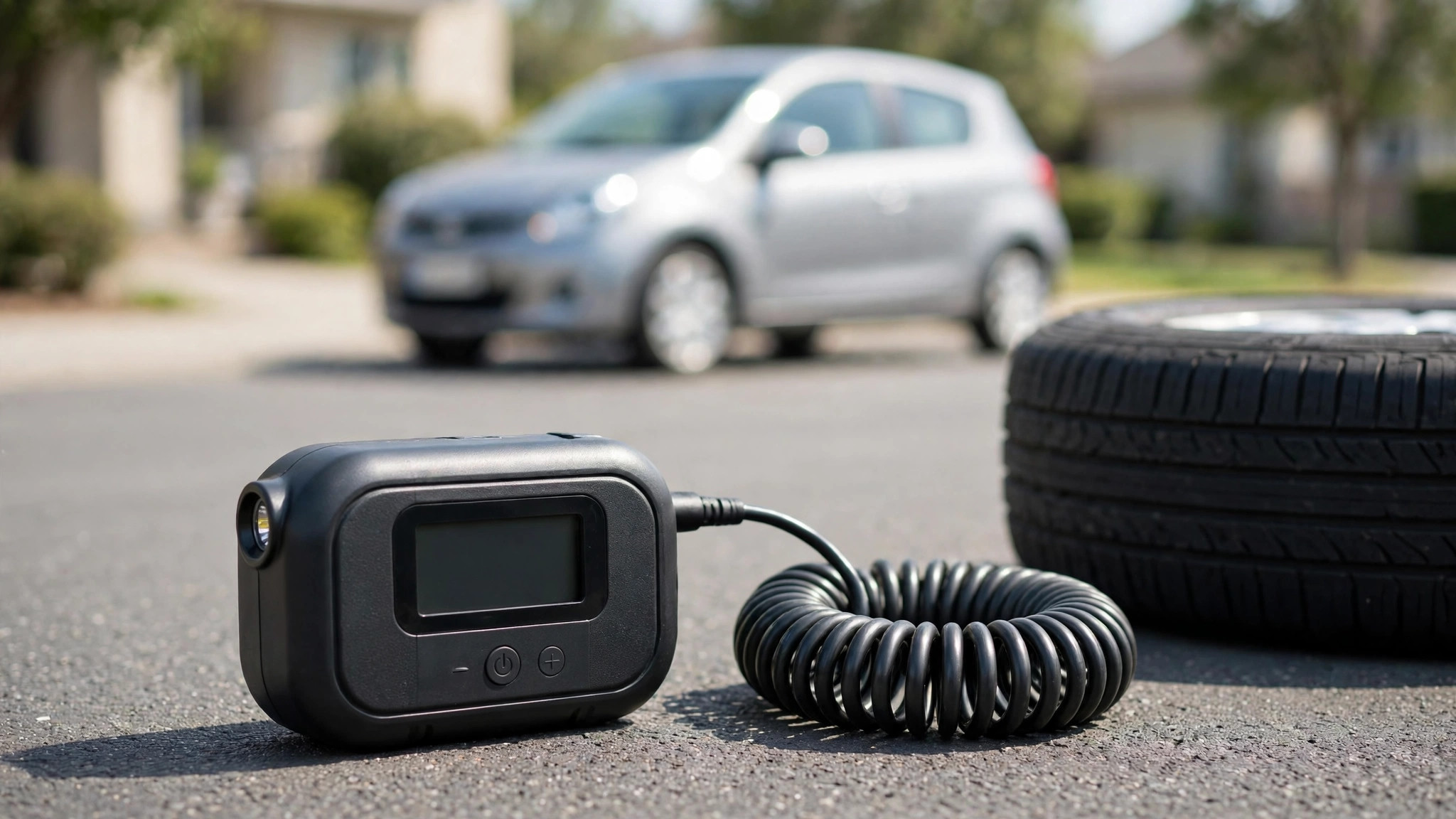
The tire pressure light pops on mid-drive, or you walk out to a visibly low tire. A portable inflator turns that moment from a stressful wait for roadside help into a five-minute driveway fix. Here are the three best beginner-friendly tire inflators for 2026 — proven, well-reviewed, and cheap enough for any first car owner's trunk.
Every pick below runs off your car, needs no special skill, and costs far less than one tow truck callout. We compare them honestly: strengths, weaknesses, and which driver each one actually fits.
Affiliate disclosure: FirstCarCare is reader-supported. If you buy through the links in this article, we may earn a small commission at no extra cost to you. It never changes which products we recommend — every pick here earned its place on real buyer feedback and honest comparison.
Our Top 3 Tire Inflators for Beginners — 2026
- #1 EPAuto 12V DC Portable Tire Inflator — Best overall for beginners: simple, cheap, auto shut-off.
- #2 AstroAI AIRUN H Tire Inflator — Best value: fast, accurate, great everyday commuter pick.
- #3 VIAIR 88P Portable Air Compressor — Best for SUVs and trucks: the most powerful, built to last.
How to Choose Your First Tire Inflator
A good beginner inflator is not the one with the biggest numbers on the box — it is the one you will actually use without fuss. Five things matter:
1. Power source
Most beginner inflators plug into the 12V cigarette-lighter socket — simple and always ready. The VIAIR 88P is different: it clamps onto the battery terminals, giving it more power but meaning you open the hood. If battery clamps put you off, stick with a socket-powered model.
2. Maximum PSI
Most car tires need 30–35 PSI, so any inflator rated 100 PSI or above has plenty of headroom. Higher max PSI only matters for SUVs and trucks with bigger tires — that is where the VIAIR 88P's 120 PSI earns its keep.
3. Auto shut-off
You set your target pressure, press start, and the inflator stops by itself — no over-inflation, no watching a gauge. Both the EPAuto and the AstroAI have it. The VIAIR 88P does not, so you watch its gauge and switch it off yourself.
4. Cord and hose length
A short cord means dragging the inflator around the car to reach the rear tires. Check cord length before you buy — a longer cord is worth a little extra, especially on a four-door car.
5. Size and storage
Your inflator lives in the trunk, probably beside the spare tire. The EPAuto and AstroAI tuck away easily; the VIAIR 88P is bigger and heavier — the trade-off for its extra power.
#1 EPAuto 12V DC Portable Tire Inflator — Best Overall for Beginners
#1 Pick — Best Overall for Beginners
The EPAuto is the classic first inflator: simple, affordable, and it does exactly what a new driver needs. Plug it into the 12V socket, set your target pressure on the digital display, and it stops automatically. It also has a built-in LED flashlight and handles car, motorcycle and bike tires plus sports balls with the included adapters.
- 100 PSI maximum pressure — plenty for any normal car tire
- Digital gauge with programmable auto shut-off
- Plugs into the 12V cigarette-lighter socket — no battery, no charging
- Built-in LED flashlight and extra nozzle adapters included
Pros: Easiest to use of the three; auto shut-off prevents over-inflation; very affordable; huge base of happy buyers behind it.
Cons: Slower than the AstroAI on a nearly flat tire; can get warm during long inflation sessions, so give it a rest between tires; cigarette-lighter power only, so it cannot help if your car's battery is dead.
Best for: First-time car owners who want the simplest, cheapest reliable inflator in the trunk.
#2 AstroAI AIRUN H Tire Inflator — Best Value
#2 Pick — Best Value
The AstroAI AIRUN H is the pick for commuters who top up their tires regularly. It inflates noticeably faster than the EPAuto, its digital display is bright and easy to read, and its programmable preset with auto shut-off makes the job a one-button task. AstroAI's ToughUltra build is designed for a longer service life, and the unit is compact enough to live permanently in the trunk.
- 100 PSI maximum pressure with fast inflation for its size
- Digital gauge with programmable preset and auto shut-off
- Compact, lightweight design that stores easily
- LED light for low-light roadside use
Pros: Faster inflation than the EPAuto; clear digital display; auto shut-off; excellent value for the price.
Cons: 12V socket power only; not designed for large truck or off-road tires; like all small compressors, it needs a cooling break after extended use.
Best for: Daily commuters who want a quick, accurate top-up tool they will actually use every month.
#3 VIAIR 88P Portable Air Compressor — Best for SUVs and Trucks
#3 Pick — Best for SUVs and Trucks
The VIAIR 88P is the heavyweight here — and the oldest design, with a track record of over 25 years. It connects directly to your car's battery with clamps, giving it the power to inflate larger SUV and truck tires that socket-powered units struggle with. With cooling breaks between tires, owners report units lasting a decade or more.
- 120 PSI maximum pressure — the strongest of the three
- Battery-clamp power: connects straight to the terminals, no socket needed
- Handles large SUV, truck and off-road tires with ease
- Proven durability — a long-standing favourite with truck and off-road drivers
Pros: Most powerful inflator here; works on big tires the others cannot; extremely durable; no reliance on the cigarette-lighter socket.
Cons: No auto shut-off — you must watch the gauge and stop it yourself; louder and heavier than the other two; needs the hood open and the battery clamps attached, which some beginners find fiddly.
Best for: SUV and truck owners, and anyone who drives off-road or tows — where the extra power genuinely matters.
Comparison Table: Which Tire Inflator Should You Buy?
| Inflator | Max PSI | Power | Auto Shut-Off | Best For |
|---|---|---|---|---|
| EPAuto 12V | 100 | 12V socket | Yes | First-time owners, best overall |
| AstroAI AIRUN H | 100 | 12V socket | Yes | Commuters, best value |
| VIAIR 88P | 120 | Battery clamps | No | SUVs, trucks, off-road |
The short version: normal hatchback or sedan and want the easiest tool? Buy the EPAuto. Top up often and want the fastest, best-value option? Buy the AstroAI. Drive an SUV or truck? The VIAIR 88P is the only one built for big tires.
How to Use a Tire Inflator: 5 Simple Steps
- Find your correct pressure. Use the sticker on the driver's door jamb — not the tire sidewall number, which is the maximum, not the recommended pressure. Most cars need 30–35 PSI. Our guide to how often to check tire pressure explains why the monthly check matters.
- Start the engine. Run the car while the inflator is plugged in so you do not drain the battery.
- Remove the valve cap and attach the hose. Push the connector onto the tire valve and lock it. If you hear hissing, reseat it.
- Set your target pressure and start. On the EPAuto and AstroAI, dial in your PSI and let auto shut-off do the work. On the VIAIR 88P, watch the gauge and switch it off at your target.
- Check and replace the cap. A quick re-check with the gauge confirms the pressure. Screw the valve cap back on — it keeps dirt out of the valve.
5 Mistakes Beginners Make With Tire Inflators
- Inflating to the sidewall number. The tire sidewall shows the maximum safe pressure, not your car's recommended pressure. Always use the door jamb sticker.
- Ignoring the tire pressure light. If the light keeps coming on, read our guide on why the tire pressure light keeps coming on — a slow leak needs a mechanic, not just more air.
- Skipping the engine. Running a 12V inflator with the engine off can drain a weak battery fast. Start the car first.
- Overheating the inflator. Small compressors are not built for continuous use. Inflate one tire, let it cool briefly, then do the next.
- Using an inflator as a flat-tire fix. An inflator tops up a slow leak. A punctured or fully flat tire needs the spare — our EPAuto spotlight explains what an inflator can and cannot do.
Verdict
For most first-time car owners, the EPAuto 12V is the right first inflator: simple, affordable, and its auto shut-off removes the one thing beginners worry about — over-inflating. If you check your tires often and want the job done faster, the AstroAI AIRUN H is the better value. And if you drive an SUV or truck, get the VIAIR 88P — it is the only one of the three with the muscle for big tires. Whichever you choose, keep it in the trunk, check your pressures monthly, and add it to your monthly car maintenance checklist — properly inflated tires are one of the cheapest ways to stay safe and save fuel. For a broader comparison, see The Motor Guy's 2026 roundup and ProtGuide's digital inflator comparison.