Why Every Beginner Needs a Tire Inflator in the Trunk
Picture this: a cold morning, you are already late, and the tire pressure light pops on. The tire is not flat — it has just lost a few PSI overnight because cold air contracts. The nearest gas station air pump is broken, busy, or costs money every time. A small 12V tire inflator in your trunk turns that into a five-minute job at home.
That is exactly what the EPAuto 12V tire inflator is for. It is small, cheap, and simple enough for a first-time car owner to use without any tools or experience. Below: how it works, its real limits, and two strong alternatives.
Disclosure: FirstCarCare is reader-supported. If you buy through the links in this article, we may earn a small commission at no extra cost to you. It never changes which products we recommend — and we only recommend products we would put in our own trunk.
The EPAuto AT-010-2 at a Glance
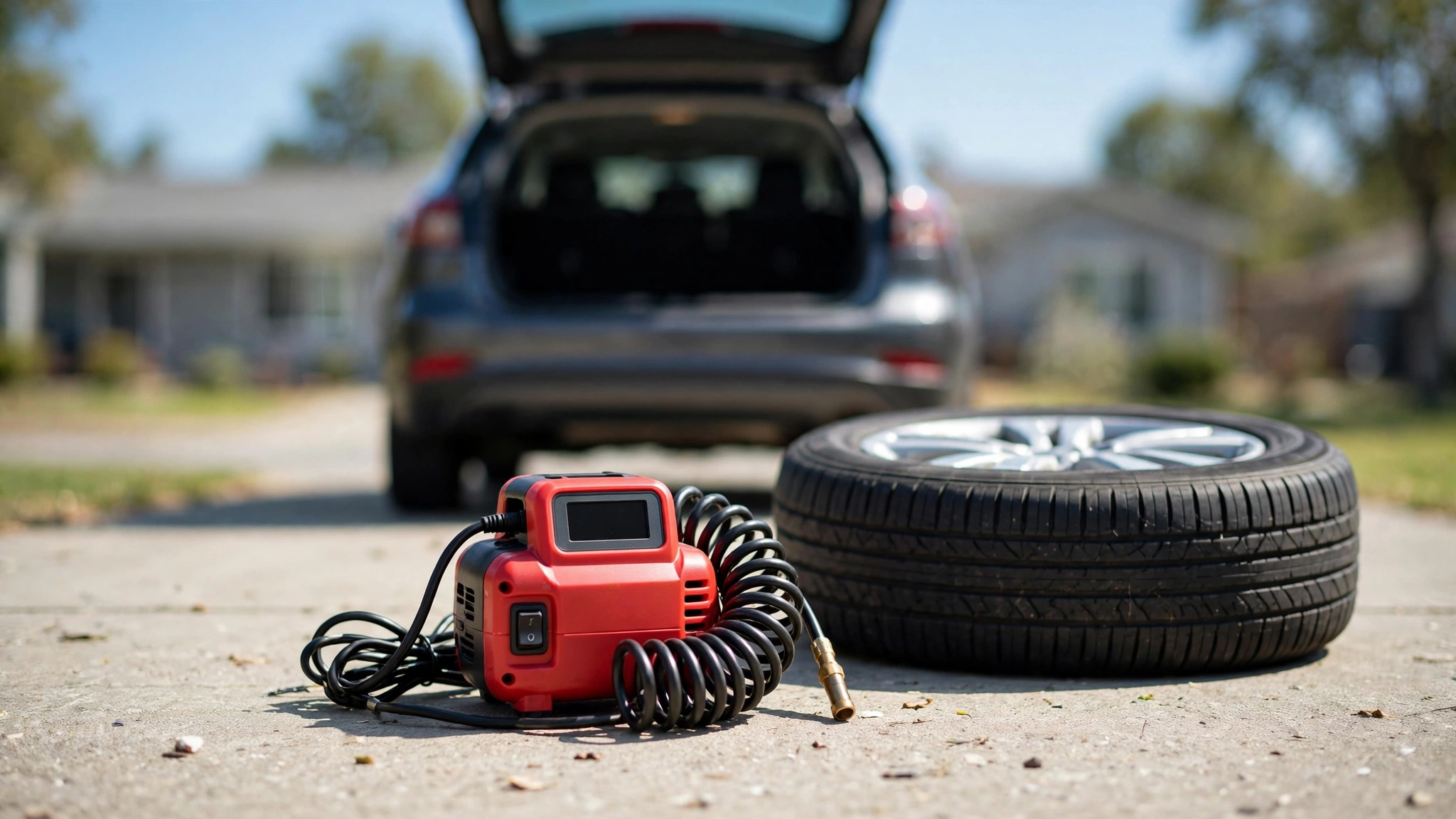
The EPAuto AT-010-2 is a compact 12V DC air compressor that plugs into your car's cigarette lighter socket. It runs on 120 watts, moves air at 1.06 cubic feet per minute, and is rated for a maximum working pressure of 100 PSI — far more than the 30–35 PSI most car tires need. It weighs just over 2 pounds and fits easily in a trunk corner.
The feature that matters most for beginners is the automatic shut-off. Dial in your target pressure on the digital display — in PSI, kPa, bar, or kg/cm² — press start, and the pump stops itself when it gets there. No guessing and no risk of over-inflating a tire. It also has a bright LED flashlight, an overheat protector, and a spare 15-amp fuse in the box.
One honest limit: EPAuto states clearly that this inflator does not support light-truck (LT), heavy-duty, or any truck tires, and it only works on 12V DC — never 24V. It is built for cars, bikes, sedans, and midsize SUVs.
#1 — Best for Beginners
EPAuto 12V DC Portable Air Compressor Pump
- Automatic shut-off at your preset pressure — no over-inflation
- Digital display in PSI, kPa, bar, and kg/cm² with a bright LED flashlight
- 120W motor, 1.06 CFM airflow, rated up to 100 PSI max working pressure
Pros: Dead simple — set it and walk away. Compact and light enough to live in the trunk permanently. The auto shut-off removes the one thing beginners worry about most.
Cons: Not for truck or LT tires. The screw-on air chuck is slower to attach than a clip-on one. It needs the engine running and a working 12V socket, so it cannot help if your battery is dead.
Best for: First-time car owners who want the simplest way to top up tires at home or on the road.
How to Use the EPAuto Inflator in 5 Steps
- Start the engine. The inflator draws up to 15 amps, so run the engine to protect your battery.
- Find your target pressure. It is on the sticker inside your driver's door jamb — not the number on the tire sidewall, which is the tire's maximum, not your car's recommended pressure.
- Attach the chuck and plug in. Screw the air hose onto the valve stem until snug, then plug the power cord into the 12V socket.
- Set the pressure and switch it on. Set your target PSI with the buttons, then flip the power switch. The pump stops automatically when it reaches your number.
- Check and go. Unscrew the chuck, replace the valve cap, and do a quick visual check. If the tire was very low or the tire pressure light keeps coming on, a slow leak may need a mechanic.
What the EPAuto Inflator Cannot Do
This is a top-up tool, not a workshop compressor. A completely flat tire on a large SUV will take a long time, and a tire with a nail in it will just go flat again — an inflator buys you time to reach a tire shop, it does not fix the puncture. It also cannot help with a dead battery, since it needs the car's 12V socket to have power. Pair it with a spare tire, a jack, and the items in our emergency kit every first-time driver should keep. The inflator handles the slow leak; the spare handles the blowout.
Two Strong Alternatives
#2 — Best Value Alternative
AstroAI Tire Inflator Portable Air Compressor (AIRUN H)
- 12V DC power with a long 9.8-foot cord that reaches rear tires easily
- Digital pressure gauge with auto shut-off and backlit display
- 100 PSI max pressure reading, 120W rated power, LED emergency light
Pros: The long cord is genuinely useful on bigger cars — no repositioning to reach the back tires. Huge review base, and the backlit screen is easy to read in bright sun.
Cons: The plug can get warm after filling several tires in a row, so allow cool-down breaks. Like the EPAuto, it needs the engine running and a 12V socket.
Best for: Drivers who want the same beginner-friendly experience with extra cord reach, especially on larger sedans and SUVs.
#3 — Best for Bigger Tires
VIAIR 88P Portable Air Compressor
- 120 PSI max working pressure, 1.47 CFM airflow, handles tires up to 33 inches
- Connects directly to the battery with alligator clamps — no 12V socket needed
- Fills a 225/60/18 tire from 20 to 30 PSI in 50 seconds or less
Pros: The only pick here that genuinely handles truck, SUV, and off-road tires. Battery clamps mean it works even if your 12V socket fuse is blown. Fast and tough, from a compressor specialist.
Cons: No automatic shut-off — you watch the gauge and switch it off yourself. Heavier at 4.75 pounds, and clipping leads to a battery is more fiddly than plugging into a socket.
Best for: Drivers of trucks, large SUVs, or off-road vehicles — and anyone who wants one inflator for the biggest tires in the household.
Quick Comparison
| Inflator | Max PSI | Power | Auto Shut-Off | Best For |
|---|---|---|---|---|
| EPAuto AT-010-2 | 100 | 12V socket | Yes | Beginners, cars & small SUVs |
| AstroAI AIRUN H | 100 | 12V socket | Yes | Extra cord reach, larger cars |
| VIAIR 88P | 120 | Battery clamps | No | Trucks, big SUVs, off-road |
Buying Guide: 5 Things to Check Before You Buy
- Power source. A 12V socket plug is easiest for beginners. Battery clamps give more power and work without a socket, but need you to open the hood and handle the clamps correctly.
- Maximum PSI. Any inflator rated at 100 PSI or more covers normal car tires (30–35 PSI) with room to spare. Only truck and off-road tires need the 120 PSI class.
- Automatic shut-off. If you are new to this, it is the single most valuable feature — it removes the risk of over-inflation.
- Cord and hose reach. A short cord means moving the car to reach the far tires. The AstroAI's 9.8-foot cord and the VIAIR's 16-foot hose solve that.
- Duty cycle. Small inflators need rest between tires. Allow a few minutes of cool-down after each tire, especially in summer.
Verdict: Which One Should You Buy?
For most first-time car owners, the EPAuto AT-010-2 is the right buy. It is the simplest inflator here: plug in, set the pressure, and it stops by itself. It costs less than a few tanks of gas, lives quietly in your trunk, and turns a stressful low-pressure morning into a five-minute fix.
Pick the AstroAI AIRUN H for extra cord length on a larger car, or the VIAIR 88P for a truck or big SUV. Whichever you choose, you will never again depend on a gas station air pump that may or may not work.
Frequently Asked Questions
Can a portable tire inflator fix a flat tire?
It can re-inflate a low or slowly leaking tire so you can drive to a tire shop, but it cannot repair a puncture. If the tire goes flat again quickly, fit the spare and see a mechanic. Our guide on how to change a flat tire walks through the spare-tire process step by step.
How long does it take to inflate a car tire?
For a normal top-up of a few PSI, about 2–4 minutes per tire with a 12V inflator like the EPAuto. A nearly flat tire takes longer, and big truck tires longer still.
Do I need to keep the engine running while using a 12V inflator?
Yes. These inflators draw 10–15 amps, which can drain a car battery fast with the engine off. Start the engine first, then plug in and inflate.
What tire pressure should I set?
Use the pressure on the sticker inside your driver's door jamb, or in your owner's manual — usually 30–35 PSI for most cars. Never use the maximum pressure printed on the tire sidewall; that is the tire's limit, not your car's recommended pressure.
Can I use a tire inflator on a bike or a ball too?
Yes — all three inflators here come with extra nozzles for bikes, sports balls, and small inflatables. Just set a much lower pressure for those, and never use a car-tire pressure on a bicycle tire without checking its own rating.