Your first months behind the wheel are when you most need a witness you can trust. A dash cam does not make you a better driver, but it does one thing no passenger can: it records exactly what happened, without arguing, forgetting, or taking sides. That is why so many new drivers buy one within weeks of getting their first car — and why the ROVE R2-4K Dual keeps showing up at the top of beginner shortlists.
Below: what it actually does, where it falls short, and two solid alternatives if your needs differ.
Affiliate disclosure: This post contains affiliate links. If you buy through them, we may earn a small commission at no extra cost to you. It never affects our recommendations — and we never print exact prices, because they change. Always check the current price on Amazon before buying.
Quick verdict
Buy the ROVE R2-4K Dual if: you want front-and-rear coverage, built-in GPS, fast phone transfers, and a memory card in the box, without paying for a premium brand. Skip it if: you need true 4K on the rear camera too, or you want parking mode with no extra hardware to buy.
What the ROVE R2-4K Dual actually is
The R2-4K Dual is a two-camera system: a front camera that records in 4K (3840 x 2160) and a separate rear camera that records in 1080p, connected by a long cable that runs to your rear windshield. It has a 3-inch screen, built-in GPS that stamps speed and location onto your clips, dual-band Wi-Fi for transferring video to your phone, and a 128 GB microSD card included in the box — something many rivals make you buy separately.
One honest detail beginner guides often skip: independent reviewers note the front sensor captures at 2.5K and upscales to a 4K file. Daytime footage is sharp and plates are usually readable, but it is not a native 4K sensor, and moving plates at night can still blur — no camera in this price range reads every plate, every time.
The main pick
#1 — Best overall for new drivers
ROVE R2-4K Dual Dash Cam
Rating: 4.4/5 · from thousands of verified buyers
- 4K front + 1080p rear recording with built-in GPS
- Sony STARVIS 2 sensor for stronger low-light footage
- Fast 5 GHz Wi-Fi transfers to your phone (up to about 20 MB/s)
- 128 GB microSD card included — ready to use out of the box
Pros: Complete kit with nothing essential missing; fast app downloads; GPS and three parking modes; US-based support that buyers frequently praise.
Cons: Rear camera is 1080p, not 4K; front 4K is upscaled from 2.5K; parking mode needs a separately sold hardwire kit; large 4K files fill cards faster on long trips.
Best for: Daily commuters and new drivers who want front-and-rear evidence without a complicated install.
Why a dash cam helps a new driver specifically
A dash cam helps a new driver in four concrete ways:
- It settles fault disputes. A clip showing who changed lanes or ran the light beats two conflicting memories.
- It speeds up insurance claims. Clear footage, sent the same day, removes a lot of back-and-forth.
- It protects you when parked. With parking mode (and the hardwire kit), an impact while you are away can trigger a locked, saved clip.
- It teaches you. Watching your own driving back — following distances, mirror checks, hesitation at junctions — is one of the fastest ways to improve.
What it will not do: prevent a crash or replace careful driving. Audio and windshield-mount rules also vary by state and country — check your local rules before switching the microphone on.
Before you buy: the beginner checklist
1. Front-only or front-and-rear?
Rear-end shunts are the most common beginner crash, and only a rear camera captures the car behind you. If your budget stretches to a dual system, get one. If it does not, a good front-only camera still beats nothing.
2. Check you are buying the Dual, not the single
ROVE sells both a front-only R2-4K and the R2-4K Dual. They look alike in listings. Before ordering, confirm the listing says Dual, shows a rear camera in the box, and mentions front-and-rear recording.
3. Count the real total cost
The ROVE includes a 128 GB card, which is a genuine saving. But if you want parking mode, add the hardwire kit to your budget — and if you are not comfortable wiring into your fuse box, add a professional install too. A camera you never wire up gives you no parking protection.
4. Think about heat
Dash cams live on hot windshields. The ROVE uses a supercapacitor instead of a lithium battery, which handles heat better — a real plus if you park in direct sun all summer.
5. Plan how you will get the video off
After an incident you want the clip on your phone fast, not trapped on a card you cannot read. The ROVE's 5 GHz Wi-Fi is a real advantage here — but test the app pairing at home, calmly, before you need it in a stressful moment.
Setting it up right: 6 steps
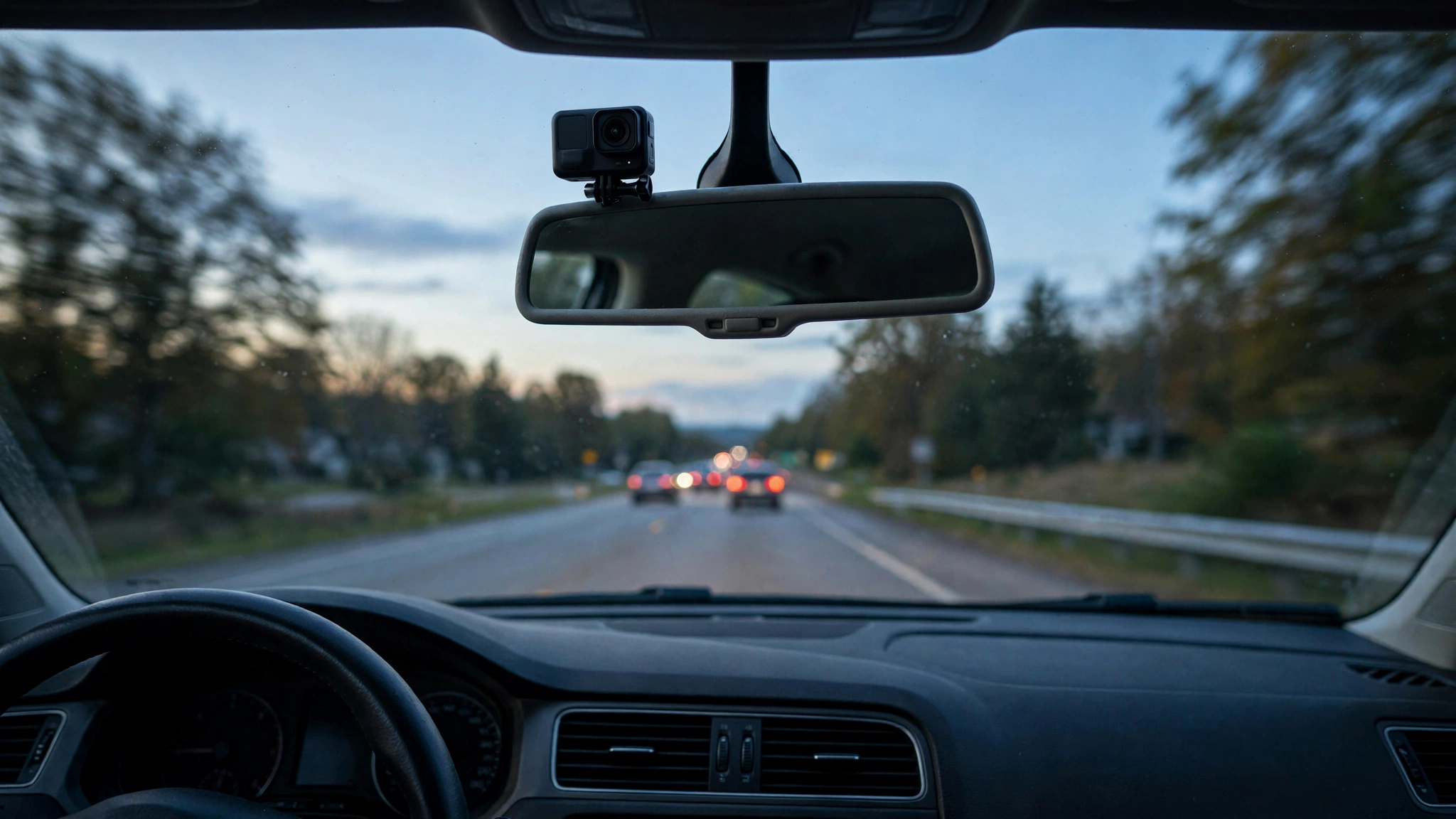
- Mount it high, behind the rearview mirror, where it does not block your view of the road.
- Route the power cable along the headliner and door seals — never dangling across the airbag zone.
- Format the memory card in the camera itself before first use, not on your computer.
- Set the date, time, and GPS on, and check one test clip on your phone.
- Turn loop recording on, so the card overwrites the oldest footage automatically.
- After any incident, lock and download the clip immediately — loop recording will eventually overwrite it.
Two alternatives worth a look
Alternative 1 — Best if you also want the cabin covered
Vantrue N4 3 Channel Dash Cam
Rating: 4.2/5 · from ~9,100 Amazon ratings
- Three channels: front, cabin (infrared night vision), and rear
- 4K front recording with parking monitor modes
- Supercapacitor design for hot and cold weather
Pros: Cabin view is ideal for rideshare drivers or anyone who wants the interior recorded; long track record with thousands of buyers.
Cons: More cameras to install and more cables to route; cabin recording raises privacy questions with passengers — tell people it is recording.
Best for: Rideshare drivers and anyone who wants front, cabin, and rear in one system.
Alternative 2 — Best if you want tiny and discreet
Garmin Dash Cam Mini 2
Rating: 4.2/5 · from verified buyers
- Key-sized, discreet camera that hides behind the mirror
- 1080p recording with a 140-degree wide lens
- Voice control and automatic incident detection
Pros: Almost invisible once fitted; trusted brand with a clean app; voice commands mean fewer button presses while driving.
Cons: Front-only and 1080p — no rear or cabin view, and less detail than the ROVE's front camera; memory card not included, and some connected features need the app and Wi-Fi.
Best for: Drivers who hate clutter and only need a simple front witness.
Comparison at a glance
| Camera | Channels | Front video | Card in box? | Best for |
|---|---|---|---|---|
| ROVE R2-4K Dual | Front + rear | 4K (upscaled) | Yes, 128 GB | New drivers wanting full coverage |
| Vantrue N4 | Front + cabin + rear | 4K | No | Rideshare / cabin coverage |
| Garmin Mini 2 | Front only | 1080p | No | Discreet, simple front camera |
Verdict
For most new drivers, the ROVE R2-4K Dual is the right balance: front-and-rear coverage, GPS, fast transfers, and a card in the box, at a price that leaves room for the hardwire kit if you want parking mode. Its limits are real but clearly stated — a 1080p rear camera and upscaled 4K up front — and neither should put off a beginner who mainly needs reliable evidence. If you drive for rideshare, step up to the three-channel Vantrue N4. If you want the smallest possible camera and only need the front view, the Garmin Mini 2 is the tidy choice.
Whichever you choose, install it properly, test it before you need it, and keep driving as if it were not there — a camera records your driving; it does not excuse it. For what to do if that footage is ever needed, read our guides on what to do after a minor car accident and car insurance basics for first-time owners, keep an emergency kit in the car, and check our heavy-rain driving guide.
Frequently asked questions
Does the ROVE R2-4K Dual record front and rear at the same time?
Yes — both record at the same time, so an incident is covered from both directions.
Is the ROVE R2-4K Dual's 4K real 4K?
Not exactly. Independent reviewers report the front sensor captures at 2.5K and the camera upscales it to a 4K file. Daytime detail is still strong, but buyers should know the distinction before comparing it with native-4K rivals.
Do I need the hardwire kit?
Only for parking mode. Normal driving recording works from the included car charger. Parking mode needs constant power, which means the hardwire kit — and a careful install that does not drain your battery.
How long does the included 128 GB card last?
Loop recording means you never run out of space — the oldest non-locked footage is overwritten automatically. Lock and download any incident clip right away.
Is a dash cam legal?
Generally yes for video in most places, but windshield-mount placement and audio recording rules vary. Check your state or country rules, and tell passengers if the cabin is being recorded.