
Petrol is probably the biggest running cost of your first car. The good news: you do not need a hybrid, a gadget, or years of experience to spend less on fuel. Most of the fuel a car wastes comes down to small, fixable habits — how you accelerate, how fast you cruise, whether your tyres are properly inflated, and how you plan your trips. This guide covers the habits that actually work, so you can start saving petrol on your very next drive.
Why New Drivers Tend to Use More Fuel
New drivers burn more fuel for a few predictable reasons: less smooth driving, hard acceleration away from lights, late braking, and unnecessary speed on the motorway. The simple maintenance habits that protect fuel economy — checking tyre pressure, keeping up with servicing — are also easy to forget when everything about car ownership is still new. European driving tests have found that aggressive driving — frequent rapid acceleration and hard braking — can increase fuel consumption by up to 25 percent compared with smooth driving. That is the single biggest saving available to you, and it costs nothing.
1. Drive Smoothly: Gentle Acceleration, Early Braking
Think of your accelerator pedal as a fuel tap. Every time you press it hard, you open the tap wide. The smoothest, cheapest way to drive is to:
- Accelerate gently. Press the pedal progressively and let the car build speed. Flooring it to reach 50 km/h a second sooner is pure waste.
- Look far ahead. Watch the traffic two or three cars in front, not just the bumper ahead of you. When you see brake lights or a red light in the distance, lift off early and coast toward it.
- Brake early and gently. Hard braking throws away the fuel you just spent getting up to speed. Coasting to a stop uses almost no fuel in a modern fuel-injected car, because the engine cuts fuel delivery when you lift off in gear.
If you find yourself braking hard more than once or twice per trip, you are probably following too closely — back off and leave a bigger gap.
2. Keep a Steady Speed on the Motorway
On open roads, speed is the enemy of economy. Air resistance rises sharply with speed, so cruising faster costs disproportionately more fuel. According to the Energy Agency, driving at 50 mph instead of 70 mph can cut fuel consumption by around 10 percent. Kwik Fit’s fuel economy guide gives the same advice: slow down, accelerate gently, and use momentum. Use cruise control on flat motorways if your car has it: it holds a constant speed far more steadily than a human foot. Skip cruise control on steep hills or slippery roads, where you need full control.
3. Check Your Tyre Pressure Every Month
Under-inflated tyres roll with more resistance, so your engine works harder on every kilometre. They also wear out faster and handle worse. Check pressures at least once a month, when the tyres are cold, using the pressure on the sticker inside your driver-side door jamb — not the maximum number printed on the tyre sidewall. If you are unsure how to do it, our guide on how often to check tyre pressure walks through the whole process.
4. Lighten the Load and Ditch the Roof Rack
Every extra kilogram your engine has to move costs fuel: an extra 50 kg of weight can increase fuel consumption by 1–2 percent. Clear out the things that live in your boot for no reason — old sports gear, bags of books, a toolbox you never use. Roof racks and roof boxes are worse, because they add drag rather than weight. At motorway speeds a roof rack can add around 16 percent more drag, and a roof box as much as 39 percent. If you only use the rack for holidays, take it off between trips.
5. Use Air Conditioning and Windows Smartly
Air conditioning puts an extra load on the engine, so running it flat out all the time costs fuel. At low speeds around town, open a window instead — the drag at 30–40 km/h is tiny. At motorway speeds, do the opposite: close the windows and use the air con, because open windows at 110 km/h create far more drag than the air con costs.
6. Combine Trips and Avoid Short Journeys
A cold engine uses more fuel than a warm one, because it runs richer until it reaches operating temperature. Several short trips with a cold engine in between can use noticeably more fuel than one longer trip covering the same distance. Batch your errands into a single outing instead of making three separate trips, and avoid the worst stop-start traffic when you have a choice of route or departure time.
7. Do Not Idle Longer Than You Need To
Modern engines do not need to warm up by idling on the driveway — that old habit comes from carburettor-era cars. Start the engine, wait a few seconds, and drive away gently; the engine warms up faster under light load than it does sitting still. If you are parked and waiting for more than a minute or so, switching the engine off saves fuel. Many new cars do this automatically with a stop-start system, and AAA testing cited by webuyanycar found stop-start can improve fuel economy by 5–7 percent in city driving.
8. Keep Up With Basic Maintenance
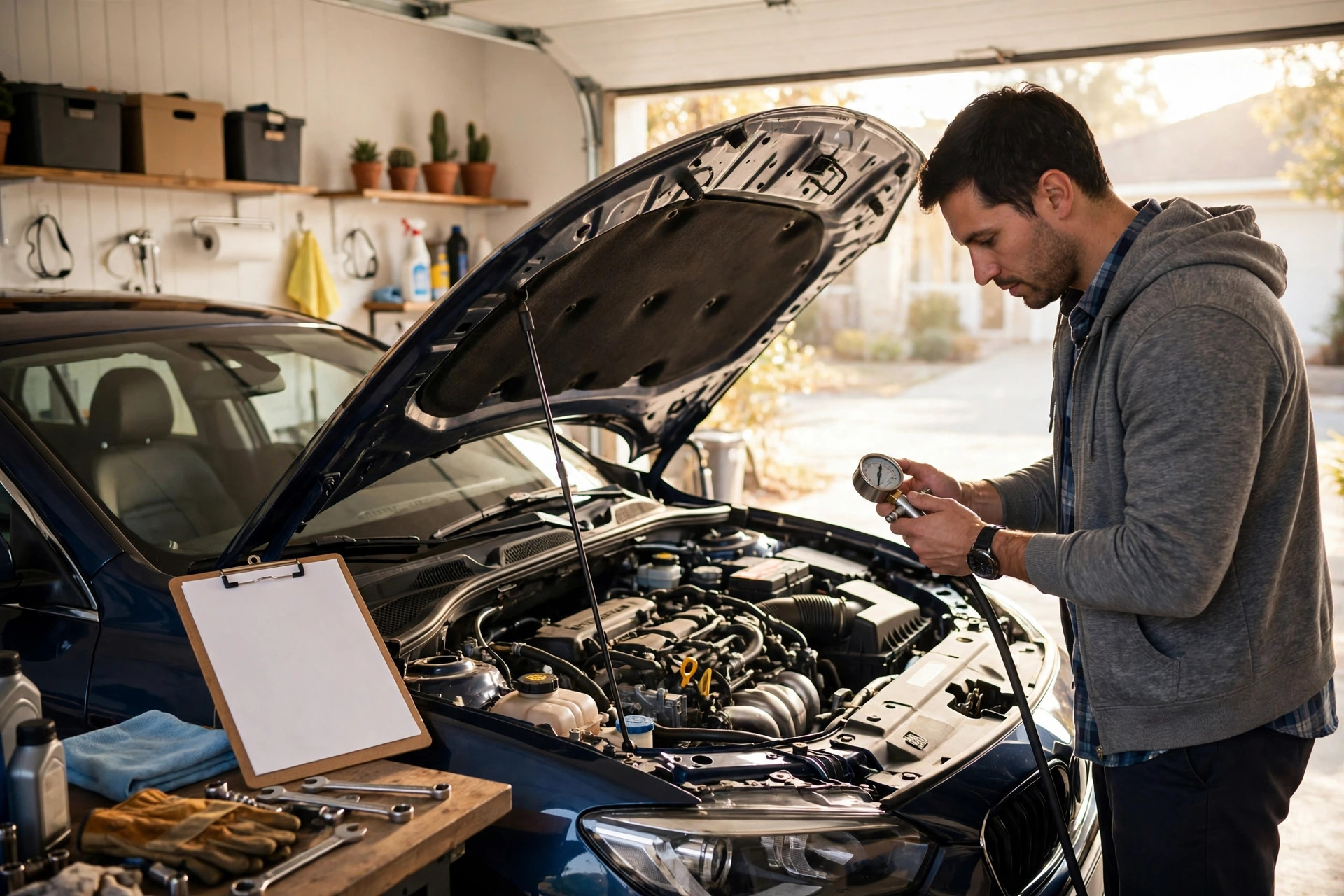
A poorly maintained car can use substantially more fuel than a healthy one. The three items that matter most are engine oil (old, thick oil increases internal friction — follow your service interval, explained in our guide on how often to change engine oil), the air filter (a clogged filter restricts airflow), and spark plugs in petrol cars (worn plugs cause incomplete combustion). Our monthly car maintenance checklist covers these in about ten minutes, and your owner’s manual lists the exact service intervals for your model.
9. If You Drive a Manual, Shift Up Early
In a manual car, high revs mean high fuel use. Get into a higher gear as soon as the car will pull comfortably in it. Shift up around 2,000–2,500 rpm in normal driving, and follow your dashboard gear-shift indicator if you have one — it is calibrated for economy.
Fuel-Saving Myths New Drivers Should Ignore
There is a lot of bad advice about saving fuel. Three claims to ignore: premium fuel saves money — unless your manual specifically requires high-octane fuel, premium petrol does nothing for economy in an ordinary car; coasting in neutral saves fuel — in a modern fuel-injected car the opposite is true, and it is less safe because you lose engine braking; and fuel additives work miracles — there is no credible evidence that aftermarket additives or devices meaningfully improve fuel economy. The habits above do the job for free.
Your First-Week Fuel-Saving Checklist
Do these five things this week and you will see the difference at your next fill-up:
- Check your tyre pressure and set it to the door-jamb figure.
- Empty the boot of anything you do not need this week.
- Take the roof rack off if it is not in use.
- On your next three drives, practise lifting off early and coasting to red lights instead of braking late.
- Note your mileage and litres at your next fill-up, then check again after two weeks of smoother driving.
Frequently Asked Questions
How much fuel can smooth driving really save?
It depends on how aggressively you drive now, but European tests put the difference at up to 25 percent between aggressive and smooth driving. Even a modest change — gentler acceleration and earlier braking — saves a noticeable amount within a few tanks.
Does driving slower always save fuel?
Up to a point. Most cars are most efficient at a steady 50–80 km/h in top gear. Below that, the engine spends more time in lower gears; above it, air resistance dominates. The biggest waste is constantly changing speed.
Is it worth turning the engine off at traffic lights?
If your car has stop-start, let it do the job — it is designed for it. If not, switching off for waits longer than about a minute saves fuel; for a normal 20–30 second red light, it is not worth the extra starter wear and hassle.
Do fuel-saving driving habits make me a slower driver?
No. Smooth driving mostly changes how you reach speed, not the speed you travel at. You still keep up with traffic — you just get there without the hard acceleration and late braking.
Which single change saves the most fuel for a new driver?
Tyre pressure is the easiest win, because under-inflated tyres cost fuel on every single trip and take two minutes to fix. After that, smooth driving — gentle acceleration and looking ahead — is the habit that saves the most over time.
Conclusion
Saving petrol as a new driver is not about buying anything or driving at a crawl. It is a handful of habits: drive smoothly, hold a steady speed, keep your tyres at the right pressure, travel light, combine your trips, and keep up with basic servicing. Each one alone saves a little; together they can cut a meaningful chunk off your monthly fuel bill — and they make you a calmer, safer driver at the same time. Start with the checklist this week: check your tyre pressure, clear the boot, and practise coasting to the next red light instead of rushing toward it.