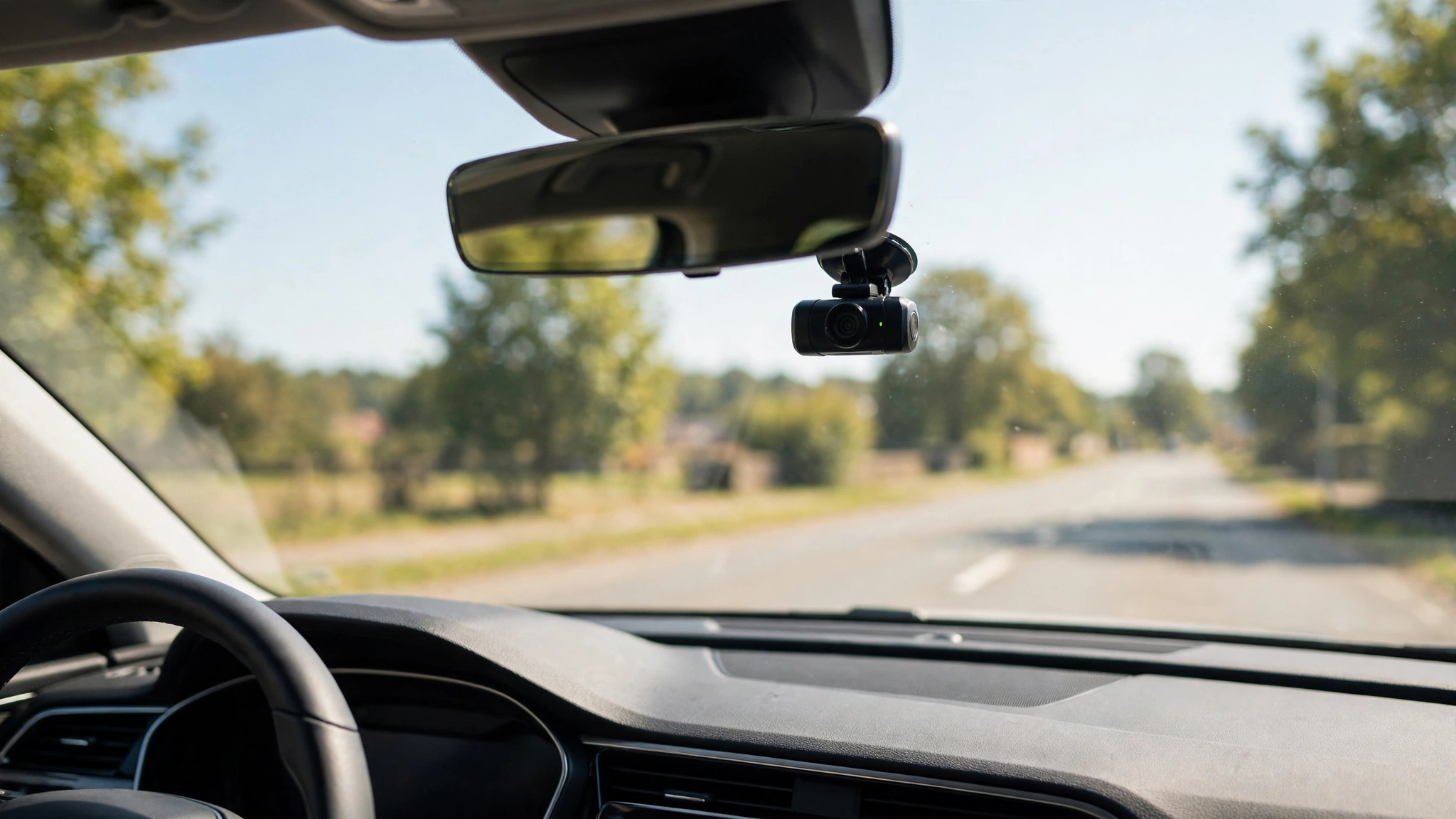
Your first car already asks a lot of you: insurance, fuel, maintenance, parking. A dash cam is the one small purchase that quietly protects you from all the arguments you never saw coming — a fender-bender that was not your fault, a hit-and-run in a parking lot, a disputed insurance claim. The footage does the talking when words fail.
But the dash cam aisle is confusing on purpose. Every box promises 4K, night vision and "AI" something. As a first-time driver you do not need the most expensive camera. You need one that records reliably every time you start the car, saves the clip when something happens, and does not need a degree in electronics to set up. These three picks do exactly that, and each one suits a different kind of new driver.
Our Top 3 Picks at a Glance
- ROVE R2-4K Dual — Best overall for first-time drivers: front + rear coverage, GPS, and a memory card in the box.
- Garmin Dash Cam Mini 2 — Best if you want it invisible: car-key sized, hides behind the mirror, voice control.
- Vantrue N4 — Best for full coverage: front, cabin and rear recording in one unit.
How to Choose Your First Dash Cam
Before comparing models, decide what you actually need. Five things matter for a beginner; everything else is marketing.
1. Coverage: front only, or front and rear?
Most incidents happen in front of you, so a front-only camera covers the most common case. But rear-end collisions are the most common crash type for new drivers, and only a rear camera proves what happened behind you. If your budget allows, front + rear is the safer buy.
2. Video quality that reads plates
Resolution numbers lie. What matters is whether you can read a license plate in daylight and at night. A good 1080p camera with a quality sensor beats a cheap "4K" camera with a poor one. Look for a known sensor name (Sony STARVIS is a good sign) and a wide aperture like f/1.5 or f/1.8, which lets in more light after dark.
3. Parking mode — and what it really needs
Parking mode records bumps and motion while your car is parked. It sounds essential, but on most cameras it needs a separate hardwire kit and a professional install. As a beginner, treat it as a bonus, not a deciding factor — your first camera's job is to record while you drive.
4. Storage included?
Every dash cam needs a microSD card, and a cheap card will corrupt your footage exactly when you need it. A camera that includes a high-endurance card in the box saves you a separate purchase and a common beginner mistake.
5. Power design
Prefer a supercapacitor over a lithium battery. Supercapacitors handle summer heat and winter cold far better, and they last the life of the camera instead of swelling and dying after a year or two.
The 3 Best Dash Cams for First-Time Drivers
#1 — Best Overall
ROVE R2-4K Dual Dash Cam
The ROVE R2-4K Dual is the safest first buy in this roundup because it removes the two things beginners get wrong: it records front and rear, and it ships with a 128GB microSD card already in the box. The front camera uses a Sony STARVIS 2 sensor with an f/1.5 lens, which is why its night footage holds up better than most cameras at this price. Built-in GPS stamps your speed and location onto every clip — exactly the detail an insurance adjuster wants — and the 5GHz Wi-Fi transfers clips to your phone at up to 20MB/s, so pulling evidence after an incident takes seconds.
- Front + rear recording (4K front file, 1080p rear)
- Sony STARVIS 2 sensor with HDR for night driving
- Built-in GPS with speed and route overlay
- Free 128GB microSD card included in the box
Pros: Complete kit — nothing else to buy for a standard install; excellent night video for the price; fast app transfers; supercapacitor design handles heat and cold.
Cons: The "4K" front video is upscaled from a 2.5K sensor, not true native 4K; full 24-hour parking mode needs a separate hardwire kit; the 3-inch screen washes out if you wear polarized sunglasses.
Best for: First-time drivers who want front and rear coverage in one simple purchase, with no extra shopping.
#2 — Most Discreet
Garmin Dash Cam Mini 2
The Garmin Mini 2 is roughly the size of a car key, and that is the whole point. It tucks behind your rearview mirror and disappears — no screen, no bulk, nothing blocking your view. It records crisp 1080p video with a 140-degree field of view, automatically saves footage when it detects an incident, and responds to voice commands ("OK Garmin, save video") so you never take your hands off the wheel. Saved clips upload to Garmin's secure online Vault over Wi-Fi, and the Parking Guard feature can alert you about incidents while the car is parked. If you drive a small car, hate clutter, or simply want a camera you will forget is there, this is the one.
- Car-key sized — hides behind the rearview mirror
- 1080p video with 140-degree field of view
- Voice control and automatic incident detection
- Parking Guard with remote Live View via the Garmin Drive app
Pros: Genuinely invisible install; dead-simple setup; voice control is genuinely useful while driving; trusted Garmin brand with solid app support.
Cons: Front-only 1080p — no rear coverage and weaker plate detail at distance; no screen, so setup and aiming happen through the app; microSD card sold separately; some owners report fiddly app connectivity.
Best for: New drivers who want a set-and-forget camera that stays out of sight and out of mind.
#3 — Best Full Coverage
Vantrue N4 3-Channel Dash Cam
The Vantrue N4 is the only camera here that watches all three directions: the road ahead in 4K, the cabin in 1440p with infrared night vision, and the rear in 1080p. That makes it the pick for new drivers who carry passengers, drive at night, or simply want the most complete record of any incident. The cabin camera with IR is the standout — it records clearly even in a dark car, which matters if you ever drive friends home late or do the occasional delivery run. It runs on a supercapacitor, supports up to 256GB cards, and has a 24-hour parking mode (hardwire kit required). The trade-off is size and simplicity: it is a bigger unit with more wiring than the other two, and there is no Wi-Fi or Bluetooth, so you pull footage off the card or the screen instead of your phone.
- Three channels: 4K front + 1440p cabin + 1080p rear
- Infrared cabin night vision for dark interiors
- Supercapacitor power, up to 256GB card support
- 24-hour parking mode with motion detection
Pros: The most complete coverage of any camera here; IR cabin camera is genuinely useful at night; strong build and reliable loop recording; huge owner base with years of feedback.
Cons: No Wi-Fi or Bluetooth — no phone app transfers; larger unit with more cables to route; the oldest design here (first released 2020); parking mode still needs a hardwire kit.
Best for: New drivers who want every angle covered — especially anyone who drives passengers or parks on the street at night.
Side-by-Side Comparison
| Dash Cam | Coverage | Front Video | Rating | Best For |
|---|---|---|---|---|
| ROVE R2-4K Dual | Front + rear | 4K file (upscaled) | 4.5/5 · ~13,600 ratings | Best overall first buy |
| Garmin Mini 2 | Front only | 1080p | 4.1/5 · ~4,600 ratings | Discreet, set-and-forget |
| Vantrue N4 | Front + cabin + rear | 4K | 4.2/5 · ~9,100 ratings | Full three-way coverage |
Which Dash Cam Should You Buy?
Buy the ROVE R2-4K Dual if you want the best all-round first camera. Front and rear coverage, good night video, GPS, fast transfers and a memory card in the box — it is the only pick here where you truly buy one thing and you are done.
Buy the Garmin Mini 2 if a big camera on your windshield would drive you mad. It is the smallest, simplest option, and its voice control and incident detection cover the essentials. Just remember to add a microSD card and accept that you have no rear view.
Buy the Vantrue N4 if you want maximum evidence. Three angles, an infrared cabin camera and a proven track record make it the most thorough witness of the three — as long as you are happy routing an extra cable and pulling clips off the card.
Whichever you choose, install it properly: mount it high behind the mirror, tuck the cable along the headliner, format the card in the camera before first use, and test it once by reviewing a clip on your phone or computer. A dash cam only protects you if it is actually recording.
Beginner Mistakes to Avoid
- Buying a no-name camera on resolution alone. A cheap "4K" sensor with poor low-light performance records blurry plates at night. A known sensor matters more than a big number.
- Skipping the memory card — or buying the cheapest one. Use a high-endurance card rated for dash cams, and format it in the camera, not on your computer.
- Mounting it where it blocks your view. Behind the rearview mirror, high on the glass, is the legal and sensible spot in most places.
- Never checking the footage. Review one clip in your first week. A loose mount, a dirty lens or a dead card is only useful to discover before an incident, not after one.
- Forgetting the law. Dash cams are legal in most places, but audio recording and filming private property have rules that vary by state and country. Check your local rules — and if you record audio, tell your passengers.
For more first-car essentials, read our ROVE R2-4K guide for new drivers, our step-by-step guide to what to do after a minor accident, and the emergency kit every first-time driver should keep. Before your first long drive, skim your owner's manual — it tells you exactly where your fuse box and 12V outlets are, which makes the install much easier.
Independent roundups worth a second opinion: FinForum's 10 best dash cams for October 2026 and Vehicle Transport Reviews' expert-tested best dash cams of 2026.
Frequently Asked Questions
Do first-time drivers really need a dash cam?
Not legally, but it is one of the cheapest forms of protection you can buy. A single disputed claim can cost far more than the camera, and footage settles "he said, she said" arguments in minutes.
Is a front-only dash cam enough?
For most daily driving, yes — the majority of incidents happen ahead of you. But rear-end collisions are common for new drivers, and only a rear camera proves what happened behind you. If you can stretch to a dual-channel camera like the ROVE, do it.
How much should a beginner spend on a dash cam?
Enough to get a known brand, a quality sensor and a supercapacitor — which is roughly the range these three picks sit in. Ultra-cheap cameras save money up front and cost you footage quality exactly when it matters.
Do dash cams drain the car battery?
While driving, no — they run off the car's power. In parking mode they draw a small current, which is why proper parking mode uses a hardwire kit with low-voltage cut-off. A normal dash cam that only records while driving will not flatten a healthy battery.
Is it legal to use a dash cam?
In most US states and many other countries, yes for video. Rules differ on audio recording and on filming private property, and some jurisdictions restrict where you can mount anything on the windshield. Check your local rules before you install.