
Your first car collects crumbs, dust, sand and pet hair faster than you expect — and a regular home vacuum is too big and clumsy to reach between the seats. A small car vacuum solves that, but walk into the choice blind and you will end up with a weak, short-lived gadget that gathers dust in the garage instead of in your car. This guide walks you through exactly what to check before you buy, in plain language, so you spend once and buy right.
Quick picks — if you just want the short answer
- Best budget starter: THISWORX TWC-01 — plugs into your car, strong suction, tiny price.
- Best all-rounder: BLACK+DECKER Dustbuster CHV1410L — cordless, 4.3/5 from 100,000+ Amazon ratings, works in the house too.
- Best for pet hair: Shark UltraCyclone Pet Pro Plus CH951 — dual brushrolls and a self-cleaning brush for fur-covered seats.
The 3 types of car vacuums — which one fits you?
Every car vacuum falls into one of three families. Pick the family first, then the model — it saves you from comparing apples to oranges.
| Type | Power source | Best for | Watch out for |
|---|---|---|---|
| Cordless handheld | Rechargeable battery | Quick cleanups, flats and apartments with no nearby outlet | 15–30 minutes of runtime; suction fades as the battery drains |
| Corded 12V | Car's 12V outlet (cigarette lighter) | Deep cleans, big cars, unlimited runtime | The cord tangles around seats; you need the car on or the battery drains |
| Wet/dry vac | Mains or battery | Spills, muddy boots, pet owners, garage use too | Bulky to store; overkill if you only need crumb duty |
If you are still torn between the first two, our head-to-head cordless vs corded car vacuums comparison breaks down the trade-offs with real models.
7 things to check before you buy
1. Suction power — read the number, not the adjectives
Suction is measured in Air Watts (AW) or Pascals (Pa), and listings love vague words like "super powerful". Ignore the adjectives and look for the number. For a cordless handheld, aim for at least 80–100 AW or around 12,000 Pa; for corded 12V models, expect more. Anything far below that will move surface dust around without lifting embedded sand or crumbs from carpet. Note that a high peak number means little if the motor loses airflow as the battery drains — consistent airflow beats a big headline figure.
2. Corded or cordless? Match it to where you park
This is the single biggest decision, and it depends on your parking situation, not the vacuum. If you park on the street or in a lot with no power nearby, cordless is the only practical choice. If you have a driveway or garage and want one thorough clean a week, a corded 12V model gives you stronger, never-fading suction for less money. Many beginners end up happiest starting corded — it is cheaper and stronger — and adding a small cordless later for quick jobs.
3. Battery life and charge time (cordless only)
Look for at least 15–20 minutes of realistic runtime — enough to do seats, mats and the boot in one pass. Check the charge time too: some models take 3 hours, others take 8. A lithium-ion battery is a must; older nickel batteries fade fast and lose charge sitting in the glovebox. If the model uses the same battery platform as tools you already own, that is a genuine money-saver — the DEWALT below is the classic example.
4. Dustbin size and emptying
A tiny dustbin means stopping every few minutes to empty it, which gets old fast in a dirty car. For a small hatchback, 0.4–0.6 litres is workable; for an SUV or a pet-hauling car, go bigger or pick a wet/dry model. One-touch or no-touch emptying matters more than it sounds — you do not want to touch a bin full of pet hair and dust with your hands. A clear bin also helps: you can see when it is full before suction drops.
5. Filter — washable beats replaceable
A good filter traps fine dust instead of blowing it back into the cabin air. A washable filter saves you money and hassle — rinse, dry fully, reuse. A HEPA filter is the gold standard for trapping the tiniest particles, which matters if anyone in the car has allergies. The U.S. EPA explains that a true HEPA filter removes at least 99.97% of particles 0.3 microns in size — see the EPA's HEPA filter guide for the full definition. Whatever filter your vacuum has, clean it on schedule: a clogged filter is the number one reason a vacuum "loses suction" after a few months.
6. Attachments — the crevice tool is non-negotiable
A vacuum is only as good as its tools. Before buying, confirm the box includes a long, slim crevice tool — that is what reaches between seats, under pedals and along seat rails. A brush tool helps on upholstery and floor mats, and an extension hose is a gift when reaching under seats. If a model ships with only a wide nozzle, you will be fighting it every time you clean.
7. Weight, size and storage
You will hold this at awkward angles and store it in a small car. Anything under about 3 lb (1.4 kg) is comfortable for a full clean; heavier models tire your wrist fast. Check where it will live — glovebox, boot cubby or a garage shelf — and measure before you buy. A wall mount or charging dock is a bonus that keeps it charged and out of the way.
Beginner-friendly picks worth your money
These six are all in our live catalogue and all suit a first-time buyer for different reasons. Each one links to Amazon, where you can check the current price.
1. THISWORX TWC-01 — Best budget starter
🏆 Best budget pick
- Plugs into your car's 12V outlet — no charging, no dead battery
- 16 ft cord reaches the boot and back seats
- Comes with a crevice tool, brush and extension hose
- Lightweight at under 2 lb
Pros: Cheapest way to get genuinely strong suction; unlimited runtime; everything you need in the box. Cons: The cord needs managing around seats; you need the car on, and a 12V outlet that works.
Best for: First-time buyers on a tight budget who want a proper deep clean, not a toy.
2. BLACK+DECKER Dustbuster CHV1410L — Best all-rounder
🏆 Best all-rounder
- 16V MAX lithium-ion battery, around 15 minutes of runtime
- Rotating slim nozzle reaches tight, awkward spaces
- Pull-out crevice tool and flip-up brush included
- Translucent, washable dirt bowl — easy to empty and clean
Pros: Cordless freedom; works in the house as well as the car; huge owner base means spare filters are easy to find. Cons: Runtime is short for a big SUV; suction is modest on deeply embedded pet hair — check our best car vacuums for beginners roundup for stronger options.
Best for: Apartment dwellers and anyone who wants one small vacuum for car and home quick cleanups.
3. Shark UltraCyclone Pet Pro Plus CH951 — Best for pet hair
🏆 Best for pet hair
- Dual cyclonic airflow keeps suction strong as the bin fills
- Self-cleaning Pet Power Brush lifts embedded fur from upholstery
- Crevice tool for seat gaps and tight corners
- Washable filter, easy-empty dust cup
Pros: The pet brush genuinely works on fabric seats; strong, consistent suction for a cordless. Cons: Heavier and pricier than basic handhelds; battery life is about average.
Best for: Dog owners and anyone whose back seat is permanently furry.
4. BISSELL Pet Hair Eraser 2390A — Best cordless for pet owners
⭐ Pet-owner favourite
- Motorized brush tool and rubber nozzle agitate fabric to lift hair
- Easy-empty dirt bin — no touching the contents
- Lightweight, balanced design for one-handed use
- Works on car seats, sofas and stairs too
Pros: Purpose-built for pet hair, not a generic handheld with a brush added on; comfortable to hold. Cons: Bin is small, so frequent emptying on a very hairy car; battery runtime is modest.
Best for: Pet owners who want a cordless that actually handles fur instead of smearing it.
5. Armor All AA255 — Best wet/dry all-rounder
⭐ Best wet/dry value
- 2.5-gallon tank handles wet spills as well as dry dirt
- Blower function for leaves and garage dust
- Long hose and on-board accessory storage
- Doubles as a garage vacuum
Pros: One machine for car, garage and spills; far more capacity than any handheld. Cons: Bulky to store in a small car; you need mains power or a long extension lead.
Best for: Homeowners with a garage who want one vacuum for car and home, and parents dealing with drink spills. See also our best wet/dry vacuums for car and garage roundup.
6. DEWALT 20V MAX Hand Vacuum DCV517B — Best if you own DEWALT batteries
⭐ Best battery-platform pick
- Runs on any DEWALT 20V MAX battery you already own (bare tool — battery sold separately)
- HEPA-rated filter traps fine dust and allergens
- Crevice tool and brush included; hang hook for storage
- Quiet, well-balanced and built to last
Pros: Zero extra battery cost if you are already in the DEWALT system; excellent build quality and filtration. Cons: Sold as a bare tool, so it is poor value if you own no DEWALT batteries; bin is on the small side.
Best for: DIYers and tradespeople who already own DEWALT 20V tools.
5 mistakes beginners make when buying a car vacuum
- Buying on Pa alone. A huge Pa number with a tiny battery or a clogged filter is useless. Check runtime, bin size and filter type together.
- Ignoring where they park. A corded vacuum is no bargain if you park on the street with no way to run it — match the power source to your parking first.
- Skipping the crevice tool. If it is not in the box, you will pay extra for it later or live with dirty seat gaps.
- Forgetting the filter. Non-washable, hard-to-find filters turn a cheap vacuum into an expensive one within a year.
- Buying too big. A full-size shop vac has great suction, but if it lives in the garage because it will not fit in the car, it cleans nothing.
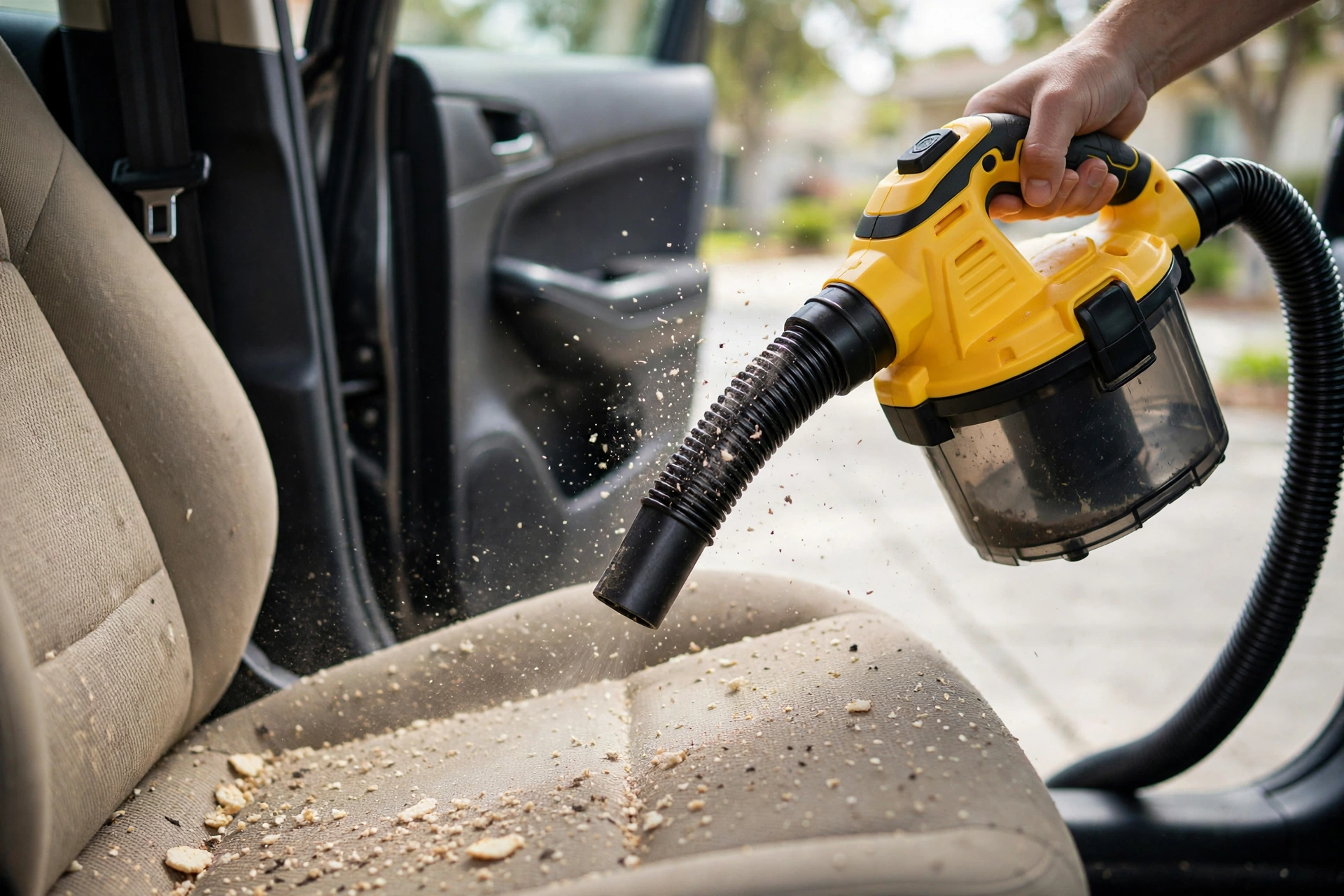
How to vacuum your car properly in 15 minutes
Once your vacuum arrives, use it right — a good tool with a bad routine still leaves a dirty car.
- Remove the mats and shake them out outside the car first — half the dirt is in them.
- Start high, finish low: dashboard and vents, then seats, then footwells, then the boot.
- Use the crevice tool along seat rails, between the seat and centre console, and under the pedals.
- Brush the upholstery first with the brush tool to lift embedded hair and dust, then vacuum it up.
- Empty the bin and tap out the filter after every clean — a full bin halves your suction next time.
Pair the routine with a proper wash and your car will look genuinely cared for — our guide on how to wash your car properly covers the outside in the same beginner-friendly way.
Verdict — what should a beginner actually buy?
Start with your parking situation. Street parking or a flat with no outdoor power? Go cordless — the Dustbuster CHV1410L is the safest first buy, and pet owners should look at the Shark CH951 or BISSELL 2390A instead. Driveway or garage? A corded THISWORX TWC-01 gives you the strongest clean for the least money. And if you want one machine for car, garage and spills, the Armor All AA255 wet/dry is the value pick. Whichever you choose, check the seven points above before you pay — suction, power source, runtime, bin, filter, attachments and size — and you will buy once and buy right.
Frequently asked questions
How much suction power does a car vacuum need?
For a cordless handheld, look for at least 80–100 Air Watts or around 12,000 Pa. Corded 12V models usually deliver more. Below that range, the vacuum will struggle with sand and crumbs embedded in carpet.
Are cordless car vacuums worth it?
Yes, if you park away from power or want quick cleanups — they are the most convenient type. Just accept 15–30 minutes of runtime and weaker suction than a corded model, and pick one with a lithium-ion battery and a washable filter.
Can I use a car vacuum for wet spills?
Only if it is a wet/dry model, like the Armor All AA255. Regular handheld vacuums are dry-only — sucking up liquid can damage the motor and is a safety risk.
How often should I vacuum my car?
Every two weeks is a good baseline for most drivers; weekly if you carry kids or pets. Quick 5-minute touch-ups between deep cleans stop dirt grinding into the carpet.
What is the best car vacuum for a first car?
For most first-time owners, the THISWORX TWC-01 (corded, budget) or the BLACK+DECKER Dustbuster CHV1410L (cordless, all-rounder) are the safest starting points — both are cheap, simple and well reviewed by thousands of buyers.