
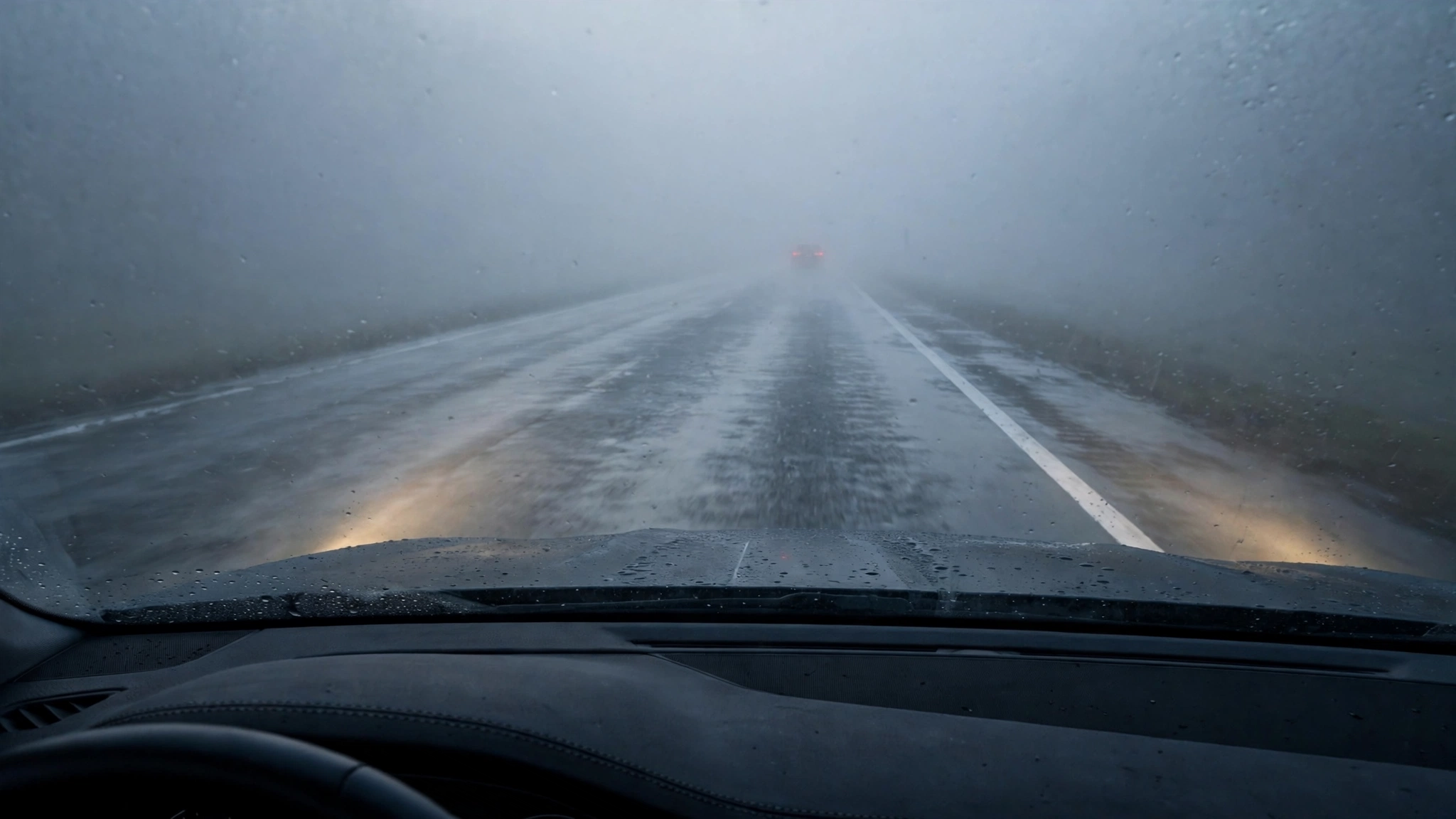
Fog is one of the most frightening conditions a new driver can face. One minute the road ahead is clear, the next you can barely see past your own hood. Fog does not just reduce visibility — it distorts your sense of speed and distance, which is exactly why so many fog crashes happen to drivers who were going "just a little too fast."
The good news: driving in fog is a skill, not a talent. A few simple rules — the right lights, the right speed, the right following distance — will keep you safe in almost any fog. This guide explains each one, the mistakes beginners make most often, and what to do when the fog gets too thick to continue.
Why Fog Is So Dangerous for New Drivers
Fog is made of millions of tiny water droplets suspended in the air. Those droplets scatter light in every direction, which is why your headlights seem to bounce back at you and everything beyond a short distance turns into a grey wall. Three things make fog especially dangerous:
- You cannot judge distance. A car that looks far away may be only a few seconds ahead of you.
- You cannot judge your own speed. With no roadside objects rushing past, 60 km/h can feel like 30 km/h, so drivers unconsciously speed up.
- Stopping distances do not shrink. Fog often comes with damp roads, and your brakes need the same distance to stop as always.
The single most important idea in this guide follows from that last point: never drive faster than the distance you can see. If you cannot stop within the stretch of road visible in front of you, you are going too fast — whatever the speed limit says.
Slow Down to What You Can See
There is no single "safe speed" for fog, because fog thickness changes from one stretch of road to the next. Use your visibility as your speedometer:
- Light fog (you can see 100 metres or more): reduce your speed by about a third below your normal pace.
- Moderate fog (visibility around 50 metres): slow to roughly 40 km/h or less on open roads, less on local streets.
- Thick fog (visibility under 30 metres): crawl at 20–30 km/h, or seriously consider pulling over (see below).
Check your speedometer regularly — fog removes the visual cues your brain uses to sense speed, so the dial is the only honest reading you have. Brake gently, too: sudden braking on a damp, foggy road can cause a skid, and the driver behind you may not see your brake lights in time.
Use Low Beams — Never High Beams
This is the rule most beginners get backwards. When visibility drops, your instinct says "more light must help," so you reach for the high beams. In fog, high beams do the opposite: their strong, upward-angled light reflects off the water droplets and bounces straight back into your eyes, creating a blinding white wall of glare. Your visibility gets worse, not better.
Low beams are the correct choice in fog. They are aimed downward and forward, so they light the road surface without throwing light into the fog bank at eye level. As J.D. Power's fog-driving guide explains, high beams reflecting off fog are one of the first things to fix when visibility drops. The rule is simple:
- High beams: OFF in fog, always.
- Low beams: ON as soon as visibility starts to drop — even in daylight fog, so other drivers can see you.
- Daytime running lights are not enough. They usually do not switch on your tail lights, so drivers behind you may not see you. Turn your headlights on manually.
If your car has automatic headlights, check they have actually switched on — in daylight fog, the sensor may think it is bright enough and leave them off.
Fog Lights: How and When to Use Them
If your car has front fog lights, fog is exactly what they are for. They sit low on the car and throw a wide, flat beam that cuts underneath the main layer of fog, lighting the road edges and lane markings close to the ground. Switch them on together with your low beams when visibility drops.
Some cars also have a rear fog light — a single, very bright red light at the back that helps drivers behind you spot you from further away. Use it in genuinely thick fog, but switch it off as soon as visibility improves: left on in clear conditions, it can dazzle the driver behind you, and in some places using fog lights when visibility is not seriously reduced can even earn you a fine. A common rule of thumb, also noted in Engineer Fix's fog guide: fog lights are for visibility under about 100 metres.
Keep a Much Bigger Following Distance
In dry, clear conditions, the familiar 3-second gap behind the car ahead is a good minimum. In fog, double it — aim for at least 5 seconds, and more in thick fog. Count it out: when the car ahead passes a fixed object (a sign, a tree, a road marking), count "one-thousand-one, one-thousand-two…" until you pass the same object. If you reach it before five seconds, drop back.
Resist the temptation to follow the tail lights ahead of you closely. Many beginners do this because the lights feel like a guide through the fog, but it is a trap: if that driver brakes suddenly or hits something, you will have no time or space to react. The tail lights are not a safe path — they are a warning that another car is close.
Stay in Your Lane: Follow the Right Edge Line
When the road ahead disappears into grey, lane markings become your best friend. Use the white line on the right edge of the road as your guide — it keeps you centred in your lane without drifting toward oncoming traffic. Do not use the centre line instead: it pulls you toward the middle of the road, and toward oncoming vehicles whose drivers are struggling to see just as much as you are.
What NOT to Do in Fog
- Do not use cruise control. It keeps your speed constant and slows your reactions. Switch it off the moment fog appears.
- Do not stop in the middle of the road. The driver behind you may not see you until it is too late. Never stop in a travel lane.
- Do not overtake. You cannot see far enough ahead to judge whether the other lane is clear.
- Do not tailgate the car ahead. Those tail lights are not a guide — they are a hazard warning.
- Do not drive distracted. No phone, no fiddling with the radio. In fog, every second of attention counts.
If the Fog Gets Too Thick: Pull Over Safely
Sometimes the right decision is to stop driving altogether. If visibility drops so low that you cannot see the edge line, or you feel genuinely unsafe, pull over — but do it the right way:
- Find a safe place off the road — a parking lot, a rest area, a petrol station, or a wide lay-by. A motorway hard shoulder is a last resort, not a first choice.
- Signal early and slow down gradually so drivers behind you understand what you are doing.
- Get as far from traffic as you can, then switch on your hazard lights so other drivers can see you.
- Wait it out. Fog often lifts within 30–60 minutes as the sun rises or the wind picks up. Only set off again when you can see clearly.
There is no shame in pulling over. Arriving late is always better than not arriving at all, and experienced drivers do exactly the same thing in thick fog.
Before You Drive Into Fog: A Quick Prep Checklist
- Clean your windshield inside and out. A dirty windshield scatters light and makes glare worse. Run the defroster and wipers to keep the glass clear — foggy, damp air mists windows up fast.
- Check your lights. Make sure headlights, tail lights, and fog lights all work, and wipe dirty lenses clean. If your wipers are old or streaky, replace them — see our guide on how to replace windshield wiper blades.
- Check the forecast. If heavy fog is expected, consider delaying your trip by an hour.
- Keep your defroster ready. If your windshield starts misting up, our guide on how to defog your windshield quickly walks through the fastest fixes.
- Carry an emergency kit. If you do have to pull over and wait, a charged phone, water, a torch, and a warm layer make the wait far more comfortable — see our emergency kit checklist for first-time drivers.
Frequently Asked Questions
Should I use high beams or low beams in fog?
Low beams, always. High beams reflect off the fog droplets and create a blinding white glare. Low beams are aimed downward, so they light the road without that glare. Turn your fog lights on as well if your car has them.
How slow should I drive in fog?
Slow enough to stop within the distance you can see. As a rough guide: around 40 km/h or less when you can see about 50 metres, and 20–30 km/h (or pull over) when visibility falls below 30 metres.
Can I use cruise control in fog?
No. Cruise control keeps your speed fixed and delays your reaction when something appears suddenly. Switch it off and keep your foot ready on the brake. The same advice applies in heavy rain — see our guide on how to drive safely in heavy rain.
Is it safe to follow the tail lights of the car ahead in fog?
No — this is one of the most common beginner mistakes. Following tail lights closely leaves you no stopping distance if that driver brakes or hits something. Keep at least a 5-second gap and follow the right edge line instead.
When should I pull over in fog?
Pull over when you cannot see the road's edge line, when you feel unsafe, or when visibility is so low that you cannot stop within the distance you can see. Find a parking lot, rest area, or petrol station, get well clear of traffic, switch on your hazard lights, and wait for the fog to lift.
Conclusion
Fog driving comes down to three habits: low beams on, speed down, gap up. Slow to a speed that lets you stop within what you can see, keep at least five seconds behind the car ahead, follow the right edge line, and switch the fog lights on when visibility drops under 100 metres. Never use high beams or cruise control in fog, and never be afraid to pull over and wait it out. Fog is at its worst in the early morning and late evening, and it often clears within an hour — so a short delay is usually all it takes.