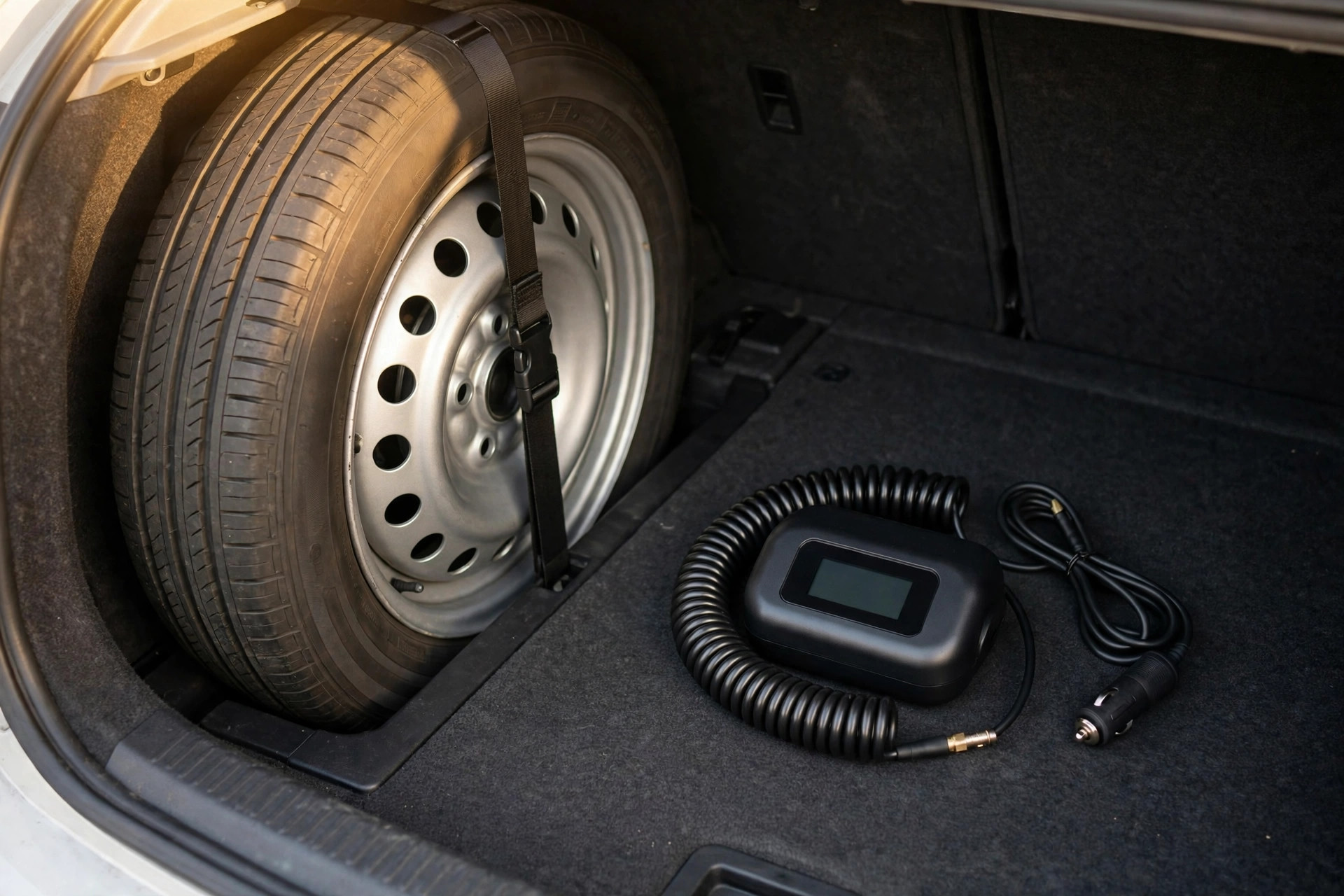
Finding your tires a little low and driving to the gas station just to use their air pump is a hassle most new drivers put up with — until they learn there is a simpler fix. A portable tire inflator is a small compressor that lives in your trunk and fills your tires anywhere: your driveway, a parking lot, or the side of the road. Once you own one, the question isn't whether you need it — it's which type suits your car.
This beginner's guide walks you through exactly what to look for when buying a tire inflator: the power source, pressure rating, speed, duty cycle and the one feature that prevents overinflation. At the end you'll find three proven picks that match each buying profile, so you can buy with confidence.
Why a Tire Inflator Belongs in Every Beginner's Trunk
Tire pressure drops naturally — roughly 1 PSI per month, faster when temperatures swing. Under-inflated tires wear out sooner, hurt fuel economy, and handle worse in rain. Your car's TPMS (tire pressure monitoring system) warns you only when pressure is already quite low. With your own inflator, a quick 5-minute top-up in your driveway solves the problem before it becomes a warning light. If you want the basics of how often to check, read our guide on how often to check tire pressure.
7 Things to Check Before You Buy a Tire Inflator
1. Power source: 12V socket, battery clamps, or cordless
Most beginner-friendly inflators plug into your car's 12V cigarette-lighter socket — simple, no extra gear needed. Heavy-duty models connect directly to the battery with alligator clamps because they draw more current than a socket can safely supply. Cordless (rechargeable) models are convenient but their battery limits how many tires you can fill before recharging. If you only inflate your own car occasionally, a 12V plug-in is the easiest start.
2. Maximum pressure (PSI) and tire size
Check the tire pressure your car needs first (the sticker on the driver's door jamb, usually 32–35 PSI for passenger cars). Your inflator's max rating should comfortably exceed that — look for at least 100 PSI max. If you drive a truck, SUV, or tow a trailer with bigger tires (up to 33 inches), you need a heavy-duty unit rated to 120 PSI.
3. Digital gauge with auto shut-off (the must-have feature)
This is the feature that matters most for beginners. A digital gauge shows the pressure while you work, and auto shut-off stops the pump at your preset PSI — so you can't accidentally overinflate a tire. Models without it force you to watch a needle and pull the trigger at the right moment, which is easy to get wrong.
4. Inflation speed
Speed is measured in CFM (cubic feet per minute) or liters per minute. A standard 12V inflator (around 1 CFM) tops up a car tire in about 3–5 minutes — fine for maintenance. Heavy-duty units push more air and work faster on large tires. Don't expect any portable inflator to match a gas station compressor; it trades speed for convenience.
5. Duty cycle (rest time)
Small motors heat up, so most budget inflators have a duty cycle — for example, 10 minutes of work then a cool-down rest. Inflating four tires back-to-back on a hot day can trigger a thermal cut-off. Let the unit rest between tires; it's normal, not a fault.
6. Cord and hose length
The 12V cord should reach from your front socket to your rear tires, and the air hose should let you hold the inflator at a comfortable angle. Short hoses force you to balance the unit on the wheel — awkward on the roadside. Battery-clamp models place the unit right next to the tire, so this matters less.
7. Useful extras
An LED work light is genuinely useful for nighttime emergencies. Nozzle adapters for bike tires, sports balls and air mattresses turn the inflator into a household tool. A carry bag keeps the hose and cord tidy in your trunk.
Which Type Matches Your Driving?
| You are… | Best match | Example pick below |
|---|---|---|
| A new driver who wants the simplest possible tool | 12V plug-in with auto shut-off and digital gauge | EPAuto |
| A driver who wants the best-rated value unit | 12V plug-in, faster fill, auto shut-off | AstroAI AIRUN H |
| You drive a truck, SUV or large family car | Heavy-duty, battery-clamp, 120 PSI | VIAIR 88P |
Our 3 Recommended Tire Inflators
Pick #1 — Best for absolute beginners
EPAuto 12V DC Portable Air Compressor
- Plugs straight into your car's 12V socket — no battery, no charging, always ready
- Digital gauge with auto shut-off: set your PSI and it stops on its own
- 120W motor, ~1.06 CFM airflow — tops up a car tire in a few minutes
- Built-in LED flashlight for nighttime roadside use; includes extra nozzles for bikes and sports balls
Pros: dead simple to use; hugely popular with verified buyers (AutoGuide's EPAuto 12V review confirms the simple setup); compact enough for any trunk.
Cons: not for truck or LT tires; has a duty cycle — let it rest between tires; needs the engine running so you don't drain the battery.
Best for: first-time car owners who want the simplest, cheapest way to handle low tires.
Pick #2 — Best value, best-rated
AstroAI AIRUN H Tire Inflator
- Same beginner-friendly 12V plug-in design, with digital gauge and auto shut-off
- One of the fastest fillers among socket-powered inflators — less waiting per tire
- ToughUltra build with heat-sink design for more consistent performance
- Includes multiple nozzle adapters for bikes, balls and inflatables
Pros: enormous track record of positive buyer ratings; quick inflation; solid auto shut-off accuracy.
Cons: still a small compressor — not ideal for large truck tires; gets warm during long sessions, so respect the rest cycle.
Best for: buyers who want the most proven, best-reviewed value unit.
Pick #3 — Best for trucks, SUVs and big tires
VIAIR 88P Portable Air Compressor
- 120 PSI max pressure — handles tires up to 33 inches on trucks and SUVs
- Connects straight to your battery with alligator clamps for full power
- 1.47 CFM airflow — noticeably faster than socket-powered inflators
- Long-standing reputation among off-road and truck owners for durability
Pros: the go-to when a basic inflator isn't strong enough; robust build; generous hose length.
Cons: no auto shut-off — you watch the gauge yourself; engine must be running; heavier and bulkier than the beginner picks.
Best for: drivers of larger vehicles or anyone who tows and needs serious airflow.
How to Use a Tire Inflator Safely (5 Steps)
- Check the correct PSI on the driver's door-jamb sticker (not the number on the tire sidewall — that's the max, not the target).
- Start the engine (for 12V and clamp models) so the alternator supplies power instead of draining your battery.
- Attach the hose to the valve stem snugly and preset your target pressure on the gauge.
- Inflate — let auto shut-off do its job, or stop at the target on a manual gauge.
- Re-check each tire with a handheld gauge when you're done, and screw the valve caps back on.
See our full best tire inflators roundup if you'd like a straight product comparison, learn what to do when the tire pressure light comes on, and compare notes with ForCarTech's complete tire inflator buying guide for a second expert opinion.
The Verdict
For most beginners, the decision is simple: pick a 12V plug-in with a digital gauge and auto shut-off. That single feature eliminates the biggest beginner mistake — overinflation — and the 12V plug means the tool is always ready in your trunk. The EPAuto is the simplest starting point, the AstroAI is the best-reviewed value choice, and the VIAIR 88P is there when your vehicle (or your ambitions) outgrow a basic unit. Whichever you choose, pair it with the habit of checking pressure monthly — see our tire pressure check guide to build the routine.
FAQs
Can a 12V tire inflator drain my car battery?
Only if you run it with the engine off. These compressors draw several amps, so always start the engine first — the alternator keeps the battery topped up while you work.
What PSI should I inflate my tires to?
Use the number on the driver's door-jamb sticker (typically 32–35 PSI for passenger cars). Ignore the max pressure printed on the tire sidewall — that's a safety limit, not the target.
Can a portable inflator fix a flat tire?
It can re-inflate a slow leak enough to drive to a shop, but it cannot seal a puncture or repair sidewall damage. If the tire is fully flat or visibly damaged, fit the spare and get it repaired professionally.
How long can a tire inflator run continuously?
Most small inflators are designed for about 10 minutes of continuous use, then a cool-down rest. Inflate one or two tires, let it rest, then continue. If it shuts off mid-job, that's the thermal protection — wait before restarting.
Are gas station air pumps better than a portable inflator?
Gas station pumps are faster, but their gauges are often unreliable and you're stuck driving on low tires to reach one. A portable inflator trades a few minutes of speed for accuracy and convenience at home.