
You're cruising along at 60 or 70 mph, everything feels normal — and then the steering wheel starts to tremble in your hands, or the whole car buzzes through the seat and floor. It is unsettling, especially the first time it happens, and the obvious question is: is this dangerous, and what do I do about it?
The reassuring news is that a shake at highway speed is usually caused by something simple, and the most common culprit is a wheel that needs balancing. The catch is that several different faults can feel almost identical from the driver's seat, and a few of them should not be ignored. This guide will help you work out what your car is telling you, what you can safely check yourself, and what to say to a mechanic so the problem gets found fast.
First, Notice Exactly When and Where You Feel It
Take a mental note of three things the next time the shake happens. These three details narrow the cause down more than anything else, and a good mechanic will ask you for them first.
- Where do you feel it? A shake in the steering wheel usually points to the front wheels. A shake through the seat or the floor usually points to the rear wheels or the drivetrain.
- At what speed does it start? A vibration that appears in a specific speed range — often somewhere between 55 and 75 mph — and fades above or below it is a classic sign of a tire or wheel balance problem.
- Does it change when you brake or accelerate? If it appears or gets worse only when you press the brake pedal, that is a different problem (usually the brakes). If it gets worse when you accelerate and eases when you coast, the drivetrain is the more likely suspect. If it stays the same, it is almost certainly the tires and wheels.
Write these three observations down before you visit a shop. They turn a vague complaint ("my car shakes") into a useful diagnosis.
The 6 Most Common Causes
1. Wheel Imbalance (the Most Common Cause)
A tire and wheel need small weights on the rim so the assembly spins evenly. A weight can fall off after a curb strike or a car wash, or the balance can drift as the tire wears. Even a tiny imbalance creates a rhythmic wobble that gets stronger with speed — which is why you feel it on the highway and not around town. The fix: a wheel balance at a tire shop, where the wheel is spun on a machine and weights are added or moved. It is quick, inexpensive, and it solves the majority of highway shakes.
2. A Bent Wheel or Damaged Tire
Potholes bend aluminum wheels far more easily than most drivers expect, and the bend is often on the inner lip where you cannot see it without removing the wheel. A bent wheel will not roll smoothly, so it produces a rhythmic pulsing at speed — much like a balance problem, except balancing does not cure it. The same goes for a damaged tire: if the steel belt inside breaks or separates, or the sidewall develops a bulge, the tire rolls unevenly. The fix: a bent wheel can sometimes be repaired, but a damaged tire is replaced, never repaired. A visible bulge in the sidewall is a safety issue — do not drive at highway speed on it.
3. Uneven Tire Wear and Cupping
When tires wear unevenly — for example, in a scalloped pattern called cupping — the tread no longer meets the road evenly, and that creates vibration. Cupping is often caused by worn shock absorbers or struts that let the tire bounce lightly as it rolls, and once it starts, it feeds on itself. The fix: the worn suspension part needs attention first, otherwise a new tire will just wear the same way again. A shop can read the wear pattern on your tires and tell you what caused it.
4. Worn Wheel Bearings, Steering or Suspension Parts
A wheel bearing lets your wheel spin freely on its hub; ball joints, tie rod ends and bushings keep the tire steady on the road. When any of them wears out, the tire is free to move more than it should, and at highway speed that looseness shows up as vibration — a constant shake with a humming or growling sound for a bearing, or looseness, clunks over bumps and wandering steering for worn joints. The fix: a mechanic inspects the front end for play and replaces the worn part. Do not put this one off: worn steering parts affect your ability to control the car, and a badly worn bearing can overheat and seize.
5. Driveshaft or CV Joint Problems
On front-wheel-drive cars, the inner CV joints transfer power to the wheels; on rear-wheel-drive cars, a driveshaft does the job. If one of these wears out, the vibration is tied to engine load rather than road speed: the shake is clearly worse when you press the accelerator and eases off when you lift your foot. You may also hear a clicking noise when turning at low speed, a classic CV joint symptom. The fix: inspection and replacement of the worn joint or shaft — a shop job.
A Note on Brakes: A Different Shake
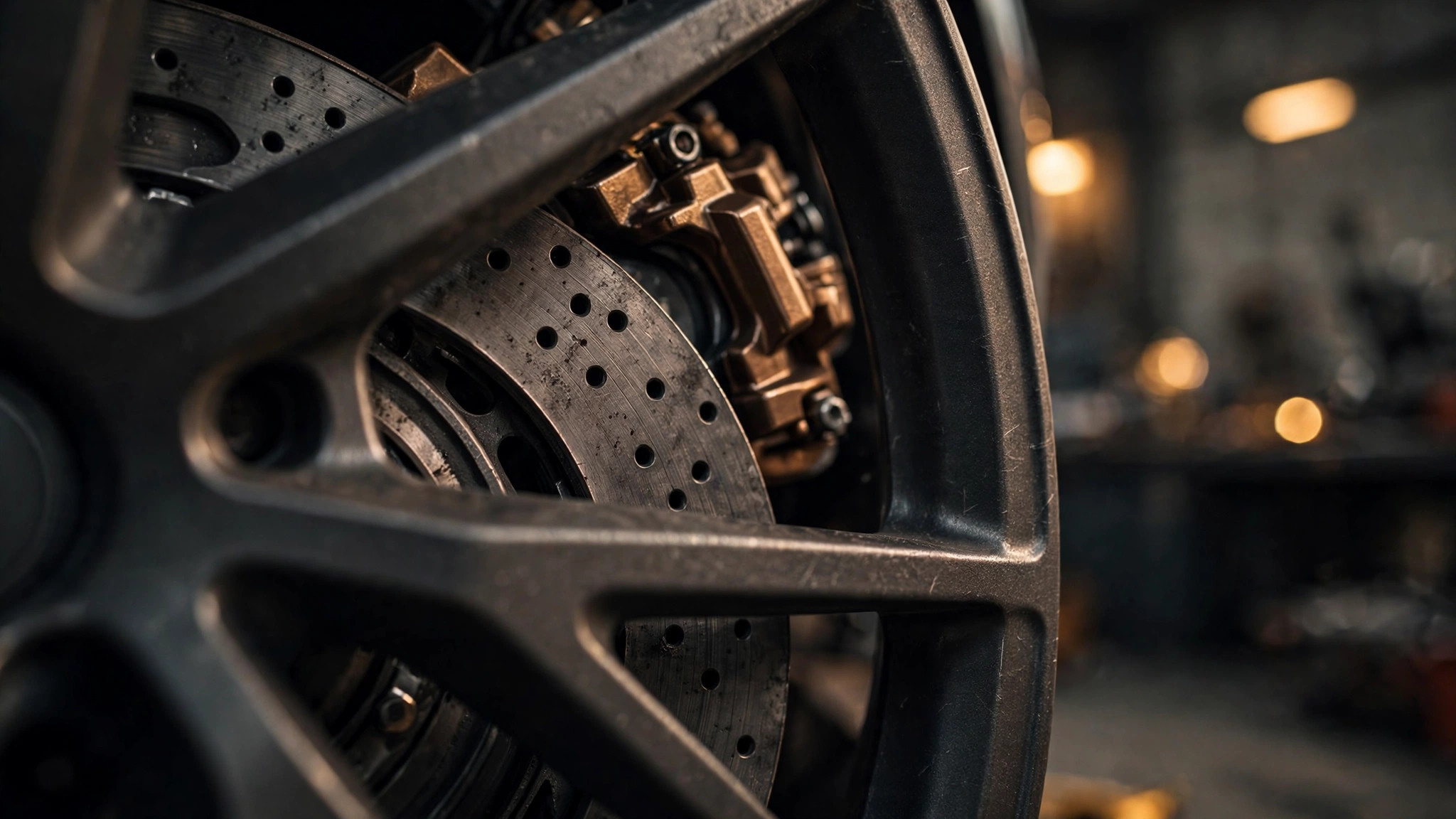
If the shake only appears — or gets much worse — when you brake, the usual suspect is a warped brake rotor. This feels like a pulsing in the brake pedal and sometimes in the steering wheel, but only while braking. It is a different problem from a tire shake that is present while cruising, and it needs a brake inspection. If you are unsure which one you have, our guide on how to tell when your brake pads need replacing explains the warning signs to look for.
What You Can Safely Check Yourself
You do not need tools or mechanical skill for these checks. Do them with the car parked on flat ground, engine off.
- Check your tire pressures. A tire far below its recommended pressure can vibrate and will wear unevenly. Use the pressure on the sticker inside the driver's door jamb, not the number on the tire itself. Our guide on how often to check your tire pressure explains the routine.
- Look at every tire closely. Check for bulges on the sidewalls, cracks, nails or screws in the tread, and patches of uneven wear. Run your hand lightly over the tread and feel for high and low spots.
- Think back to recent impacts. Did the shake start right after a pothole, a curb, or road debris? After new tires were fitted, or after the car sat unused for weeks? Note the answer — it matters.
- Notice the speed and the feeling. Where you feel it, at what speed it starts, and whether braking or accelerating changes it. Jot it down on your phone before you forget.
What you should not do is jack the car up and start pulling at wheels or loosening anything yourself. Checking for play in a wheel bearing or a ball joint is a job for a lift and a trained eye — and getting it wrong can be dangerous.
When to Slow Down and See a Mechanic Right Away
Most highway shakes can wait a day or two for an appointment, but slow down, avoid highway speed, and get the car checked promptly if any of these apply: the shake started suddenly and is strong or getting worse quickly; the steering wheel pulls hard to one side, or the car wanders and is hard to keep straight; you can see a bulge on a tire sidewall, or a tire is losing pressure; the shake comes with grinding, loud humming, or a clunking noise; or the vibration is violent enough that you cannot hold the wheel steady.
If the car feels unsafe to drive, do not try to push through it at highway speed. Slow down, pull over somewhere safe, and call for help. A shake that is getting worse while you drive is your car telling you to stop.
What a Fix Usually Costs
Prices vary by shop, region and car, so treat these as rough guideposts, not quotes. A standard wheel balance typically runs around $15–$50 per tire, and a road-force balance — a more thorough version that can spot tire defects a normal balance misses — runs roughly $20–$30 per wheel. Those two fixes cover the majority of highway shakes. A bent wheel, a replacement tire, a wheel bearing or a suspension part costs more, and the range is wide depending on the car and the part. Always ask for a written estimate before approving any work, and ask the shop to show you the worn part or the wear pattern they found. If you are still building a relationship with a garage, our guide on how to find a trustworthy mechanic explains how to test a shop with a small job first. When you go in, tell the mechanic the speed the shake starts at, where you feel it, and whether braking or accelerating changes it — those three facts point straight to the right test. For a deeper look at how balancing and alignment differ, see our guide on wheel alignment vs balancing.
Frequently Asked Questions
Is it safe to drive if my car shakes at highway speed?
A mild, steady shake is usually a balance issue and is not an emergency, but do not ignore it for weeks — it wears your tires unevenly and can hide a developing fault. Slow down, avoid long highway trips until it is checked, and book a shop visit promptly. If the shake is violent, sudden, or comes with pulling, grinding or a visible tire bulge, do not drive at highway speed at all.
Why does my car only shake between 60 and 70 mph?
Because the vibration is tied to how fast the wheel spins. At a certain rotational speed the imbalance hits a resonance with the suspension, and the shake becomes noticeable. Above or below that speed range the effect fades. That speed-specific pattern is the single best clue that the problem is a wheel or tire issue.
Can low tire pressure cause shaking at high speed?
Yes. Check your pressures first — it is free, takes two minutes, and rules out the simplest cause. If the pressures are correct and the shake remains, the next step is a wheel balance.
Will an alignment fix a highway shake?
Usually not on its own. Alignment sets the angles of the wheels; balancing sets the evenness of their spin. A bad alignment causes pulling and uneven wear, and that wear can eventually cause a shake — but the shake itself is fixed by balancing or by replacing the worn tire. If a shop recommends an alignment, ask them to show you the uneven wear that justifies it.
How much does it cost to fix a car that shakes at highway speed?
Most cases are solved by a wheel balance, roughly $15–$50 per tire, or a road-force balance at roughly $20–$30 per wheel. A bent wheel, a damaged tire, a wheel bearing or a suspension part costs more and varies widely by car — get a written estimate before approving the work.
Conclusion
A car that shakes at highway speed is almost always trying to tell you something specific — and once you know how to read it, the message is surprisingly clear. Where you feel the shake, the speed it starts at, and whether braking or accelerating changes it will point you to the cause in most cases. In the majority of cars, the answer is a wheel balance: quick, cheap, and done in under an hour. But if the shake is violent, sudden, or comes with strange noises or pulling, slow down and get it checked without delay. Your tires are the only thing between your car and the road — when they start talking, it pays to listen.
Further reading: MotorLogic — Car Shakes at High Speed: Causes, Diagnosis and Repair Cost and Apkappe — Why Does My Car Shake at Highway Speed?