



If you have just started paying attention to car maintenance, you have probably heard the phrases "wheel alignment" and "tire balancing" tossed around as if they were the same thing. Shops often mention them together, and both relate to your wheels — but they fix completely different problems. Getting them mixed up means you might pay for the wrong service and still drive home with the original issue.
This beginner's guide explains, in plain language, what each service does, how to tell which one your car needs, how often they should be done, and what happens if you ignore them.
Wheel Alignment vs Balancing: The Short Answer
Here is the simplest way to remember it:
- Tire balancing is about weight. It evens out the weight around each wheel so it spins smoothly without shaking.
- Wheel alignment is about angles. It adjusts the angles of your wheels (camber, caster, and toe) so they point straight and sit correctly on the road.
A wheel can be perfectly balanced and still misaligned, and a wheel can be perfectly aligned and still badly out of balance. They are independent issues that just happen to cause overlapping symptoms — which is exactly why drivers confuse them.
What Is Tire Balancing?
Even brand-new tires are not perfectly uniform. Tiny variations in rubber density and slight differences in the wheel itself create "heavy spots." When the wheel spins at speed, those heavy spots cause the wheel to wobble — and you feel that as vibration.
During a balancing service, a technician removes each wheel and mounts it on a spinning balancing machine. The machine pinpoints exactly where the heavy and light spots are, and the technician attaches small metal weights to the rim to counteract them. The result is a wheel that spins evenly.
Balancing is usually done when new tires are mounted, whenever a tire is repaired or remounted, and whenever vibration shows up. Many shops also check balance when they rotate your tires. It is a quick job — typically 15 to 45 minutes for all four wheels.
What Is Wheel Alignment?
Alignment has nothing to do with weights. It is about the three suspension angles that decide how each wheel meets the road: toe (whether the tires point inward or outward when viewed from above), camber (whether the tire tilts inward or outward when viewed from the front), and caster (the angle of the steering pivot).
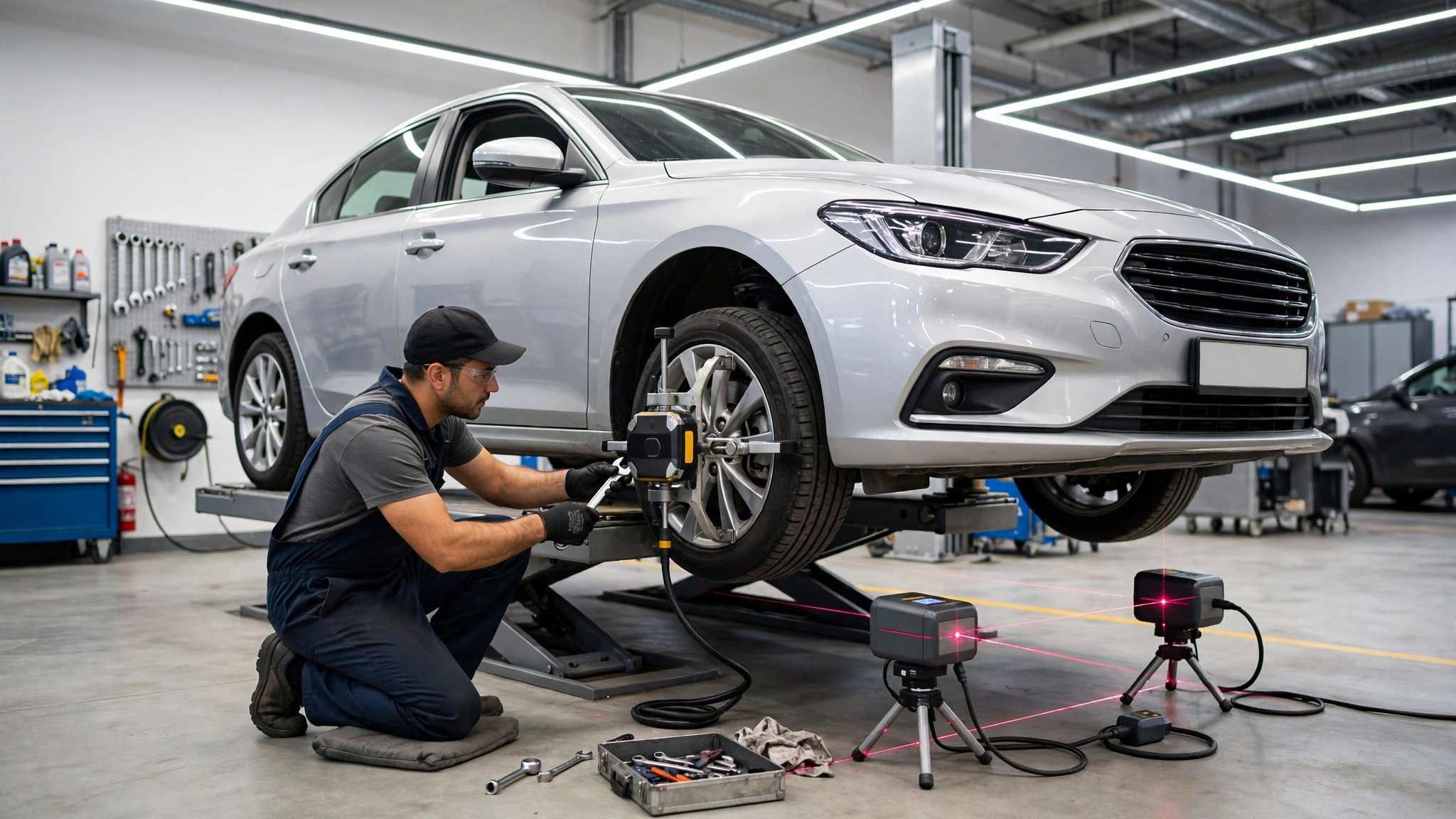
During an alignment, the car goes up on a special rack, sensors or lasers are attached to each wheel, and a computer compares every angle against the manufacturer's specifications. The technician then makes precise adjustments to the suspension components to bring everything back into spec. This normally takes about an hour.
Alignment is what keeps your car driving straight, your steering feeling responsive, and your tires wearing evenly. It is about control; balancing is about comfort.
How to Tell Which One You Need: The Symptom Guide
This is the part that matters most to a beginner. The two services fix different problems, and your symptoms tell you which one to ask for.
Signs you need tire balancing
- Vibration in the steering wheel, especially at highway speeds (roughly 50–70 mph / 80–110 km/h).
- Vibration in the seat or floorboard at higher speeds — this often points to a rear-wheel balance issue.
- A shaky feeling that gets stronger the faster you drive.
- Cupped or scalloped tread wear — patchy dips around the tire surface. (If you are not sure what healthy tread looks like, our tire tread depth guide shows the quick coin test.)
- The vibration started right after new tires were fitted or a tire was repaired.
Signs you need a wheel alignment
- The car pulls or drifts to one side when driving on a flat, straight road.
- The steering wheel sits crooked even though you are driving straight.
- Uneven tread wear — one edge of the tire (inner or outer) is wearing noticeably faster than the other.
- The steering feels loose, or the car wanders and needs constant small corrections to stay in its lane.
- The symptoms started after an impact — a hard pothole hit, scraping a curb, or a minor accident.
Quick test you can do yourself: on a quiet, flat, straight road, briefly loosen your grip on the steering wheel (keep your hands hovering right over it). If the car tracks straight but shakes, that points to balance. If it drifts left or right, that points to alignment. Never take your hands fully off the wheel — this is a feel test, not a trick.
If you notice both pulling and vibration, there is a good chance you need both services. That is completely normal, and shops handle the combination all the time.
What Causes Each Problem?
Alignment problems are usually caused by impacts and wear: hitting potholes or curbs, worn suspension or steering components, or a minor collision. Even normal driving gradually pushes things out of spec.
Balance problems come from more everyday causes: normal uneven tread wear over time, a wheel weight that fell off (check your rims for a clean spot where a weight used to be), a new tire that was never balanced, or a significant impact.
How Often Should You Get Them Done?
As a rough beginner-friendly schedule:
- Balancing: every time new tires are mounted, and worth checking with every tire rotation — roughly every 5,000–7,500 miles (8,000–12,000 km). Balance immediately if vibration appears.
- Alignment: about once a year or every 10,000–15,000 miles, and immediately after any hard impact, new suspension work, or when you spot pulling or uneven wear.
Always check your owner's manual first — the manufacturer's recommendation beats any generic rule. If you drive on rough, pothole-filled roads, both services may be needed more often.
What Does It Cost?
Prices vary by shop, vehicle, and region, but typical ranges are:
- Tire balancing: roughly $40–$75 for all four wheels.
- Wheel alignment: roughly $75–$150, with four-wheel alignments at the higher end.
Many tire shops offer package deals that include rotation, balancing, and an alignment check, which can save money — but only pay for what your symptoms actually point to. A trustworthy technician measures first and recommends based on results, not assumptions. For another visual walkthrough of how the two services differ, see this tire balancing vs wheel alignment guide from Mavis.
What Happens If You Ignore Them?
Ignoring a balance issue leads to accelerated tire wear in that distinctive cupped pattern, and the constant vibration puts extra stress on suspension components over time. Your ride gets uncomfortable and your fuel efficiency can drop.
Ignoring an alignment issue is usually more expensive. Misaligned wheels can shorten tire life dramatically, forcing you to buy a new set of tires (often $600–$1,200) far earlier than necessary. Handling also suffers — a car that pulls or wanders is less safe, especially in emergency maneuvers or on wet roads. Checking your tire pressure regularly is a good companion habit, since pressure problems and alignment problems both cause uneven wear.
Do You Need Both at the Same Time?
Sometimes yes, sometimes no. If vibration is your only complaint and the car tracks straight, balancing alone usually solves it. If the car pulls and the steering wheel is crooked but there is no shaking, alignment alone is the answer. When in doubt, ask the shop to do a quick measurement of both — it takes minutes and removes the guesswork.
FAQs
Can wheel alignment fix a vibrating steering wheel?
Rarely. Vibration at speed is almost always a balance issue (or a damaged tire or bent rim), while alignment fixes pulling and uneven wear. If your steering wheel shakes on the highway, ask for a balance check first.
Is tire balancing part of a tire rotation?
Not automatically. Rotation moves the tires to different positions so they wear evenly; balancing adjusts the weight distribution on each wheel. Shops often do them together because the wheel is already off the car, but they are separate services — confirm what is included before you pay.
Can I do alignment or balancing myself?
Balancing requires a specialized spin machine, and alignment requires an alignment rack with precise sensors — neither is a practical DIY job. A wrong DIY adjustment makes things worse. For beginners, both of these are firmly "take it to a shop" services. If you want a DIY starting point, learn how to read your tire sidewall markings so you can at least talk confidently to the technician.
How long does an alignment last?
Under normal driving, roughly a year or 10,000–15,000 miles — but a single hard pothole or curb hit can knock it out of spec in an instant. Treat every big impact as a reason to get it rechecked.
Conclusion
Balancing fixes vibration; alignment fixes pulling and uneven wear. Remember that one line and you will never again be confused at the service counter. Keep an eye on how your car feels — a shake at highway speed means balancing, a drift to one side means alignment — and act early. Both services are inexpensive compared to a prematurely worn-out set of tires, and they make every drive smoother, safer, and more efficient.