
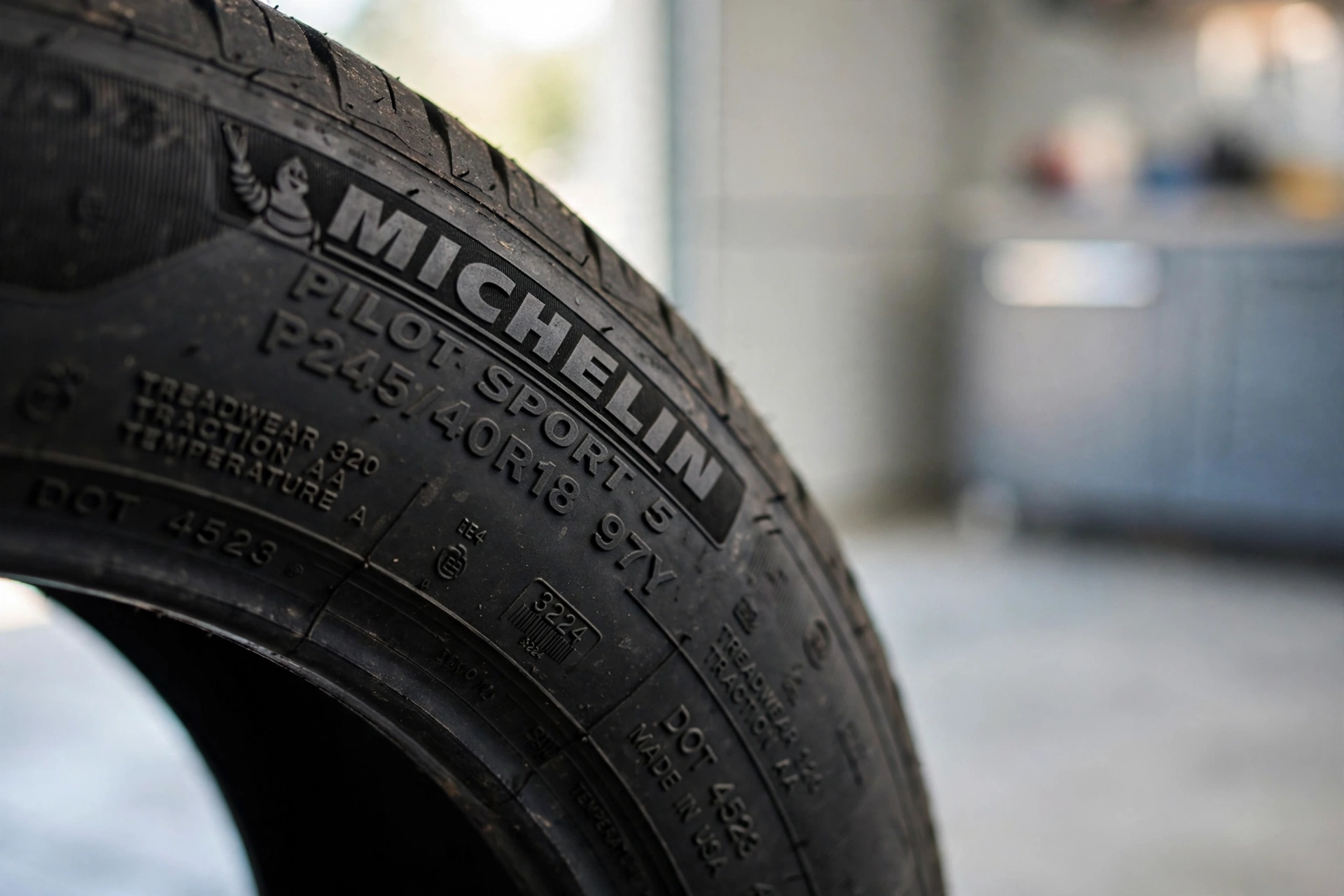
Look at the side of any car tire and you'll see a cryptic string of letters and numbers molded into the rubber: something like P205/55R16 94V XL. It looks like a secret code, but it's actually one of the most useful pieces of information on your car — every character tells you something about the tire's size, strength, speed capability, and age. Learning to read it takes about five minutes, and it pays off every time you shop for new tires or check whether your current ones are still safe.
This guide decodes each marking step by step, in plain English, using a common real-world example — P205/55R16 94V, a size fitted to countless compact cars — so you can walk out to your own car and follow along.
The Tire Size: Width, Profile, Rim
The first part of the sidewall code is the tire size. In P205/55R16, each element means:
The letter before the numbers: vehicle type
P stands for passenger vehicle — the standard designation for tires made for cars and small SUVs. If there's no letter at all, the tire follows the European metric standard (same idea). You may also see LT (light truck, for pickups and heavy vans), ST (special trailer), or T (temporary spare). For most first-time car owners, you'll see P or no letter.
205: section width in millimeters
The first number is the tire's width from one sidewall to the other, measured in millimeters. In our example, the tire is 205 mm wide across the tread. Wider tires grip better but use slightly more fuel; the right width is whatever your car was designed for.
55: aspect ratio (sidewall height as a percentage)
The second number is not a height in millimeters — it's a percentage. An aspect ratio of 55 means the sidewall height is 55% of the tire's width (55% of 205 mm ≈ 113 mm). A lower number (like 40) means a shorter sidewall and sharper handling but a firmer ride; a higher number (like 65) means a softer ride and more pothole protection.
R: radial construction
R means radial construction, where the internal cord plies run straight across the tire. Virtually every modern car tire is radial.
16: wheel (rim) diameter in inches
The last number of the size tells you the wheel diameter the tire fits, in inches. A "205/55R16" tire only fits a 16-inch wheel. Notice the mix: width and aspect ratio use the metric system, but rim diameter uses inches. That's just how the global tire industry works.
Load Index: How Much Weight the Tire Can Carry
After the size comes a two- or three-digit number — the load index. In our example, 94 means each tire can safely carry up to 670 kg (1,480 lb) when properly inflated. This is not a weight in itself; it's a code that points to a standard table. Some common values:
- 91 = 615 kg (1,356 lb) per tire
- 94 = 670 kg (1,480 lb) per tire
- 95 = 690 kg (1,521 lb) per tire
- 97 = 730 kg (1,609 lb) per tire
- 104 = 900 kg (1,984 lb) per tire
Never fit tires with a lower load index than your car requires — check the door jamb sticker or owner's manual for the correct minimum. Using an underrated tire is genuinely unsafe, especially when the car is fully loaded. An underinflated tire also can't safely support its rated load, which is why checking tire pressure regularly matters so much.
XL: Extra Load
You might also see XL (Extra Load) after the load index — a reinforced tire rated for more weight at higher inflation pressure. If your car specifies XL tires, don't replace them with standard-load ones.
Speed Rating: The Letter After the Load Index
Right after the load index comes a letter — the speed rating. In our example, V means the tire has been tested to handle speeds up to 240 km/h (149 mph) safely under load. Common ratings:
- S = 180 km/h (112 mph)
- T = 190 km/h (118 mph)
- H = 210 km/h (130 mph)
- V = 240 km/h (149 mph)
- W = 270 km/h (168 mph)
- Y = 300 km/h (186 mph)
This is a laboratory testing rating, not an invitation to drive that fast. What matters for you: replace tires with a speed rating equal to or higher than the original — a lower one can overheat at highway speeds.
The DOT Code: Your Tire's Birthday
Every tire sold carries a DOT code (from the US Department of Transportation) ending in four digits. Those digits are the tire's manufacturing date: the first two are the week of the year, the last two are the year. A tire stamped 4523 was made in the 45th week of 2023.
Tires age even when they aren't driven — rubber gradually hardens and cracks. Most tire makers and safety bodies recommend replacing tires at 6–10 years from manufacture, regardless of tread, and professional inspection from year 5. The DOT code is on only one side of the tire, so check both sides if you can't find it.
UTQG Grades: Treadwear, Traction, Temperature
On the sidewall you'll also see three UTQG (Uniform Tire Quality Grading) ratings, required on passenger-car tires:
- Treadwear (a number, e.g. 320): a relative rating for tread life — higher is longer-wearing. Only compare ratings within the same brand, since there's no enforced industry-wide standard.
- Traction (AA, A, B, or C): wet-braking grip on asphalt. AA is the highest rating currently given.
- Temperature (A, B, or C): how well the tire resists heat buildup. A is best.
Other Markings Worth Knowing
- Max pressure (e.g. "Max Press. 35 PSI"): the maximum cold inflation the tire is built to handle. This is not your daily pressure — use the car maker's door-jamb recommendation, which is usually lower.
- M+S: Mud and Snow — basic all-season traction. The 3-peak mountain snowflake symbol means the tire has passed actual severe-snow testing — far more meaningful for winter driving.
- Rotation arrow: directional tires must be mounted so they rotate in the arrow's direction. Fitting them backwards ruins their wet-grip design.
- "Inside/Outside": on asymmetric tires, the side marked "Outside" must face outward.
A Quick Worked Example
Decoding a full marking — P205/55R16 94V XL:
- P — passenger vehicle tire
- 205 — 205 mm wide
- 55 — sidewall height is 55% of 205 mm (≈113 mm)
- R — radial construction
- 16 — fits a 16-inch wheel
- 94 — carries up to 670 kg (1,480 lb) per tire
- V — tested to 240 km/h (149 mph)
- XL — reinforced Extra Load construction
Now walk out to your car and try it on your own tires.
Why This Matters for a First-Time Car Owner
Three practical payoffs make this skill worth having. First, when buying replacement tires, you'll know exactly what your car needs — and you'll spot immediately if a shop offers the wrong size or a lower load index. Second, you'll understand why the door-jamb pressure sticker specifies a size: matching tires to the car's designed specification keeps handling, braking, and fuel economy as the engineers intended. Third, the DOT date code lets you check the age of second-hand tires or a spare that's been sitting in the trunk for years. Speaking of spares, our guide on how to change a flat tire walks you through using one safely, and if your tire pressure light keeps coming on, check pressures before assuming anything else is wrong.
For deeper technical reading, see Tire Rack's sidewall guide and Nokian Tyres' sidewall explanation.
Frequently Asked Questions
Can I fit a different tire size than what's on the door sticker?
You can go one size up or down in some cases ("plus sizing"), but it changes speedometer accuracy, ride, and clearance, and the overall diameter must stay close to stock. Never improvise — check the owner's manual or a tire professional first. When in doubt, stick to the door sticker size.
Is a higher load index always better?
Not necessarily. Meeting or slightly exceeding the required load index is right; going far beyond it usually means a heavier, stiffer tire that rides harsher. Match what the car asks for.
Does the speed rating matter if I never drive fast?
Yes. The rating also reflects how the tire handles sustained heat at highway speeds. Dropping to a lower rating than specified can cause overheating on long highway drives in hot weather.
How do I read the DOT date if I can only find part of the code?
The full four-digit date code is stamped on only one sidewall. If you see a shorter DOT stamp, check the other side — that's where the week/year digits are.
Do all tires have UTQG ratings?
No — only passenger-car tires sold in markets that require it (notably the US). Winter tires, temporary spares, and many trailer tires are exempt, so its absence isn't a red flag by itself.
Conclusion
The sidewall of your tire is really a specification sheet molded in rubber. Once you know the pattern — type, width, aspect ratio, construction, rim diameter, then load index, speed rating, and the bonus codes (XL, DOT date, UTQG) — you can decode any tire in seconds. That knowledge protects you at the tire shop and tells you when a tire is simply too old to trust. Add a monthly tire-pressure check to your routine, and your tires will reward you with better fuel economy, longer life, and safer driving.