Your dashboard tire pressure light only warns you when a tire is already about 25% underinflated — by then you have been driving on a soft tire for days, wearing it out unevenly and burning extra fuel. A small tire pressure gauge in your glovebox catches the problem weeks earlier, and the whole check takes about two minutes. The only real question is which type to buy: digital, pencil, or dial? This guide compares the three types honestly, then rounds up the 5 best tire pressure gauges for beginners in 2026.
Disclosure: As an Amazon Associate, FirstCarCare earns from qualifying purchases made through links on this page, at no extra cost to you. Our picks are based on verified buyer ratings and independent roundup testing — never on commission.
Our Top 3 Picks at a Glance
- Best Overall — JACO ElitePro Digital 100 PSI: the most accurate consumer gauge in independent testing, with a big backlit screen.
- Best Budget — AstroAI Digital 150 PSI: the most-reviewed gauge on Amazon, accurate to 0.1 PSI, for the price of a coffee or two.
- Best No-Battery Backup — Milton S-921 Pencil: a brass classic that never needs batteries and lasts for decades.
Digital vs Pencil vs Dial: Which Type Should a Beginner Buy?
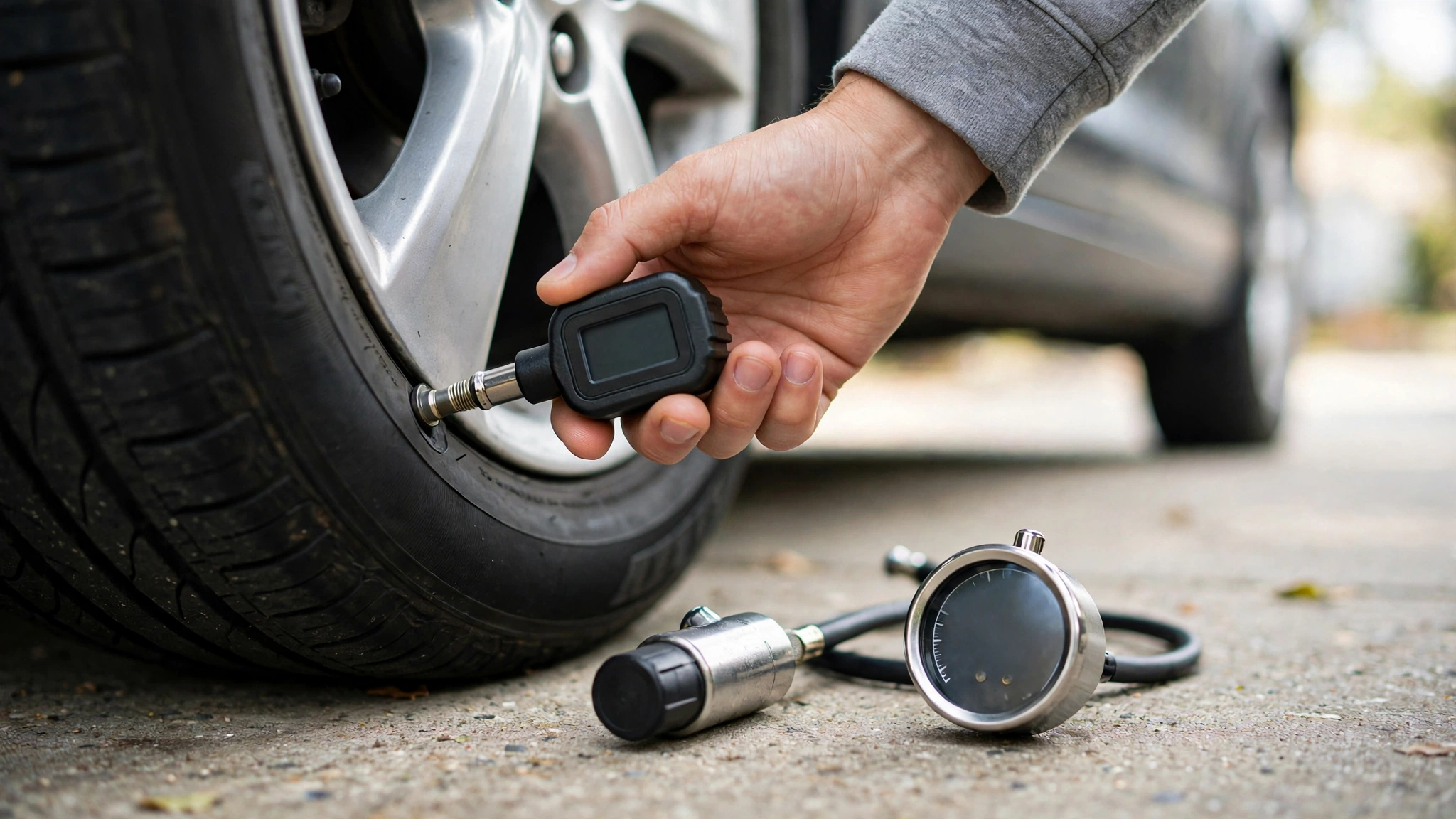
There are three kinds of tire pressure gauge, and each one trades accuracy for simplicity in a different way. Here is the honest comparison before you spend anything.
Digital gauges
A digital gauge shows your pressure as a number on a backlit screen, usually to 0.1 PSI. They are the easiest to read — especially at night or in a dark garage — and the most accurate at beginner prices. The catch: they need batteries, and batteries die fastest in cold weather, exactly when tire pressure matters most. Keep a spare set of batteries in the glovebox, or keep a pencil gauge as backup.
Pencil (stick) gauges
A pencil gauge is a brass tube with a sliding white bar that pops out to show your pressure in 1 PSI steps. No battery, no screen to crack, nothing to calibrate, and the good ones last for decades. The catch: they read in whole PSI only, the scale is harder to read in dim light, and most top out at 50 PSI — fine for a sedan, not enough for a truck or trailer.
Dial gauges
A dial gauge has a round analog face on a hose, like a tiny speedometer for your tires. No batteries, easy to read at a glance, and the hose makes it comfortable to use on hard-to-reach valves. The catch: they are bulkier than the other two, so they live in the trunk rather than the glovebox, and a hard drop can knock the needle out of calibration.
Our recommendation for most beginners: buy a digital gauge as your main tool and a pencil gauge as a cheap backup. You get precise readings every month and a tool that still works when the batteries die.
What to Look For in Your First Tire Pressure Gauge
Range: your gauge must cover your car's pressure with room to spare. Most sedans run 30–35 PSI, so a 0–50 PSI pencil gauge works — but your spare tire often needs 60 PSI, and trucks can need 80 PSI, so a 0–100 PSI or 0–150 PSI digital gauge is the safer all-rounder.
Accuracy: look for ANSI B40.7 Grade 2A (digital) or ANSI B40.1 (dial) calibration. That means the gauge was tested against a standard, not just stamped with a number. A gauge accurate to ±1 PSI is plenty for a beginner — chasing 0.1 PSI precision matters less than checking regularly.
Readability: a backlit screen or a glow-in-the-dark dial matters more than it sounds. You will check your tires in parking garages and on winter mornings, and a gauge you cannot read is a gauge you will not use.
Chuck and hose: a straight chuck works on most cars, but a 360-degree swivel chuck or a short hose helps on wheels where the valve stem sits at an awkward angle. If the chuck does not seal cleanly, air hisses out and the reading drops — press firmly and listen for the hiss to stop.
Batteries: digital gauges use LR44 coin cells or AAA batteries. AAA is easier to replace and lasts longer in the cold. Whichever you buy, note the battery type on a sticky note inside the glovebox.
The 5 Best Tire Pressure Gauges for Beginners (2026)
#1 — Best Overall
JACO ElitePro Digital Tire Pressure Gauge — 100 PSI
- Working range 5–100 PSI with 0.1 PSI resolution — precise enough for any passenger car
- Calibrated to ANSI B40.7 Grade 2A, accurate to ±0.5% of full scale
- Large 2.5-inch backlit LCD and a 360-degree swivel chuck that seals easily
- Brass and steel build with a lifetime warranty from JACO
Pros: the most accurate consumer gauge in Project Farm's independent 26-gauge test, with just 0.9 PSI total error across three checkpoints; big, clear screen; built to last. Cons: reads PSI only, so drivers who work in bar or kPa need a conversion; costs more than a budget digital gauge.
Best for: beginners who want to buy once and never second-guess a reading.
#2 — Best Budget
AstroAI Digital Tire Pressure Gauge — 150 PSI
- Range 0–150 PSI with readings in 0.1 PSI increments, in PSI, bar, kPa or kg/cm²
- Factory calibrated to ANSI B40.7, accurate to ±1 PSI
- Backlit LCD, lighted nozzle for dark wheel wells, and a Presta valve adapter for bicycles
- Runs on 3 LR44 batteries (included) and shuts off automatically
Pros: the most-reviewed tire gauge on Amazon for good reason — accurate, tiny enough for any glovebox, and genuinely cheap. Cons: the small LR44 batteries are fiddly to replace; the plastic body feels less premium than the JACO.
Best for: first-time buyers and anyone who wants a reliable gauge for the least money.
#3 — Best for Trucks and Wide Range
ETENWOLF T300 Digital Tire Pressure Gauge — 3–200 PSI
- Wide 3–200 PSI range — covers sedans, SUVs, trucks, RVs and trailers in one tool
- Calibrated to ANSI B40.7 Grade 2A, accurate to ±0.5 PSI
- Backlit LED screen, replaceable AAA batteries, auto shut-off after 30 seconds
- Industrial alloy build, rated from -4°F to 130°F
Pros: one gauge for every vehicle in the household; AAA batteries are easy to find; accurate even at very low and very high pressures. Cons: no automatic shutoff on some early batches according to reviewers — check yours powers down; overkill if you only own one small car.
Best for: households with a truck, SUV or trailer alongside the daily car.
#4 — Best Dial (No Battery)
Rhino USA Heavy Duty Tire Pressure Gauge — 75 PSI
- Range 0–75 PSI with a large 2-inch glow-in-the-dark dial, easy to read at dawn or dusk
- Certified accurate to ANSI B40.1, with a premium braided hose and solid brass hardware
- No batteries, no screen — works in any weather, year after year
- Unlimited lifetime warranty from Rhino USA, a family business in California
Pros: the best-reviewed dial gauge in its class; the hose reaches awkward valves without scraping your knuckles; feels like a real tool, not a gadget. Cons: 75 PSI ceiling rules out heavy trucks and some spares; the largest gauge here, so it lives in the trunk, not the glovebox.
Best for: drivers who hate batteries and want a gauge that simply cannot die.
#5 — Best Pencil / Glovebox Backup
Milton S-921 Pencil Tire Pressure Gauge — 5–50 PSI
- Classic pencil design in plated brass, made in the USA, in production since the 1930s
- Reads 5–50 PSI in 1 PSI steps, plus 40–350 kPa on the same scale
- Built-in deflator valve and a tire tread depth gauge on the same tool
- No battery, no moving dial — nothing to break or recalibrate
Pros: the cheapest genuinely good gauge you can buy; fits anywhere; reviewers report readings comparable to gauges costing five times more. Cons: 50 PSI maximum, so it cannot check a spare or a truck tire; 1 PSI steps and a small scale are harder to read in dim light.
Best for: a glovebox backup, a second car, or a beginner on the tightest budget.
Comparison Table
| Gauge | Type | Range | Accuracy | Rating | Best For |
|---|---|---|---|---|---|
| JACO ElitePro Digital | Digital | 5–100 PSI | ±0.5% FS (ANSI 2A) | 4.7/5 · ~7,100 ratings | Best overall |
| AstroAI Digital | Digital | 0–150 PSI | ±1 PSI (ANSI B40.7) | 4.4/5 · ~72,000 ratings | Best budget |
| ETENWOLF T300 | Digital | 3–200 PSI | ±0.5 PSI (ANSI 2A) | 4.6/5 | Trucks and wide range |
| Rhino USA Heavy Duty | Dial | 0–75 PSI | ANSI B40.1 | 4.6/5 · ~4,600+ ratings | Best no-battery dial |
| Milton S-921 | Pencil | 5–50 PSI | 1 PSI steps | 4.6/5 · ~5,600 ratings | Best backup |
How to Check Your Tire Pressure in 2 Minutes (Cold Tires Only)
Always check on cold tires — before you drive, or at least three hours after parking. Driving even a mile warms the air inside and raises the reading by a few PSI, which hides an underinflated tire.
- Find your number: open the driver's door and read the sticker on the door jamb. That is your car's recommended pressure — not the maximum printed on the tire sidewall. If the sticker is missing, check your owner's manual.
- Remove the valve cap: unscrew the small cap on the valve stem and put it in your pocket so it does not roll away.
- Press the gauge on firmly: push the chuck straight onto the valve stem until the hissing stops. A digital gauge beeps or locks the reading; a pencil gauge pops its bar out; a dial gauge needle settles.
- Read and compare: write the number down. If it is more than 2 PSI below the door sticker, add air. If it is higher, press the deflator tab (or the valve pin with the back of the pencil gauge) in short bursts and re-check.
- Replace the cap and repeat: do all four tires plus the spare if you have one. The spare is the tire most beginners forget — and the one you need most when a flat happens.
If one tire keeps losing pressure week after week, do not just keep topping it up — that is usually a slow leak from a nail, a bad valve stem, or a damaged rim seal, and a tire shop should look at it. And if your tire pressure light keeps coming on, our guide to why the tire pressure light keeps coming on walks through the common causes.
Verdict: Which Tire Pressure Gauge Should You Buy?
For most beginners, the JACO ElitePro Digital is the right buy — it is the most accurate gauge in its price range, the screen is easy to read, and you will trust every reading. If money is tight, the AstroAI Digital 150 PSI gives you nearly the same everyday accuracy for far less, and its huge review count means you know exactly what you are getting. Add the Milton S-921 pencil gauge as a backup for a few dollars more and you are covered even when the batteries die. Truck and SUV owners should pick the ETENWOLF T300 for its 200 PSI range, and anyone who simply hates batteries will love the Rhino USA dial gauge.
Whichever you choose, the gauge only helps if you use it. Put it in the glovebox today, set a monthly phone reminder, and pair it with a portable inflator — see our roundup of the best tire inflators for beginners and our guide to how to choose a tire inflator — so a low reading is a two-minute fix, not a trip to the gas station. For the rest of the monthly routine, our how often to check tire pressure guide and monthly maintenance checklist keep the whole car on track.
Frequently Asked Questions
How often should I check my tire pressure?
At least once a month and before any long trip — always on cold tires, before you drive or at least 3 hours after parking.
What PSI should my tires be?
The number on your driver's door jamb sticker (or owner's manual) — not the maximum PSI printed on the tire sidewall.
Are digital tire pressure gauges more accurate than pencil gauges?
Usually yes — a good digital gauge reads to 0.1 PSI, while a pencil gauge reads in 1 PSI steps. But a quality pencil gauge is still accurate enough for monthly checks.
Can I use a pencil gauge on a truck or SUV?
Only if your pressure is under the gauge's range — the Milton S-921 tops out at 50 PSI, so trucks and trailers needing more need a digital or dial gauge.
Why does my tire pressure light come on in cold weather?
Tire pressure drops about 1 PSI for every 10°F temperature drop, so a cold snap can push a borderline tire below the warning threshold.