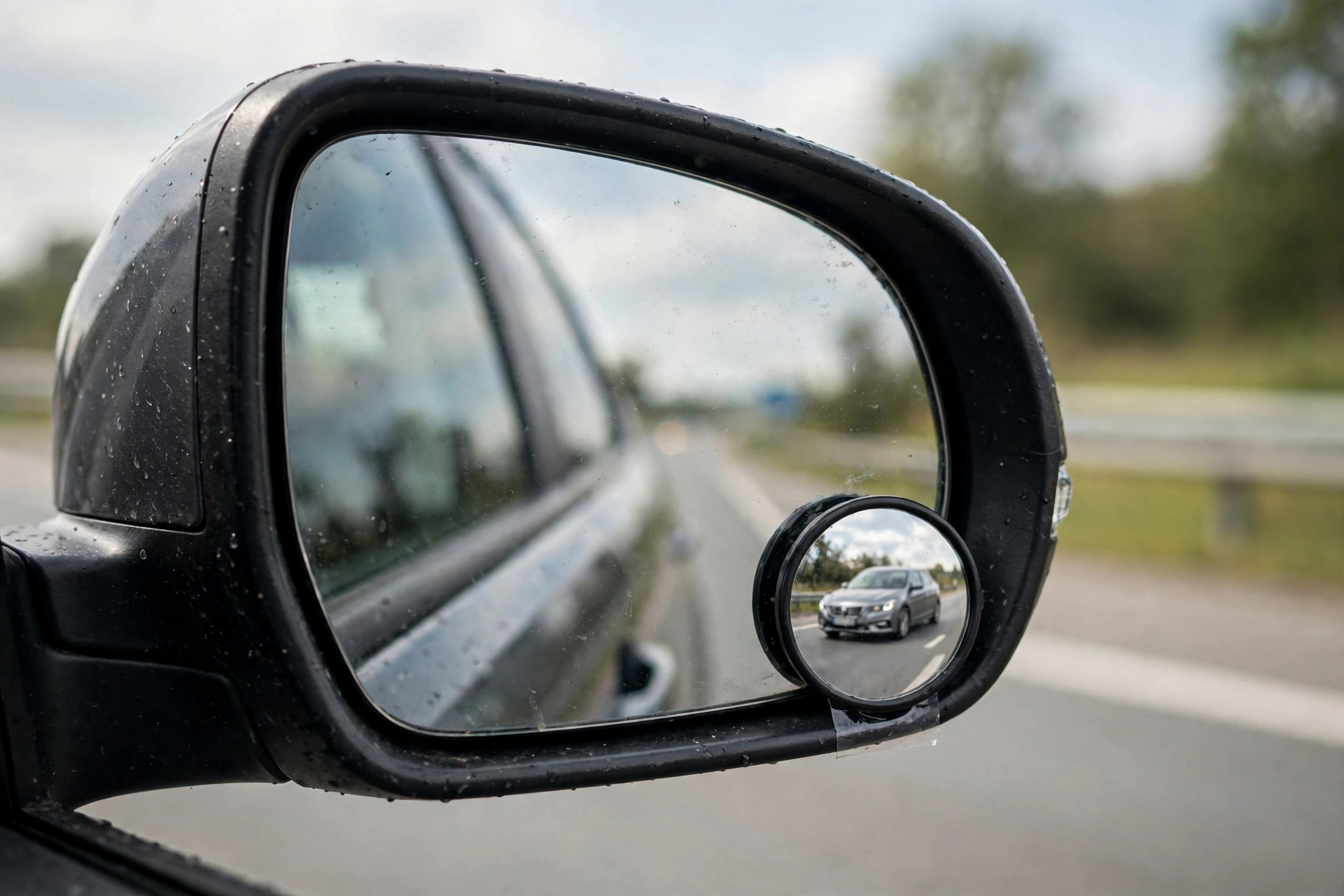
Every new driver learns the same scary lesson on the highway: you check your mirror, the lane looks clear, you start to move — and a car is suddenly right there, exactly where your mirror could not see it. That gap is the blind spot, and it is not a small problem. Safety sources citing NHTSA figures put blind-spot crashes at nearly 840,000 a year in the United States. A blind spot mirror is a small, curved stick-on mirror that sits on the corner of your side mirror and shows you the lane your main mirror misses. It costs less than a tank of gas, installs in five minutes, and works on any car. The catch is that placement matters more than brand — put it in the wrong corner and it hides your normal view instead of helping. This guide shows you how they work, exactly where to stick one, how to use it while driving, and the five best stick-on mirrors for beginners.
Affiliate disclosure: FirstCarCare.com is a participant in the Amazon Services LLC Associates Program. As an Amazon Associate, we earn from qualifying purchases made through links on this page, at no extra cost to you. We only recommend products that fit a beginner's real needs.
Our top 3 at a glance
- Best overall — Essential Contraptions 2-Inch Round Mirror (2-pack): real HD glass in a rust-resistant aluminum frame, named the best all-around blind spot mirror in GearInstant's November 2026 roundup and thedailyautomotive.com's October 2026 guide — the safe default for a first car.
- Best frameless round — LivTee 2-Inch Round Mirror (2-pack): slim, frameless HD glass on a 360-degree swivel bracket, named best overall by thomasacres.com — the pick if you want the mirror to blend in and aim exactly where you want it.
- Best shaped view — Utopicar Convex Mirror (2-pack, BSM017): a rhombus shape that shows a larger, wider image than a round mirror of the same size, scored 9.6/10 in top5best.com's 2026 list — the pick if a round mirror feels too small.
Do blind spot mirrors actually work?
Yes — with one honest limit. A blind spot mirror is a small convex mirror: its surface curves outward, which lets it reflect a much wider scene than a flat mirror of the same size. Where your flat side mirror shows roughly the lane directly behind you, a convex add-on squeezes about 150–200 degrees of view into a two-inch circle. That is why a car sitting in your blind spot — the zone just behind and beside your rear door — suddenly appears in the small mirror while your main mirror shows nothing.
The limit is distance. Because the convex curve compresses the scene, everything in the small mirror looks smaller and farther away than it really is. A car that looks three car-lengths back in the blind spot mirror may be right beside your rear door. That is why these mirrors are a warning system, not a measuring tool: they tell you something is there, and you judge how far away it is in your flat main mirror or with a shoulder check. Used that way, they genuinely make lane changes safer — safety researchers have found that blind-spot warning technology cuts lane-change injury crashes by about 23%, and a stick-on mirror gives you a simpler version of the same early warning.
One thing to settle before you buy anything: your main mirrors come first. If your side mirrors are still aimed at your own doors — the way most new drivers set them — no add-on can fully fix the gap. Set your main mirrors properly first (the SAE method below), and only then add the small mirror to cover what is left.
Step 1: set your main mirrors first (the SAE method)
The Society of Automotive Engineers (SAE) recommends a simple method that shrinks your blind spot before any add-on is involved. It takes two minutes, parked, and it is the single most useful mirror habit a new driver can learn.
- Sit in your normal driving position. Seat, steering wheel, and posture exactly as you drive — mirror settings only work for the position you set them in.
- Driver's side: lean your head to the left until it almost touches the driver's window. Adjust the left mirror outward until you can just barely see the edge of your car — then stop. When you sit back upright, your own car should be just out of view.
- Passenger's side: lean to the right toward the center console and do the same with the right mirror — adjust it outward until the edge of your car just disappears when you sit upright.
- Rearview mirror: frame the whole rear window in it, centered on the road behind you. The three mirrors should now hand traffic off to each other: a car leaving your rearview mirror appears in your side mirror, and a car leaving your side mirror appears in your peripheral vision.
If this feels strange at first, that is normal — most drivers aim their side mirrors too far inward and see far too much of their own car. Give the SAE setting a few days. Once it feels natural, the blind spot mirror only has to cover the small zone that remains, which is exactly what it is good at. Our guide to changing lanes safely walks through the full mirror-and-shoulder-check routine this setting supports.
Step 2: where to put the blind spot mirror
Placement is the part most beginners get wrong, and it matters more than which brand you buy. Driver-education guides and mirror makers agree on one default position: the outer bottom corner of your side mirror — the corner farthest from you, at the bottom. That spot gives the widest view of the adjacent lane while hiding the smallest useful part of your normal mirror. A placement guide from hzgoldensun.com reaches the same conclusion after comparing every corner, and it is the position recommended in most installation instructions.
There is one common alternative. Some drivers — especially taller drivers, and drivers who want help seeing the curb when parking — prefer the outer top corner. The top corner shows the adjacent lane just as well; the bottom corner is slightly better for curb and parking-line visibility. Either outer corner works. What does not work is the inner edge or the center of the mirror: there the small mirror covers the part of your main mirror you actually use, and it shows you the lane you can already see.
- Test before you stick. Hold the mirror in the corner with a small piece of tape, sit in the driver's seat, and check that you can see the adjacent lane from your rear fender to the next car's front end — without moving your head much. Move it until the view is right, then commit.
- Keep it small. The add-on should cover no more than about 10% of your main mirror's surface. A standard 2-inch round mirror is the right size for most cars; the larger rectangular and wing shapes in this guide suit the bigger mirrors on SUVs and trucks.
- Mind the law. In the United States, federal standard FMVSS 111 allows auxiliary mirrors as long as the primary side mirror stays fully functional and unobstructed — which is exactly what the 10% rule protects. Keep the add-on under about 4 inches and out of the center of the mirror.
Step 3: install it in 5 minutes
- Clean the glass. Wipe the corner of your side mirror with rubbing alcohol (isopropyl) and a lint-free cloth to remove grease, wax, and road film. Any residue on the glass weakens the adhesive immediately — this is the step people skip, and the reason mirrors fall off.
- Dry it completely. Let the alcohol evaporate fully. Do not install on a wet or cold mirror, and do not touch the cleaned spot with your fingers — skin oil is exactly what you just removed.
- Position and check from the driver's seat. Hold the mirror in the outer bottom corner, leaving 3–5 mm of clearance from both edges, and check the angle from your normal seating position before you peel anything.
- Peel and press for 30 seconds. Remove the adhesive backing and press the mirror firmly with even pressure across its whole surface for a full 30 seconds. For swivel-bracket models (LivTee, Amfor, Ampper), press the bracket base down first, then snap the mirror onto it.
- Aim it, then test it parked. Swivel the small mirror until it shows the adjacent lane. Then have a friend walk or drive slowly alongside your car in the next lane while you watch from the driver's seat — you should see them enter the small mirror just as they leave your main mirror, with no gap. If there is a gap, re-aim before you drive.
Give the adhesive a day to cure before washing the car or driving through a car wash, and avoid touching the mirror surface during installation so you do not leave smudges on the glass. Removing one later is easy: warm it with a hair dryer for a minute, slide dental floss or fishing line behind it to cut the adhesive, and wipe the residue off with a little adhesive remover or rubbing alcohol.
Step 4: how to use it while driving
A blind spot mirror only helps if it becomes part of your normal scan. Build it into the routine you already use for lane changes — the same routine in our lane-change guide — and it will feel automatic within a week.
- Rearview mirror first. Check the road behind you. A car approaching fast in the next lane will show up here first.
- Main side mirror next. Look for the car as it draws level with your rear bumper. This is your distance and speed check — the flat mirror shows size honestly.
- Blind spot mirror last. Glance at the small convex mirror. If a car is sitting in the zone your main mirror misses, it appears here — small, but unmistakable.
- Shoulder check, then move. The small mirror says a car is there; the shoulder check confirms exactly where it is. Signal, check again, and move smoothly. Never change lanes on the small mirror alone.
Two more uses beginners love: parking, where the bottom-corner placement shows you the curb and the parking line without craning your neck, and merging onto the highway, where the wide view catches cars approaching in the lane you are joining — the exact situation our highway-merging guide covers. At night and in rain the mirrors still work, but glare and water drops make the small image harder to read — slow down, and lean on the shoulder check even more. If your car already has electronic blind-spot monitoring, the stick-on mirror is still useful: it shows you the car, while the warning light only tells you it is there.
How to choose: round, rectangular, or long?
1. Round 2-inch — the default for most cars
A 2-inch round mirror is the size most people picture, and it suits the corner of most side mirrors without eating into the main view. It is the cheapest shape, the easiest to place, and the right first pick if you have never used one. Essential Contraptions and LivTee both make this shape, and both are in this guide.
2. Rectangular or fan-shaped — a wider view of the lane
A rectangle or fan shape gives you more horizontal coverage — you see more of the adjacent lane in one glance — at the cost of taking up a little more of the mirror's edge. This shape suits drivers who do a lot of highway driving and want the widest possible lane view. The Amfor rectangular pick below is the example, and the Utopicar rhombus works the same way.
3. Long strip — for sedans and big mirrors
A long, low mirror (about 5 inches wide and 1.25 inches tall) spreads its view along the bottom edge of the mirror. It is a good fit for sedans and for the larger mirrors on SUVs and trucks, where a round mirror can feel too small. The Ampper wing-shaped pick below is the closest shape in this guide.
4. Framed or frameless?
A frame — usually aluminum — protects the glass edge and makes the mirror feel solid, but it adds a visible border. Frameless mirrors blend into the main mirror and look more like factory equipment, but the glass edge is exposed. Neither is better in absolute terms: pick framed for durability (Essential Contraptions), frameless for a clean look (LivTee, Utopicar, Amfor, Ampper).
5. Glass, not plastic
Every pick in this guide is real HD glass, and that is deliberate. Plastic mirrors are cheaper, but they scratch, yellow in the sun, and go hazy after a season or two. Glass stays clear, resists scratches, and handles heat and cold without warping. For a part you will look at every time you change lanes, glass is worth the few extra dollars.
The 5 best blind spot mirrors for beginners (2026)
#1 — Best Overall
Essential Contraptions Blind Spot Car Mirror, 2-Inch Round (Pack of 2)
Rating: Best overall pick in GearInstant's November 2026 roundup and thedailyautomotive.com's October 2026 guide
- Real HD glass in a rust-resistant aluminum frame — the only framed pick in this guide, and the frame is what keeps the glass edge protected for years
- 2-inch round shape, the standard size that fits the corner of most car, SUV, and truck mirrors without covering the main view
- Pressure-sensitive adhesive tape for a stick-on fit — no tools, no bracket, just clean, press, and drive
- Sold as a 2-pack, so one purchase covers both side mirrors
Pros: This is the safest default pick in the roundup: GearInstant's November 2026 guide names it the best overall blind spot mirror, and thedailyautomotive.com's October 2026 guide calls it the best all-around pick for most sedans and compact cars, specifically because the small footprint is less likely to block the factory mirror. The aluminum frame and real glass are the durable combination — no plastic to yellow, no exposed edge to chip. For a first car with ordinary-sized mirrors, this is the one to buy first.
Cons: The fixed adhesive mount does not swivel, so you set the angle once and live with it — if you want to fine-tune the aim later, the LivTee's swivel bracket is the better choice. The 2-inch size can feel small on the very large mirrors of a full-size truck, where the Ampper wing shape covers more. And the frame, while protective, is more visible than a frameless mirror.
Best for: First cars and compact cars — the default pick for a beginner who wants the proven, durable option.
#2 — Best Frameless Round
LivTee Blind Spot Mirror, 2-Inch Round HD Glass Frameless (Pack of 2)
Rating: Best overall pick in thomasacres.com's blind spot mirror guide
- 2-inch round frameless HD glass — ultra-thin, so it blends into the main mirror and looks close to factory equipment
- 360-degree rotating swivel bracket that also sways, so you can aim the mirror exactly at the adjacent lane and re-aim it whenever you want
- Glass is described as rust-resistant and haze-free, with a waterproof adhesive backing
- Pack of 2, for cars, vans, SUVs, and trucks
Pros: The adjustability is the reason to pick this one: the swivel bracket rotates a full circle and sways, so two drivers of different heights can each aim it their way, and you can fine-tune the angle after installation instead of peeling the mirror off and starting over. Thomasacres.com names it the best overall blind spot mirror in its guide, and the frameless design is the cleanest-looking pick here — it reads as part of the mirror rather than an add-on.
Cons: The frameless glass edge is exposed, so it is more vulnerable to a chip than the framed Essential Contraptions pick if something brushes the mirror. The swivel bracket adds a small base under the mirror, so it sits slightly proud of the glass. And like every 2-inch round, it can feel small on a very large truck mirror.
Best for: Drivers who want to aim the mirror precisely, shared cars with two drivers, and anyone who prefers the clean frameless look.
#3 — Best Shaped View
Utopicar Blind Spot Convex Car Mirror, 2-Pack (Model BSM017)
Rating: 9.6/10 in top5best.com's 2026 blind spot mirror list
- Rhombus shape, 1.8 x 3 inches — wider than a round mirror of the same area, so it shows a larger image of the adjacent lane
- HD glass convex lens with a frameless design that blends into the mirror housing
- Utopicar says the shape shows a 3x larger image than a standard round mirror, and the mirror is built to stay clear in rain and sun
- Model BSM017, pack of 2, with a one-year warranty from the maker
Pros: The shape is the selling point: the rhombus is wider than it is tall, which matches the shape of the lane you are trying to see, so you get more useful view per square inch than a round mirror. Top5best.com's 2026 list scores it 9.6/10, and it is the pick that shows up in the most roundups of any Utopicar model. The one-year warranty is also unusual for a product this cheap — most stick-on mirrors carry no warranty at all.
Cons: The wider shape takes up more of the mirror's edge than a 2-inch round, so measure your side mirror before ordering — on a very small mirror it can cover more than the 10% guideline. The adhesive is fixed (no swivel), so you need to get the placement right the first time. And the "3x larger image" claim is the maker's own description, not an independent measurement — treat it as a shape advantage, not a lab result.
Best for: Highway drivers who want the widest possible lane view, and anyone who found a round mirror too small.
#4 — Best Rectangular
Amfor Blind Spot Mirror, Rectangular HD Glass Frameless (Pack of 2)
Rating: 9.9/10 in top5best.com's value-focused 2026 list
- Rectangular HD glass convex lens, frameless, with an adjustable swivel bracket — the widest horizontal view of any pick in this guide
- Waterproof adhesive backing and a stick-on design that needs no tools
- Pack of 2, universal fit for cars, trucks, and SUVs
- Model ABSM-2Pack-Rectangle
Pros: If the round mirrors feel too small, this is the answer: the rectangle covers more of the adjacent lane in a single glance, which is exactly what you want on a multi-lane highway. Top5best.com's value-focused 2026 list scores it 9.9/10, the highest score in this roundup, and the adjustable bracket means you can aim it after sticking it on. The frameless glass keeps it looking tidy despite the larger size.
Cons: The larger rectangle covers more of the main mirror than a 2-inch round, so it is the pick most likely to break the 10% guideline on a small mirror — measure first, and skip it if your side mirrors are compact. The bigger surface also catches more glare in direct sun. And the shape suits the bottom edge of the mirror better than the corner, so placement needs a little more thought.
Best for: Highway commuters and SUV drivers with larger mirrors who want the widest lane view.
#5 — Best for Big Mirrors
Ampper Large Rear View Blind Spot Mirror, Wing Shape (Pack of 2)
Rating: 9.9/10 in top5best.com's 2026 blind spot mirror list
- Wing-shaped frameless HD glass, 2.5 x 2 inches — larger than a standard round mirror, sized for the bigger side mirrors on SUVs and trucks
- 360-degree rotation and 20-degree sway on the swivel bracket, for fine-tuned positioning
- HD glass, fully waterproof, with 3M adhesive backing
- Model Am-BSM1503, pack of 2, sold by Ampper Direct
Pros: Ampper is the most-reviewed blind spot mirror brand in 2026 roundups, and this wing shape is its answer for drivers who found the standard 2-inch round too small: the larger surface shows more of the lane, and the swivel bracket lets you aim it precisely. Top5best.com's 2026 list scores it 9.9/10. Ampper's own guidance is refreshingly honest — it says plainly that the mirror is an assist, not a replacement for the main mirror, and warns that 2 inches can be small for a big car's side mirror.
Cons: At 2.5 inches it is the largest pick here, so it is the wrong choice for a compact car's small mirror — it would cover too much of the main glass. The wing shape is less common, so if you ever want a matching replacement you are tied to this model. And the larger surface catches more glare than a small round mirror in direct sun.
Best for: SUVs, trucks, and any car with large side mirrors where a 2-inch round feels lost.
Quick comparison
| Mirror | Shape / size | Best for | Rating note |
|---|---|---|---|
| Essential Contraptions | Round 2", framed | First cars, durability | Best overall (GearInstant, Nov 2026) |
| LivTee | Round 2", frameless, swivel | Precise aiming, shared cars | Best overall (thomasacres.com) |
| Utopicar BSM017 | Rhombus 1.8 x 3" | Widest shaped view | 9.6/10 (top5best.com 2026) |
| Amfor | Rectangle, swivel | Highway driving, big mirrors | 9.9/10 (top5best.com 2026) |
| Ampper wing | Wing 2.5 x 2", swivel | SUVs and trucks | 9.9/10 (top5best.com 2026) |
5 mistakes beginners make with blind spot mirrors
- Sticking it on before setting the main mirrors. If your side mirrors are aimed at your own doors, the add-on cannot fix the gap — it just duplicates a view you already have. Set the main mirrors with the SAE method first, then add the small mirror for what is left.
- Placing it in the center or on the inner edge. The middle of the mirror is the part you use most. A blind spot mirror there blocks your normal view and shows you the lane you can already see. Outer corner only — bottom for most drivers, top if you prefer it for curb visibility.
- Skipping the cleaning step. Grease, wax, and road film are invisible, and they are the reason mirrors fall off a week after installation. Rubbing alcohol and a lint-free cloth take thirty seconds; a mirror that falls off at highway speed takes a lot longer to explain.
- Trusting it for distance. The convex curve makes cars look smaller and farther away. Never judge a gap by the small mirror alone — use it to spot the car, then confirm the distance in your flat mirror and with a shoulder check before you move.
- Forgetting the shoulder check. The mirror reduces how often you need to turn your head, and it never removes the need. Motorcycles, in particular, can hide in the gap between what the small mirror shows and what your main mirror shows. Signal, check the mirrors, shoulder check, then move — every time, even on an empty-looking road.
Frequently asked questions
Where is the best place to put a blind spot mirror?
The outer bottom corner of your side mirror — the corner farthest from you, at the bottom. That spot shows the adjacent lane while hiding the least of your normal mirror view, and it is the placement driver-education guides and mirror makers agree on most. Leave 3–5 mm of clearance from the edges, and never let the small mirror cover more than about 10% of your main mirror. Test the spot with tape first: sit in the driver's seat and check you can see the next lane before you peel the adhesive backing.
Do blind spot mirrors replace the shoulder check?
No — never. A blind spot mirror is an aid, not a replacement. It shows you a car is there, but the convex curve makes cars look smaller and farther away than they really are, so it is bad at judging distance and speed. Use the mirror to spot traffic early, then do a quick shoulder check before you move. The mirror cuts down how often you need to turn your head sharply; it does not remove the need to look.
Will a blind spot mirror fit my car?
Almost certainly yes. The standard 2-inch round mirror fits the side mirrors of most cars, SUVs, and trucks, and every pick in this guide is a universal stick-on design. Measure your side mirror first if it is unusually small: the add-on should cover no more than about 10% of the main mirror's surface. If your mirror is very small, the 2-inch round picks are the safest choice; the larger rectangular and wing shapes suit bigger mirrors on SUVs and trucks.
Why do cars look smaller and farther away in a blind spot mirror?
Because the mirror is convex — it curves outward. A convex curve squeezes a much wider scene (roughly 150–200 degrees) into a small round surface, which is exactly why it can show you a car your flat mirror misses. The trade-off is that everything in it looks smaller and farther away than it really is. Treat the small mirror as a "something is there" warning, and judge distance and speed in your flat main mirror or with a shoulder check.
Are blind spot mirrors legal?
In the United States, yes — federal standard FMVSS 111 allows auxiliary mirrors as long as your primary side mirror stays fully functional and unobstructed. Keep the add-on small (under about 4 inches) and positioned so it covers no more than roughly 10% of the main mirror, and it stays within the rules. Laws vary outside the US, so check your local rules if you drive abroad.
The verdict
For most beginners, the Essential Contraptions 2-inch round mirror is the pick: real glass, a protective aluminum frame, the smallest footprint in this guide, and the best-overall award from two separate 2026 roundups. If you want to aim the mirror precisely or share the car with another driver, the LivTee's swivel bracket is worth the switch. And if your mirrors are large — an SUV or a truck — step up to the Ampper wing shape instead of squeezing a small round onto a big mirror.
But the mirror itself is the smaller half of the job. Set your main mirrors with the SAE method first, stick the small mirror on the outer bottom corner, test it parked with a friend walking the next lane, and build it into your mirror-shoulder-check routine. Five minutes of setup and a week of habit will make every lane change calmer — and the next time a car sits in your blind spot, you will see it before you move, not after. Pair the habit with the full routine in our lane-change guide and the highway-merging guide, and the blind spot stops being the scary part of driving.
Sources: hzgoldensun.com's blind spot mirror placement guide, Travelest's 6 best blind spot mirrors for safer highway driving, and the rating sources cited in the text. We have not tested these products ourselves; ratings are roundup figures as published by the cited reviewers in 2026.