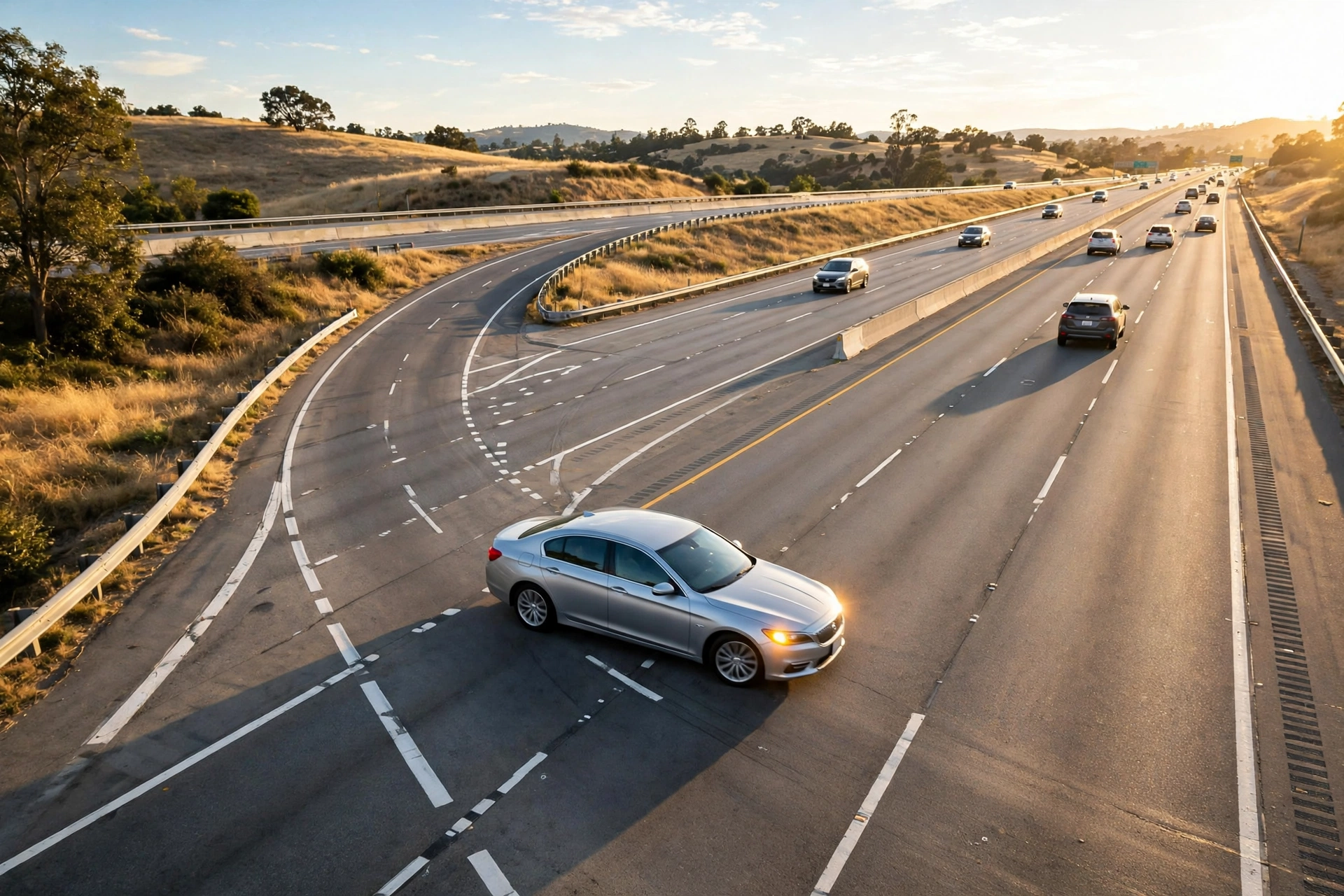
For most new drivers, merging onto the highway is the single scariest moment in the car. The ramp is short, the traffic is fast, and it feels like everyone is judging your timing. Here is the reassuring truth: merging is a skill, not a talent — it follows the same six steps every time. Learn them, practise on a quiet road first, and the merge that feels impossible today will feel routine within weeks.
Written for US drivers in automatic cars.
Why Merging Feels Scary (and Why It Is Simpler Than It Looks)
Merging feels hard because three things happen at once: you are speeding up, watching traffic, and steering into a moving gap. But the cars on the highway are travelling in a straight line at a steady speed. Your job is only to arrive at the same speed, in a gap, at the right moment. You do not need to be brave. You need a routine.
The 6-Step Merge (Use It Every Time)
Memorise these six steps. They work on every ramp, in any car.
Step 1: Read the traffic while you are still on the ramp
Start looking at the highway as soon as you can see it, while you are still on the curved part of the ramp. Ask: How fast is traffic moving? Is the right lane open? Where is the next gap? Picking your gap early means you are planning, not panicking.
Step 2: Use the acceleration lane to match traffic speed
The acceleration lane exists for one reason: to let you speed up. Press the accelerator smoothly until your speed is close to the traffic you are joining — if traffic moves at 65 mph, aim to be near 65 mph before you merge, within the limit. Merging at 40 mph into 65 mph traffic is far more dangerous than getting up to speed, because it forces everyone behind you to brake. The Wisconsin DOT puts it plainly: enter at the same speed traffic is moving.
Step 3: Signal early
Turn your left signal on as soon as you are on the straight part of the acceleration lane. State Farm recommends signalling 100 to 300 feet before you merge. The signal tells the driver beside you "I am coming over" and gives them time to make room. Signal before you move, never during the move.
Step 4: Mirror, blind spot, mirror
Use the SMOG habit driving schools teach: Signal, Mirror, Outside mirror, Glance over your shoulder — then go, if clear. Check your left mirror for an opening, glance over your shoulder to confirm it is real and your blind spot is clear, then check the mirror once more.
Step 5: Pick a gap of 3 to 4 seconds
Look for a gap with at least three to four seconds of following distance to the car you will follow. Judge it with a fixed point — a sign or a pole. When the car ahead passes it, count "one-one-thousand, two-one-thousand, three-one-thousand." If you pass it before you finish, the gap is too small. Never force your way into a tiny opening; adjust your speed slightly to fit a larger, safer gap.
Step 6: Commit smoothly and settle in
Once you have picked your gap, keep your speed steady and ease into the lane in one smooth move — no sudden yanks on the wheel. Then turn your signal off, look well ahead, and rebuild a safe following distance. A good merge looks boring from the outside. That is the goal.
What to Do When the Ramp Is Ending and There Is No Gap
This is the moment beginners fear most, and it has a simple answer: slow down early so you can speed up later. If no gap is open, ease off the accelerator while you are still on the ramp. That opens space behind the car ahead and leaves you room to accelerate into the next gap. The Wisconsin DOT gives exactly this advice.
Do not stop on the acceleration lane unless the traffic ahead has genuinely stopped — a stopped car at the end of a ramp invites a rear-end crash. Never cut in and force another driver to brake or swerve. NHTSA research estimates hundreds of thousands of lane-change crashes are reported to police each year. Patience on the ramp is always cheaper than a crash.
Short Ramps, Heavy Traffic, and Trucks
Short urban ramps. Older city interchanges often have much shorter acceleration lanes. The method stays the same, but the timing changes: read traffic earlier, accelerate sooner, and pick your gap before you reach the lane. At a metered light, stop, then accelerate firmly on green.
Heavy traffic. In a solid stream, look for the rhythm, not a single gap. Watch two or three cars ahead in the right lane: when one moves left or exits, a gap opens behind it. Match its speed, signal, and slide in. If traffic crawls at 20 mph, merge at 20 mph.
Merging near trucks. Give trucks extra room — they need far more distance to slow down than a car, so never merge tightly in front of one. Either pass before your gap or slow down and merge behind. If you cannot see the truck's mirrors, the driver cannot see you.
5 Mistakes That Cause Most Merging Crashes
- Braking on the acceleration lane. Slowing down here forces you to merge much slower than traffic — the riskiest way to enter.
- Stopping at the end of the ramp. Unless traffic ahead has genuinely stopped, keep moving and keep matching speed.
- Skipping the shoulder check. Your mirrors leave a blind spot. A missed check is a top cause of sideswipe crashes — and of failed driving tests.
- Staring at the merge point. Your eyes should be out on the traffic, looking for a gap — not locked on the white line beside you.
- Assuming other drivers will make room. They often do, but you must never count on it. Merge only when the gap is really there.
A Calm Practice Plan for Nervous Drivers
Confidence comes from repetition, not willpower. Climb this ladder one step at a time, with a calm, experienced driver beside you:
- Learn the routine off the highway first. On a quiet multi-lane road, practise signal, mirror, shoulder glance, smooth lane change until it feels automatic.
- Merge at a quiet time. Pick a Sunday morning or a weekday mid-morning, when the highway is light. Enter at a quiet interchange you know well.
- Repeat it 10 or more times. Driving-instruction guidance suggests practising merging and exiting 10 to 12 times each, or more, until comfortable. Do a loop: on, off at the next exit, back on again.
If your hands shake on the ramp, that is normal — your body reacting to something new, not a sign you cannot drive. Breathe slowly, grip the wheel loosely, and run the six steps out loud. Talking through them keeps your brain on the routine instead of on the fear. Once quiet merges feel easy, add one new difficulty at a time: busier traffic, a shorter ramp, then rain.
If You Are Already on the Highway: Let Mergers In
Merging is a two-way skill. When you see a car on the ramp signalling, move one lane left if safe. If you cannot, ease off the gas slightly to open a gap. Never speed up to block a merging driver.
Frequently Asked Questions
Who has the right of way when merging onto the highway?
The cars already on the highway have the right of way — you must yield. That does not mean they should block you; it means you may not force your way in. Wait for a real gap and merge smoothly.
How fast should I go on the entrance ramp?
As fast as the traffic you are joining, within the speed limit. If traffic moves at 65 mph, aim to be near 65 mph by the merge point. Use the full acceleration lane to build speed gradually.
What if nobody lets me in?
Slow down early on the ramp to open a gap behind the car ahead, then accelerate into the next opening. Watch for a car that slows down or moves left — that driver is making room. Never force your way in.
Should I stop on the ramp if there is no gap?
Almost never. Stopping on the acceleration lane is dangerous because the driver behind you expects you to keep moving. Only stop if traffic ahead has genuinely stopped.
Is it safer to merge slowly to be careful?
No — merging too slowly is one of the most dangerous things you can do. A large speed difference causes rear-end crashes. Being careful means matching speed and choosing a proper gap — not crawling onto the highway.
Conclusion
Merging is not a test of courage. It is a six-step routine: read traffic early, match speed, signal early, check mirror and blind spot, pick a three-to-four-second gap, and commit smoothly. Practise it ten times on a quiet highway and it stops feeling like a leap of faith. Next time, run the steps out loud, trust the routine, and slide into the flow — calmly, at speed, in your own gap.
Keep building your highway confidence with our heavy-rain driving guide, our first-time snow driving guide, and our emergency kit checklist.
Sources
State Farm — How to Merge onto the Highway (right of way, 100–300 ft signal, 3–4 second gap)
Wisconsin DOT — Practice Safe Merging Techniques to Prevent Crashes (match traffic speed; slow on the ramp to create room)