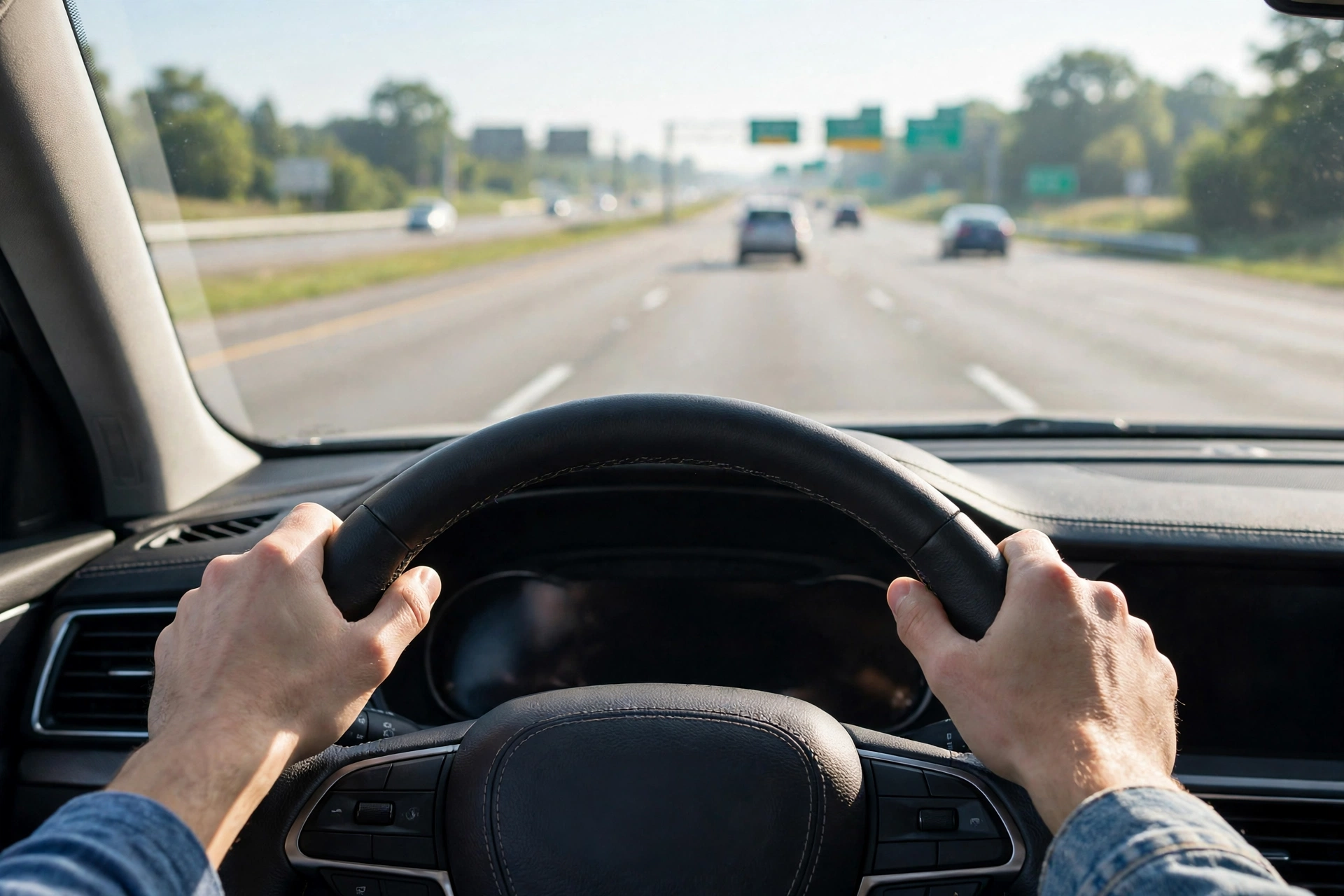
Your hands are at ten and two. The speedometer is climbing past 60 for the first time. Cars are flying past on your left, a truck is filling your mirror on the right, and every instinct says this was a mistake. It was not. Every driver you see felt exactly this way on their first highway trip — and the highway is actually one of the safest places to drive once you know the rules. This guide gives you a complete plan: what to do before you leave, how to merge without panic, where to sit in traffic, and how to get off safely.
Before You Go: The 10-Minute First-Trip Plan
A good first highway drive is decided before you turn the key. Do these four things and the drive itself gets much easier.
- Pick a short, easy route. A 10-minute hop with one or two exits, not a two-hour trip. Know your exit number in advance so you are not reading signs and steering at the same time.
- Pick a quiet time. Mid-morning on a weekday or a Sunday morning is ideal. Avoid rush hour (roughly 7–9 a.m. and 4–7 p.m.) and skip rain, fog, or darkness for your first trip.
- Do a 60-second car check. Tires look properly inflated, fuel above a quarter tank, mirrors adjusted, phone on silent and out of reach.
- Bring a calm passenger if you can. An experienced driver in the passenger seat can watch your blind spot and read exit signs while you focus on the road.
Merging: The Scariest 30 Seconds (and How to Own Them)
Merging is the part every beginner dreads, and it is also the part with the clearest technique. The on-ramp is your acceleration zone — use all of it. Get up to highway speed on the ramp, so you join traffic at the same speed instead of crawling in front of cars doing 65 mph. Signal early, check your mirror and blind spot, find a gap of at least three seconds, and steer smoothly into it — do not stop on the ramp unless traffic is completely blocked. If no gap appears, slow down on the ramp and wait for the next one; never force your way in. For the full step-by-step version, read our dedicated guide on how to merge onto the highway safely.
Which Lane Should You Stay In?
For your first 10 to 20 highway trips, live in the right lane. It is the slowest lane, it is where on-ramps join, and it is where your exits are. The middle lane is for steady cruising once you are comfortable, and the left lane is for passing only.
Two rules that keep you safe: do not cruise in the left lane at the same speed as the traffic behind you, and do not weave between lanes to gain a few seconds. Pick a lane, hold your speed, and change lanes only when you have a clear reason and a clear gap.
The 3-Second Rule: Your Following Distance
At highway speed, distance is measured in seconds, not car lengths. The AAA three-second rule is the standard: pick a fixed object — a sign or an overpass — and start counting when the car ahead passes it. If you reach the same object before you finish counting "one thousand one, one thousand two, one thousand three," you are too close.
Why it matters: at 60 mph you travel about 88 feet every second, and your total stopping distance is roughly 270 feet. Three seconds is the minimum in perfect conditions. At highway speeds, aim for four seconds, and double the gap to six seconds in rain. Rear-end collisions make up roughly 29% of all US crashes, and most happen because drivers followed too closely. Space is your cheapest safety equipment.
Passing and Changing Lanes Safely
Changing lanes at 65 mph uses the same technique as at 30 mph, just with bigger gaps. Use the SMOG routine every time:
- Signal — let everyone know your intention.
- Mirror — check the rearview and side mirror.
- Over-the-shoulder — a quick glance covers the blind spot mirrors cannot see.
- Go — move over smoothly, without speeding up or slowing down mid-move.
Pass one car at a time and return to your lane only when you can see the passed car's headlights in your rearview mirror. Never pass on the right unless traffic is genuinely flowing that way.
Sharing the Road With Trucks
A truck's blind spots — the "no-zones" — are far bigger than a car's: directly behind the trailer, just in front of the cab, and along both sides, especially the right. If you cannot see the truck driver's mirrors, the driver cannot see you.
Three truck rules for beginners: never cut in front of a truck and brake — it needs far more distance to stop than you do; pass trucks decisively, in one smooth move, and do not dawdle beside the trailer; and expect a push of wind as you pass, so hold the wheel steady with both hands. If a truck is tailgating you, do not speed up — ease off the gas slightly and let it pass when it can.
Exiting Without Panic
Exits cause more beginner mistakes than merges, because they sneak up. Start watching for your exit sign about a mile out. Move into the right lane early, signal, and slow down on the exit ramp, not on the highway itself.
If you miss your exit, you miss your exit. Never reverse on a highway, never swerve across lanes at the last second, and never stop on the shoulder to turn around. Take the next exit, turn around safely, and come back. Losing five minutes is always better than causing a crash.
If Something Goes Wrong
Most first trips go fine, but knowing the plan removes the fear. If your car starts shaking, losing power, or a warning light comes on, signal, ease off the gas, and move to the right shoulder as soon as it is safe. Once stopped, turn on your hazard lights, stay in the car with your seatbelt on, and call for help.
If a tire blows out at speed, do not slam the brakes. Hold the wheel firmly, ease off the gas, and let the car slow on its own before steering gently to the shoulder — our guide to handling a tire blowout safely covers this in detail. And before any long drive, keep a basic emergency kit in your car: a charged phone, water, a flashlight, and your roadside-assistance number saved in advance.
Your First-Trip Practice Ladder
Confidence is built in small steps, not one brave leap. Try this three-trip ladder:
- Trip 1 — one exit, off-peak. On at one ramp, off at the very next exit. Ten minutes total. That is a complete success.
- Trip 2 — three exits, light traffic. Practice one lane change and one pass of a slow vehicle.
- Trip 3 — a real destination. A 20–30 minute drive to somewhere you actually want to go, in daylight, in dry weather.
5 Mistakes First-Timers Make
- Driving too slowly. Going 45 in a 65 zone is more dangerous than keeping up — it forces everyone to brake and swerve around you. Match the flow of traffic.
- Staring at the car ahead. Look 10–15 seconds down the road, not at the bumper ahead. Your steering follows your eyes.
- Gripping the wheel too tight. A white-knuckle grip makes every small correction jerky. Hold the wheel firmly but relaxed, at nine and three.
- Forgetting the blind spot. Mirrors do not show everything. One quick shoulder check before every lane change, every time.
- Using cruise control too early. Skip cruise control on your first few trips — you want your foot on the pedals while you are still learning how the car feels at speed.
Frequently Asked Questions
How fast should I drive on the highway for the first time?
Drive at or near the posted speed limit, matching the flow of traffic around you. Going much slower than traffic is dangerous, and going much faster is unnecessary.
Is it normal to be nervous on the highway?
Completely normal. Almost every new driver is nervous for the first few trips, and the nerves fade with repetition — that is why the practice ladder above starts with a single-exit trip.
What should I do if a car tailgates me on the highway?
Do not speed up and do not brake-check them. Stay calm, keep your speed steady, and move to the right lane when you safely can so they can pass.
Can I drive on the highway with my learner's permit?
It depends on your state — many allow highway driving with a licensed adult in the passenger seat, while others restrict it. Check your state's DMV rules before your first trip.
What is the safest time for a first highway drive?
A clear, dry weekday mid-morning (around 10–11 a.m.) or a Sunday morning, when traffic is light and visibility is good. BrokerLink's first-time highway guide gives the same advice: avoid rush hour and bad weather for your first trip. Avoid night driving until you have several highway trips behind you.
Conclusion
Your first highway drive is a milestone, not a test. Pick a short route, go at a quiet time, merge at highway speed, stay in the right lane, keep a four-second gap, and take the next exit if you miss yours. Do that a few times and the highway becomes just another road. The nervousness is temporary. The freedom is permanent.