Changing lanes looks easy — until you do it in real traffic, where it causes a large share of beginner crashes. The car you never saw was sitting in your blind spot the whole time. The good news: a safe lane change is a routine, not a talent. Learn the same six steps, use them every time, and the move becomes boring, which is exactly what you want.
NHTSA figures put blind-spot crashes in the United States at nearly 840,000 a year, and lane-change crashes make up 4 to 10 percent of all crashes. Most are caused by a skipped check, not bad luck.
What a Blind Spot Actually Is
Your blind spot is the area beside and just behind your car that neither your rear-view mirror nor your side mirrors can show you. A whole car, a motorcycle, or a cyclist can sit there while both mirrors look empty. The zone sits roughly alongside your rear doors and moves with you.
It exists because mirrors have a fixed field of view, your car's pillars block parts of your peripheral vision, and other vehicles move: a car visible in your mirror five seconds ago can slide into the blind spot while you decide. Check at the moment you move, not from memory.
Set your mirrors properly first. The NHTSA method: lean your head against the driver's window and angle the left mirror outward until the side of your car barely shows at its inner edge, then lean toward the centre and do the same for the right mirror. You will see little of your own car and much more of the next lane — but the shoulder check is still required.
The 6-Step Safe Lane Change Routine
Use the same order every time — a fixed routine means you never have to decide what to check next at 65 mph.
Step 1: Plan before you signal
Decide why you are changing lanes first: passing a slow vehicle, moving out of a merging lane, or getting into the correct lane for an exit? If you have no reason, stay where you are.
Step 2: Check your mirrors
Start with the rear-view mirror, then the side mirror on the side you want to move toward. Ask two questions: is there a gap, and is anything closing it fast? A car that looks small may be approaching much faster than it seems.
Step 3: Signal early
Turn your indicator on at least 3 seconds before your wheels start moving — longer on fast roads. A signal is a request, not a reservation: it tells other drivers what you intend to do, it does not make the gap yours. New York law requires a signal at least 100 feet before a lane change; California suggests about 5 seconds before a freeway exit.
Step 4: Do the shoulder check
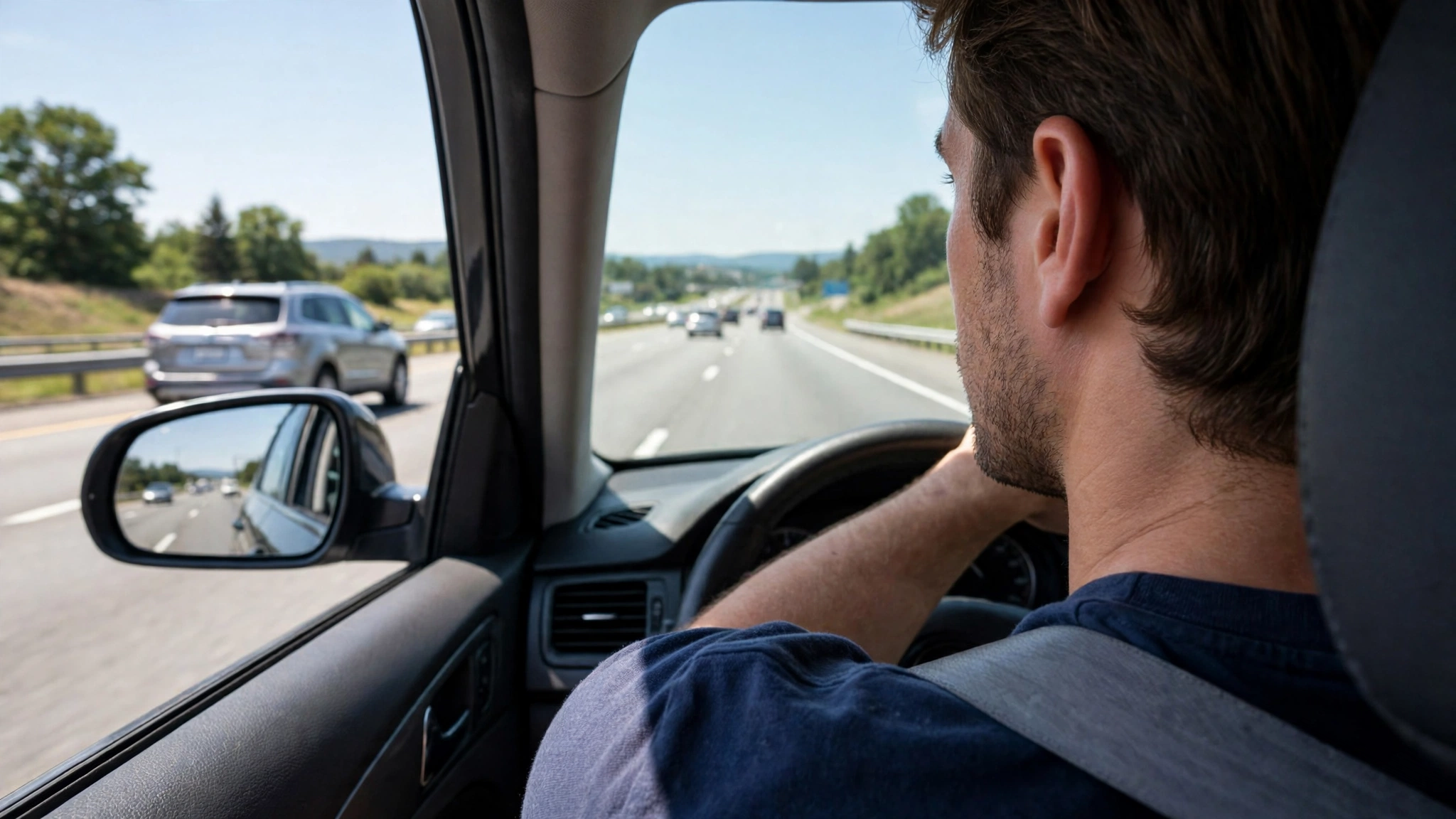
This is the step people skip, and the one that prevents the most crashes. Turn your head — not your shoulders — and glance quickly over the shoulder on the side of your intended lane change, at the space beside your rear door. Keep it brief: your eyes must be back on the road ahead within about a second. If anything is there, abort and wait.
Step 5: Move gradually
Steer smoothly into the new lane in one gentle, continuous movement. Do not swerve, and do not slow down while you cross the line — that surprises the driver behind you. Keep your speed steady or increase it slightly; the whole move should take about 3 to 5 seconds.
Step 6: Cancel the signal and settle in
Once fully in the new lane, cancel your indicator and re-check your mirrors. Keep at least 3 seconds of following distance from the vehicle ahead at highway speed. A good lane change ends with nobody around you braking.
How to Judge Whether the Gap Is Big Enough
The hardest part is not the steering; it is judging the gap. You need enough room that the driver behind you will not have to brake or swerve. If you are not sure, the gap is too small.
At highway speed, a safe gap is roughly 4 to 6 car lengths behind the vehicle ahead in the target lane, with at least 2 to 3 clear car lengths behind you. At city speeds of 30 to 40 mph, 2 to 3 car lengths is usually enough. Watch the closing speed, not just the distance: a car two lengths back but approaching 20 mph faster than you will be on your bumper before you finish the move. When in doubt, wait — missing your exit costs almost nothing, while a sideswipe costs a repair bill and an insurance claim.
5 Mistakes Beginners Make When Changing Lanes
1. Trusting the mirrors alone. Mirrors are your first check, never your only check — in NHTSA's 100-Car study, only half of drivers even glanced out the side window before a planned left-lane change.
2. Signalling while already moving. A signal that comes on halfway across the line warns nobody. Signal first, wait, then move.
3. Slowing down mid-change. Lifting off the accelerator leaves you half in each lane, slower than both lanes of traffic. Keep your speed steady.
4. Changing lanes in or near an intersection. Other drivers are turning, merging, and crossing your path there, and lane markings often prohibit it anyway. Stay in your lane and change after you are clear.
5. Chasing a disappearing gap. If the gap closes while you are signalling, let it go. Do not speed up to squeeze in, and do not force the driver behind to brake. Another gap will come in a few seconds.
Special Cases: Trucks, Motorcycles, Rain, and Blind-Spot Monitors
Large trucks have blind spots the size of rooms. The Federal Motor Carrier Safety Administration calls them "No-Zones": about 20 feet in front of the cab, about 30 feet behind the trailer, one full lane left, two full lanes right. If you cannot see the truck driver's mirrors, the driver cannot see you — pass on the left, and never linger beside one.
Motorcycles are the easiest vehicles to lose. A motorcycle's narrow profile can hide completely in a blind spot. Check twice on a busy road, once for cars and once for anything smaller — a car you miss might dent your door, but a motorcycle you miss can throw its rider.
Rain and darkness shrink everything. Wet mirrors distort, spray blurs your view, and at night a motorcycle's single headlight can look like a distant car. In bad weather, double your following distance, signal earlier, and only change lanes when the gap is clearly large. If you cannot do a proper shoulder check, do not change lanes.
Blind-spot monitors help, but they do not replace looking. Cars with blind-spot warning systems show 23 percent fewer lane-change injury crashes, according to the Insurance Institute for Highway Safety. But the sensors can miss a fast vehicle, a motorcycle, or a car in heavy rain. Treat the warning light as a backup, not permission.
A 10-Minute Practice Drill for Beginners
Build the routine into muscle memory before you need it in traffic. On a quiet multi-lane road, practise the full sequence out loud: "Mirror, signal, shoulder, move." Practise left and right changes, and practise aborting: signal, check, see an imaginary car, and cancel the signal without moving.
Quick Checklist: Before Every Lane Change
- Do I have a reason to change lanes?
- Rear-view mirror checked?
- Side mirror checked?
- Signal on for at least 3 seconds?
- Shoulder check done — blind spot actually clear?
- Gap big enough?
- Move smoothly, keep my speed, cancel the signal, re-check mirrors.
Frequently Asked Questions
How long should I signal before changing lanes?
At least 3 seconds before your wheels start moving, and longer on fast roads. New York law requires at least 100 feet — but the time rule is safer, because 100 feet passes in about one second at 65 mph.
Do I really need the shoulder check if my mirrors are set correctly?
Yes. Correctly set mirrors shrink your blind spots, but they do not remove them. NHTSA still advises a shoulder check before every lane change.
What should I do if someone is in my blind spot when I check?
Abort. Cancel your signal, stay in your lane, and wait for the next gap. Never speed up to get ahead of the hidden vehicle.
Is it safe to change lanes next to a large truck?
Only when you can see the truck driver's mirrors and you have a clear gap ahead. Never linger beside a truck — its blind spots cover one full lane on the left and two on the right.
Can I rely on my car's blind-spot monitor instead of looking?
No. Monitors reduce lane-change injury crashes by about 23 percent, but they can miss fast vehicles, motorcycles, and cars in heavy rain. Always check yourself.
Conclusion
A safe lane change is six steps in the same order every time: plan, check your mirrors, signal early, glance over your shoulder, move smoothly, and settle in. The shoulder check is the step that saves you — quick, easy, and the one beginners skip most. Practise it until it is automatic, and when in doubt, wait.
Sources: Ontario MTO Driver's Handbook — Changing Positions; Safety Behind the Wheel Foundation — Changing Lanes Safely. Related reading on FirstCarCare: How to Merge Onto the Highway Safely, Driving on the Highway for the First Time, How to Parallel Park, How to Back Into a Parking Space.