Parallel parking is the one driving skill almost every new driver dreads: a tight gap, cars in front and behind, a curb you cannot see, and usually someone waiting behind you. Here is the secret experienced drivers know — it is not about talent. It is a repeatable sequence of reference points: follow the same steps, watch for the same cues, and the car goes in the same way every time.
This guide breaks the maneuver into six steps, explains the reference points that tell you when to turn the wheel, and ends with a 15-minute practice drill.
What Is Parallel Parking?
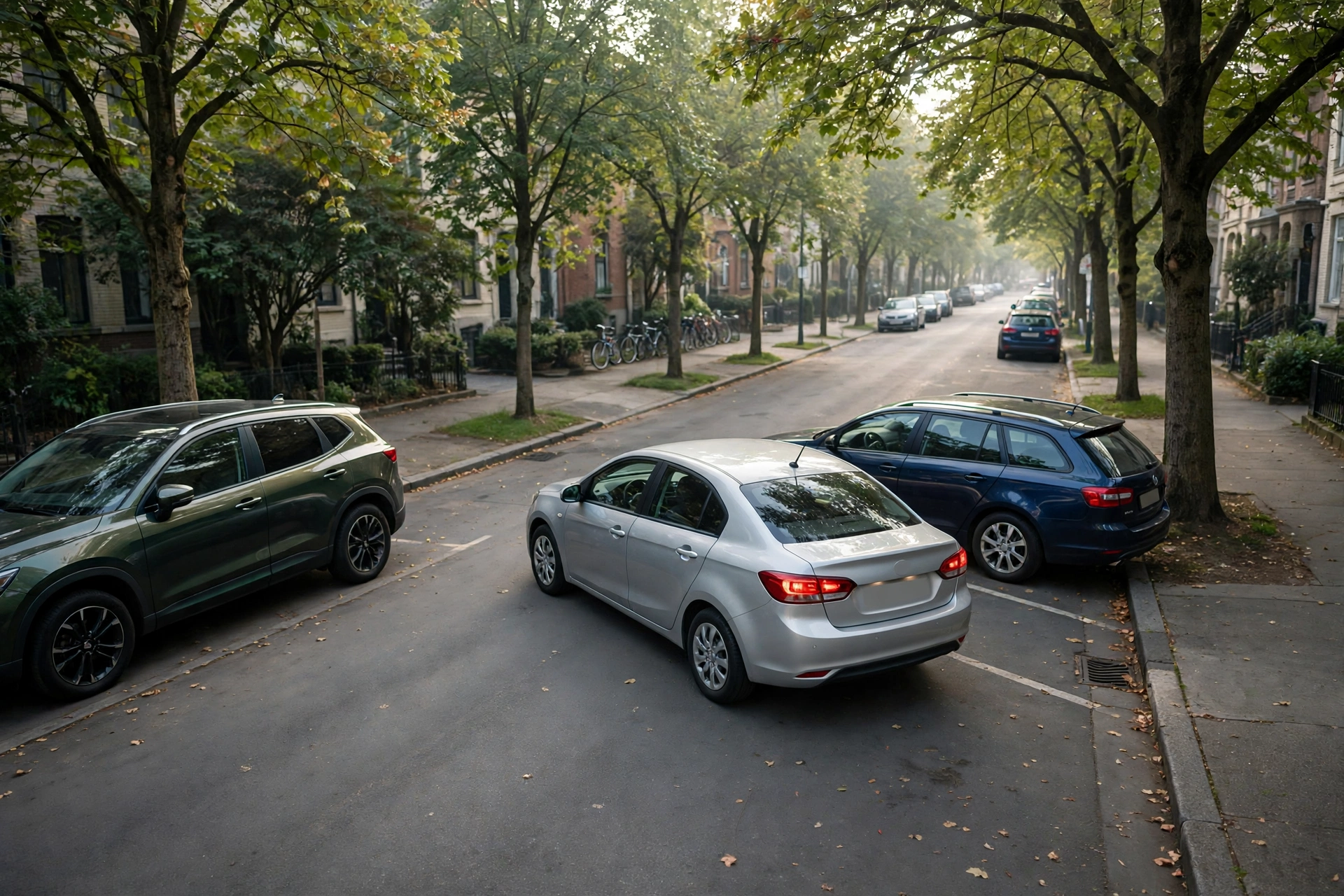
Parallel parking means parking your car in line with the road, parallel to the curb, in a space between two parked cars. It is the standard way to park on city streets and in older residential areas with no marked bays — and you have to reverse into the space. That is deliberate: reversing in lets your front wheels swing out while your rear wheels tuck toward the curb.
Before You Start: 3 Things to Know
1. The space must be big enough. Look for a gap at least one and a half times your car's length — for an average sedan, roughly 6 feet longer than the car. If it looks too tight, it probably is. Drive on and find a better one.
2. Set your mirrors first. Adjust your side mirrors so you can see the curb and the cars beside you. If your car tilts the passenger-side mirror down in reverse, use it — it shows your rear wheel's distance from the curb.
3. Go slow. The whole maneuver should happen at walking pace or less, foot covering the brake. At 2 mph you have time to see each reference point; at 5 mph you will be past it before you notice.
How to Parallel Park in 6 Steps
The steps below assume you are parking on the right-hand side of the road, the usual case in the US. Parking on the left? Mirror everything.
Step 1: Signal and pull up alongside the front car
Turn on your right turn signal. Pull up parallel to the car parked in front of the empty space, leaving about 2 to 3 feet between your car and theirs. Stop when your rear bumper lines up with theirs — this is your starting position, and everything else follows.
Step 2: Check all around, then shift into reverse
Check your mirrors and look over your right shoulder for pedestrians, cyclists, and cars coming up behind you. A useful memory aid is MSMOG: Mirrors, Signal, Mirrors again, look Over your shoulder, then Go when safe. Shift into reverse, foot on the brake.
Step 3: Turn the wheel fully toward the curb and reverse slowly
Turn the steering wheel all the way to the right (toward the curb) and reverse very slowly. Your car will angle into the space, nose swinging out into the road. Keep going until you are at roughly a 45-degree angle — a handy cue is that you can now see the headlights of the car behind you in your driver's-side mirror.
Step 4: Straighten the wheel and keep reversing
At about 45 degrees, straighten the wheels and keep reversing slowly. Watch your passenger-side mirror: the curb should be coming into view along the bottom.
Step 5: Turn the wheel fully away from the curb
When your front bumper has cleared the rear bumper of the car in front — for most cars, when that bumper lines up with your passenger-side mirror — turn the steering wheel all the way to the left (away from the curb) and keep reversing slowly, until your car is parallel to the curb.
Step 6: Centre the car and finish
Straighten your wheels. If you are too far forward or back, pull forward or reverse a little to centre your car. Finish 12 to 18 inches from the curb — close enough that you are not blocking traffic, far enough that your tires never touch it. Put the car in park, set the parking brake, and check for traffic before you open your door.
Reference Points Cheat Sheet
These visual cues tell you when to act — no guessing required:
- Starting position: rear bumpers lined up, 2–3 feet out from the front car's side.
- First turn (full lock toward the curb): as soon as your rear bumper passes the front car's.
- Straighten the wheel: at about 45 degrees to the curb, or when you can see the car behind you in your driver's-side mirror.
- Second turn (full lock away from the curb): when the front car's rear bumper lines up with your passenger-side mirror.
- Stop reversing: when your car is parallel to the curb, 12–18 inches away.
5 Common Mistakes (and the Fix for Each)
1. Starting too far forward or too far back. If your rear bumper is not lined up with the front car's, the geometry is wrong from the start. Fix: pull forward and line the bumpers up before you reverse.
2. Turning the wheel too late. Waiting too long means your car goes straight back instead of angling in. Fix: turn the wheel fully as soon as you start moving — turn fast, drive slow.
3. Going too fast. Speed turns small errors into big ones. Fix: keep your foot over the brake and reverse at walking pace. If in doubt, stop and look around.
4. Staring at the backup camera. The camera shows a narrow slice behind you and flattens distance. Fix: use mirrors and look over your shoulder as your main guides; glance at the camera only to confirm the distance behind.
5. Finishing too far from the curb. Ending up two feet from the curb blocks traffic and can earn a ticket. Fix: pull forward and start again — one clean retry beats a crooked park.
Using Your Backup Camera and Parking Sensors
Modern cars make parallel parking easier — but the technology is a helper, not a replacement for the technique above. Use the backup camera to confirm the distance to the car behind you: the guide lines typically show green for clear space, yellow for caution, and red for stop, usually around 15 to 18 inches from an obstacle. But the camera has no depth perception and can be fooled by glare. Parking sensors beep as you approach an object — a steady tone means stop — but they can miss low curbs and thin poles. Mirrors and shoulder checks first, camera and sensors as confirmation.
How to Get Out of a Parallel Space
Signal left and check your mirrors and blind spot. Reverse a little if you have room, then turn the wheel fully away from the curb and pull forward slowly when the way is clear. If the car in front is very close, go back and forth once or twice to create enough angle.
A 15-Minute Practice Drill
The fastest way to make parallel parking automatic is to practice it somewhere with no pressure.
- Place two cones, boxes, or bins about 1.5 car lengths apart along a curb or a painted line — these stand in for the parked cars.
- Drive up alongside the "front" cone, line up your bumpers, signal, and run through the six steps.
- Repeat five times, moving the cones closer each time until the gap is just 1.5 times your car's length.
- Practice getting out again, five times, until pulling out feels routine.
- Finally, try it between two real parked cars on a quiet street, with a friend watching the first time.
After about ten repetitions, the reference points become muscle memory.
Frequently Asked Questions
How big does a parallel parking space need to be?
At least one and a half times your car's length — for an average sedan, roughly 6 feet longer than the car. The California DMV handbook says at least three feet longer, but a bigger gap is far easier.
How close to the curb should I finish?
12 to 18 inches away, parallel to the curb. Closer risks scraping a wheel; further out blocks traffic and can earn a ticket.
Can I use my backup camera during the driving test?
It depends on where you take the test. In many places you may glance at it, but examiners expect you to look over your shoulder and use your mirrors.
What if I hit the curb while parallel parking?
A light touch is usually fine — stop, pull forward, and try again. If you hit it hard, check the tire and wheel for damage before driving on.
Is it OK to pull forward and try again?
Yes — absolutely. Pulling out and starting over is what good drivers do when the angle is wrong. On a driving test, a correction is usually allowed; hitting the curb or another car is not.
The Bottom Line
Parallel parking is a sequence, not a talent. Pick a space at least 1.5 times your car's length, line up your rear bumper with the front car's, reverse at a 45-degree angle using your reference points, straighten, swing the front in, and finish 12 to 18 inches from the curb. Practice it ten times and it becomes automatic.
Do the drill this week — before you need the skill on a busy street. For more beginner driving skills, see our guides on backing into a parking space and parking safely on a hill. For the official steps, the California DMV driver handbook and GEICO's parallel parking guide are both excellent references.