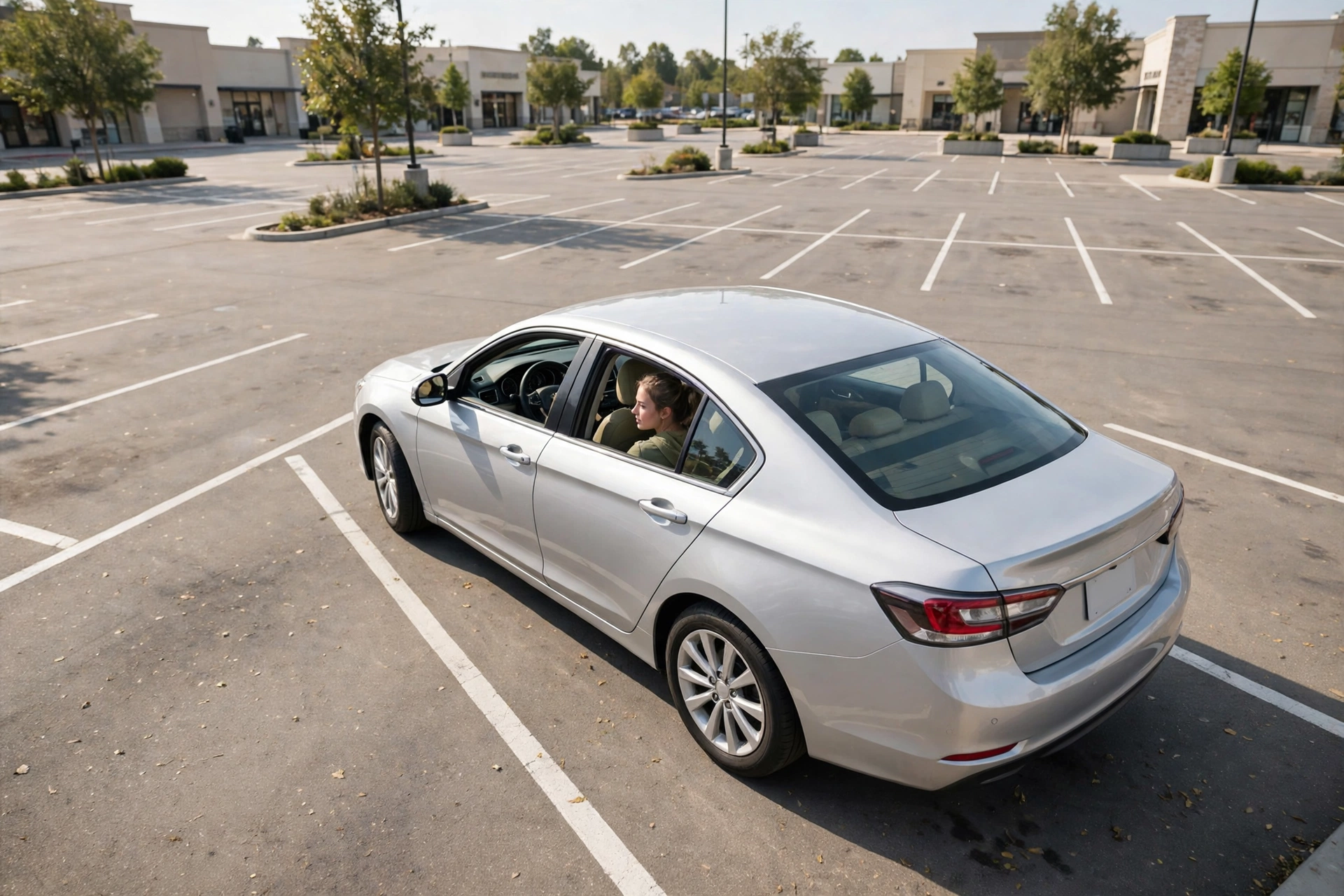
Backing into a parking space feels awkward at first — steering backwards, judging distances in mirrors. Most new drivers avoid it and pull in nose-first. Understandable, but riskier: the hard part is not getting into the space, it is getting back out of it, blind, into a lane of moving cars and pedestrians.
That is why AAA updated its driver-training curriculum around 2020 to recommend backing into spaces whenever possible. A 2020 study in Transportation Research found that backing out of a space caused 90% of the parking accidents it examined, and the Insurance Institute for Highway Safety reports that about 20% of all reported vehicle crashes happen in parking lots. Back in when you arrive, and you drive out facing the traffic.
This guide gives you one repeatable method for a perpendicular bay, plus the angled-bay exception, a tight-space variation, and a 15-minute practice drill — with reference points you can see from the driver's seat.
Before You Start: Set Up Your Mirrors and Seat
Good reverse parking starts before you move:
- Dip your side mirrors slightly. Tilt both side mirrors down just enough that you can see the rear wheels and the painted bay lines in them. You can return them to normal after parking. This one change is the difference between guessing where the lines are and actually seeing them.
- Know your camera's guide lines. If your car has a backup camera (standard on new US vehicles since 2018), the coloured lines show roughly where your rear bumper will go. They help, but they never replace mirrors and a shoulder check — AAA testing found rear cross-traffic systems miss pedestrians far more often than drivers expect.
- Pick an easy space first. While you are learning, choose a bay with an empty space on at least one side, or an end bay. Fewer neighbouring cars means more room for error.
The 45-Degree Method: Backing Into a Perpendicular Bay, Step by Step
This is the method driving instructors teach, and it works because you line the car up before you are deep inside the bay. Follow it slowly — walking speed, foot hovering over the brake.
Step 1: Signal and drive past the space
As soon as you choose your bay, switch on your indicator toward that side. This tells drivers behind you that you are about to slow down and manoeuvre, so they give you room instead of trying to pass. Then drive slowly past the bay.
Step 2: Stop in the right starting position
Stop when your shoulder — or your side mirror — is roughly level with the far line of the bay, about one car's width out from the row of parked cars. Think of it as parking one lane away from the bay, not right beside it. This gap lets you swing in at a smooth angle instead of jack-knifing.
Step 3: Check all around, then turn away from the bay
Check mirrors, blind spots, and over your shoulder for pedestrians, carts, and cars. If anyone is close, wait. Then, moving forward slowly, turn the wheel away from the bay so the front end swings out and the car angles to roughly 45 degrees. Stop.
Step 4: Shift to reverse and turn toward the bay
Shift into reverse, turn the wheel fully toward the bay, and back up slowly in an arc, checking both mirrors and glancing over your shoulder. Your rear wheels track tightly into the bay while the front swings wide — normal, and why you left that car's width of space.
Step 5: Straighten up as the car lines up
As soon as your car looks parallel with the painted lines in your mirrors, turn the wheel back to centre and keep reversing straight back, slowly. Small steering corrections now are easy; big ones later, when you are boxed in between two cars, are not.
Step 6: Stop at the right depth
Use the rear-window rule: keep reversing until the curb or painted line at the back of the bay appears to cut across (bisect) your rear window. That is your stop point — the rear bumper is just inside the bay. Cross-check with the camera's guide lines if you have one.
Step 7: Final checks, then park
Check both mirrors: you should be roughly centred, with similar gaps on each side. If a little off, pull forward a touch and straighten. Shift to park (or neutral with the handbrake in a manual) and switch off — you are now facing out, ready for an easy exit.
Angled Bays: The One Exception — Pull In Forward
Angled parking bays (usually 45 or 60 degrees) are designed for one-way flow. AAA's guidance is clear: follow the flow of traffic and pull forward into an angled bay. Backing into one means driving against the flow and cutting across traffic, which confuses other drivers. For these, nose in.
Backing In Between Two Cars (Tight Spaces)
A bay between two parked cars uses the same method, just slower and with smaller margins:
- Go even slower. At crawling speed you can stop the instant a mirror shows you drifting toward a neighbour's door.
- Use your mirrors, not just the camera. The camera shows what is directly behind you; the mirrors show how close your rear corners are to the cars beside you. Check both, alternating.
- Accept two attempts. If the angle is wrong halfway in, do not keep steering and hope. Stop, pull forward out of the bay, and reset. A clean second attempt takes twenty seconds; a scraped bumper takes a body shop visit.
What to Do When It Goes Wrong Mid-Manoeuvre
Every driver gets the angle wrong sometimes. The fix is always the same:
- Stop. Foot on the brake, take a breath. Nothing bad happens while the car is stationary.
- Look. Check both mirrors and the camera. Identify exactly what is wrong: too close on the left, angled too far right, too far forward.
- Pull forward and reset. Shift to drive, pull forward out of the bay, and start the 45-degree setup again from step 2.
- Ask for a spotter if one is available. A passenger outside, visible in your mirror, can guide you with hand signals — agree on them first, and that "stop" means stop immediately.
Never reverse further into a problem hoping it fixes itself. Reversing only makes a bad angle worse.
The 15-Minute Practice Drill (Empty Lot)
Reading about reverse parking helps, but ten real repetitions in an empty lot teach you more than any article. Try this drill this weekend:
- Find an empty section of a parking lot — a quiet corner on a Sunday morning is ideal — and bring two empty plastic bottles or cones.
- Mark a bay with the bottles or cones, using the painted lines if there are any.
- Run the 45-degree method five times into the same bay. Each time, check your mirrors at the end: centred? Stopped at the right depth?
- Add a "neighbour". Move one bottle to mark the edge of an imaginary neighbouring car and repeat three times, watching that side's mirror the whole way in.
- Practice the reset. Deliberately start one attempt with a bad angle, then practise stopping, pulling forward, and resetting cleanly. This is the skill that saves bumpers in real life.
After ten repetitions, the reference points — shoulder level with the far line, 45-degree swing, rear-window stop rule — feel automatic. In a busy lot, you want the method to run on habit.
Why Bother? The Payoff Is Real
Backing in takes about thirty seconds longer than pulling in forward — and it pays that time back the moment you leave. You drive out facing the traffic with a full view of the lane, pedestrians, and oncoming cars, instead of reversing blind into them. Once the 45-degree method becomes habit, it just becomes how you park.
For more first-car driving skills, see our guide to parking safely on a hill and our first-car checklist before you drive home. Our monthly car maintenance checklist covers the habits that keep a new car reliable, and our pre-road-trip inspection checklist is worth a read before any long drive.
Frequently Asked Questions
Is it better to back into a parking space or pull in forward?
Back in whenever it is legal and the space is not angled. AAA recommends it because you drive out facing traffic — a 2020 study found backing out caused 90% of the parking accidents it examined.
How far should I drive past the space before reversing in?
Until your shoulder (or side mirror) is roughly level with the far line of the space, about one car's width out from the row. That gap gives you room to swing in at a 45-degree angle.
How do I know when to stop reversing?
Use the rear-window rule: stop when the curb or painted line at the back of the bay appears to cut across (bisect) your rear window. Then confirm you are centred in both mirrors.
What if I get the angle wrong halfway in?
Stop, shift to drive, pull forward out of the bay, and start again. A clean reset takes 20 seconds and saves a bumper.
Is backing into a space illegal anywhere?
It is legal almost everywhere, but some garages and lots post "head-in only" signs. Always follow posted signs, and in angled bays follow the flow of traffic and pull in forward.