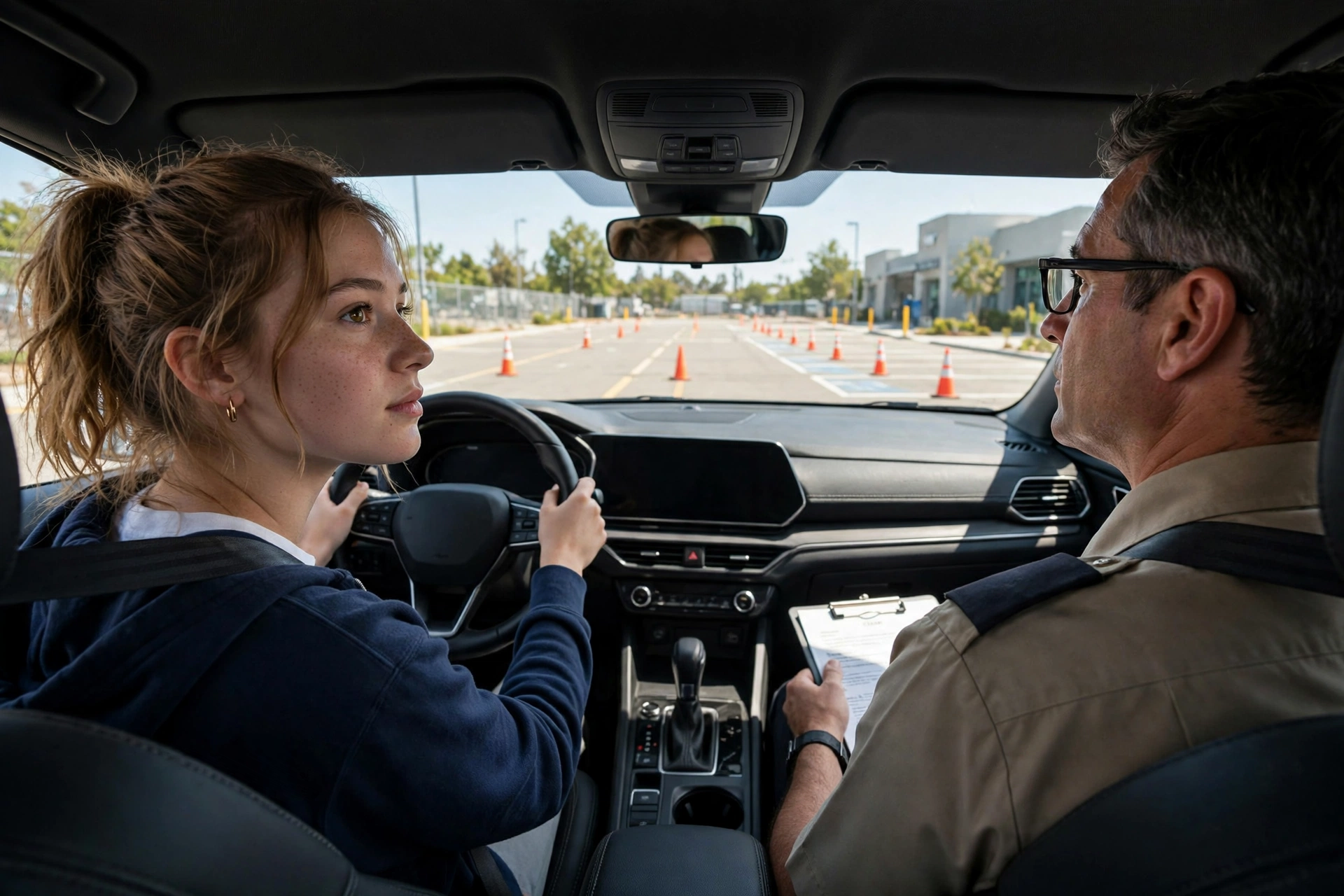
About half of first-time road test takers fail — usually on the same five preventable mistakes. The people who pass are rarely better drivers; they are better prepared, calmer, and more predictable. These 15 tips cover the test, the manoeuvres that fail the most people, and your nerves.
What the Road Test Actually Is
The road test (also called the behind-the-wheel test) is the in-car part of your driving exam. A licensed examiner rides with you for about 15 to 30 minutes on real roads, scoring how you handle traffic, turns, intersections, and one or two parking manoeuvres. This minute-by-minute road test walkthrough shows what examiners watch for at each stage.
Most states score 25 to 35 specific actions and allow a set number of small point deductions. A few errors are automatic fails — running a red light or stop sign, hitting a cone or curb while parallel parking, failing to yield to a pedestrian, driving without a seatbelt, or disobeying the examiner. Everything else is points.
What you are tested on varies by state: California, Texas, and Florida test both parallel parking and the three-point turn; New York tests parallel parking only; Pennsylvania tests the three-point turn only; North Carolina does not require it at all. Check your state's DMV website before test day.
The 5 Mistakes That Fail Most First-Timers
1. Rolling stops
The number-one failure cause in most states. At every stop sign your wheels must come to a complete, dead stop — even at a quiet intersection. Count "one Mississippi, two Mississippi" on the brake before moving off. A slow creep counts as a moving violation, and in many states it is an automatic fail.
2. Skipped mirror and blind-spot checks
Examiners need to see you check. Before every lane change, turn, or merge, check your mirrors and physically turn your head for the blind spot — an eye flick is not enough.
3. Wrong speed
Both directions hurt. Driving 5 mph under the limit reads as hesitation; 10 or more under reads as a lack of confidence. Going over is worse. Match the posted limit and adjust for rain, curves, and traffic.
4. Drifting out of lane
Riding the centre line or hugging the shoulder burns points fast. Keep your eyes well ahead of the car and your lane position will steady itself.
5. Parking panic
Parallel parking alone accounts for roughly 18 to 22 percent of road test failures — usually from multiple attempts or touching the curb. Slow down, use your reference points, and remember you can usually pull out and try again.
Before Test Day: 5 Tips That Decide the Result
Tip 1 — Book only when you are genuinely ready. The biggest predictor of a first-time pass is readiness. You should be able to drive 30 to 40 minutes in traffic without your instructor saying anything.
Tip 2 — Take at least two mock tests. Ask your instructor to run a full mock test under real conditions: same time limit, no coaching, scored like the real thing. Nine out of ten learners say mock tests helped them prepare (DVSA Ready to Pass campaign).
Tip 3 — Learn your state's test format. Download your state's official driver's handbook from your DMV and read the road test section — which manoeuvres are tested, how scoring works, and what counts as an automatic fail.
Tip 4 — Practise on the test routes. Most tests follow patterns around the local test centre: the same tricky intersections, school zones, and speed changes. Drive those streets until they feel familiar — fewer surprises means fewer decisions under pressure.
Tip 5 — Know your test car inside out. Take the test in a car you know well — usually your instructor's car — and check its lights, indicators, horn, wipers, and handbrake beforehand. A car that stalls or shows a warning light can end your test before you leave the parking lot.
Master the Manoeuvres: 3 Tips for the Scary Part
Tip 6 — Drill parallel parking with reference points. This is the manoeuvre new drivers fear most, and it is entirely learnable. Our step-by-step parallel parking guide walks through the reference points. Practise until you can do it three times in a row without touching the curb. Go slowly: speed is never scored, accuracy is.
Tip 7 — Practise the three-point turn until it is boring. Signal right and pull over, signal left and check for traffic, turn fully left and drive forward, reverse while looking over your shoulder, then drive off. The examiner watches signalling, observation, and staying off the curb — not speed.
Tip 8 — Practise backing up in a straight line. Several states test straight-line reversing. Turn your head and look out the rear window while you steer in tiny corrections — your eyes out the back window are what keep you straight. Our guide on how to back into a parking space covers the same observation habits.
On the Road: 4 Tips for the Driving Itself
Tip 9 — Stop fully, every single time. At stop signs, stop lines, and red lights, come to a complete stop behind the line, then look left, right, and left again before moving. This one habit alone prevents the most common failure in the country.
Tip 10 — Exaggerate your observations. Check your mirrors every 8 to 10 seconds in traffic, before every turn, and before every speed change. Turn your head clearly for blind spots — examiners score what they can see.
Tip 11 — Drive smoothly and signal early. Gentle braking, smooth steering, and signals at least 100 feet before a turn. Brake early so the car never lurches. Predictable driving is what examiners reward.
Tip 12 — If you miss a direction, keep driving safely. If the examiner says "turn left" and you are already past the turn, do not swerve or brake suddenly — keep going and they will reroute you. A missed turn is a small error; a panicked swerve is a dangerous one. The same applies to merging: slow down and wait for a gap. Our guides to merging onto the highway and driving on the highway for the first time cover the technique.
Test-Day Mindset: 3 Tips for Your Nerves
Tip 13 — Sleep well and take a lesson before the test. A good night's sleep beats last-minute cramming. If you can, book a short lesson on the morning of your test — it warms up your driving and calms your nerves.
Tip 14 — Breathe before you start. Before you turn the key, take three slow breaths: in for four counts, out for four. Adjust your seat and mirrors deliberately — it looks confident and gives your hands something useful to do. Examiners score your driving, not your heartbeat.
Tip 15 — Never assume you have failed. If you make a mistake — a kerb touch, a missed mirror check, a wobbly park — keep driving as if you are still going to pass, because you probably are. Most tests allow a number of minor faults. The drivers who fail after one mistake are usually the ones who give up mentally and then make three more.
Test-Day Checklist
- Your learner's permit or provisional licence, plus any paperwork your state requires
- Proof of insurance and registration for the test car
- A roadworthy car: working lights, indicators, horn, wipers, and enough fuel
- Glasses or contact lenses if your licence requires them
- Arrive 10 to 15 minutes early — late arrivals can be turned away
- Phone on silent and out of reach; seatbelt on before you move, mirrors adjusted
What Happens If You Don't Pass?
Nothing terrible. Roughly half of first-timers do not pass, and most pass on the second try because they now know what the test feels like. The examiner will explain what went wrong — that feedback is a free lesson plan. Most states let you rebook after a short wait, so book your next test while the experience is fresh and drill the one or two things that cost you. For a plain-English overview, see this DMV road test overview.
Frequently Asked Questions
How long does the driving road test take?
Most road tests last 15 to 30 minutes. The pre-drive vehicle check adds a few minutes before that.
What is the most common reason people fail the road test?
Rolling stops at stop signs, followed by missed mirror and blind-spot checks and parallel parking errors.
Can I use my own car for the driving test?
Yes, in most states, as long as it is roadworthy, insured, and registered. Many learners prefer their instructor's car because it is familiar.
Do I have to parallel park on the driving test?
It depends on your state. New York and California test it; Pennsylvania does not; North Carolina dropped it. Check your state DMV's handbook before test day.
How many mistakes can I make and still pass?
Most states score 25 to 35 actions and allow a set number of small deductions. One serious error — like running a red light — can fail you on the spot, but a few minor faults will not.
Conclusion
Passing first time is not about being a perfect driver. It is about being a predictable one: full stops, visible mirror checks, steady speed, and calm manoeuvres. Book when you are ready, take two mock tests, drill your manoeuvres until they are boring, and never give up after one mistake.
Sources: Wheelingo 2026 road-test guides (pass rates, common failures, walkthrough); DMV Change of Address road-test overview; PennDOT test guide (automatic fails).