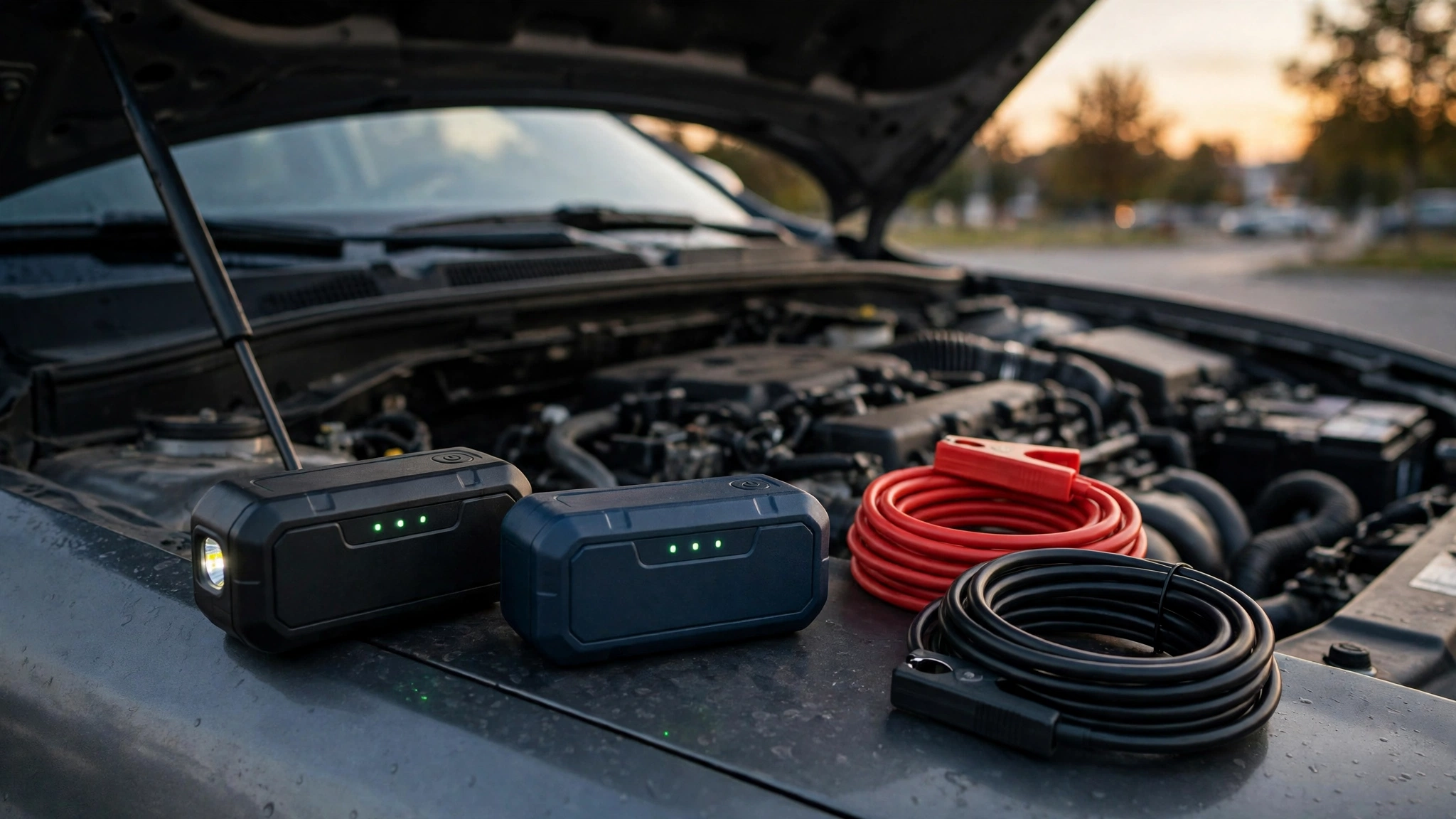
Your car will not start. No clicking, no slow crank — just silence, or one sad click, in a car park at night. This is the exact moment a portable jump starter earns its place in your trunk. But the two names every beginner meets first — the NOCO Boost Plus GB40 and the AstroAI 2000A 8-in-1 — look almost identical on a shelf: small black boxes, red and black clamps, big amp numbers. They are not the same tool, and buying the wrong one usually means buying twice.
This comparison is written for a first-time driver, not a mechanic. We compare the two head to head in plain English, explain the one number that actually matters, clear up the most common misunderstanding about the AstroAI (it does not inflate tires), and bring in a third option — the GOOLOO New GP2000 — for drivers with bigger engines. Everything below comes from the makers' own published specifications and independent 2026 roundups, not from a test bench we do not have.
Affiliate disclosure: FirstCarCare is reader-supported. If you buy through a link on this page, we may earn a commission at no extra cost to you. It does not change what we recommend — every pick below has honest pros and cons, including the reasons you might not want it.
Our top 3 at a glance
- Best overall — NOCO Boost Plus GB40: the safest, simplest first jump starter. Rated for most cars, up to 20 starts per charge, and the one most 2026 roundups name as their top pick.
- Best value and most versatile — AstroAI 2000A 8-in-1: double the peak amps, a bigger power bank, an LCD screen and a 12V output that can run your other car gadgets. The best deal if you want one box that does several jobs.
- Biggest engines — GOOLOO New GP2000: the lightest of the three and the only one rated for engines up to 8.0L gas or 6.0L diesel. The pick for big SUVs, vans and diesel drivers.
The 30-second answer
Buy the NOCO GB40 if you want the simplest, most proven jump starter and you drive an ordinary petrol car or small SUV. Buy the AstroAI 2000A if you want more peak power, a bigger power bank and a screen that tells you what is happening — and you are happy with a slightly bigger, heavier box. Buy the GOOLOO GP2000 if your engine is large, especially a diesel, because it is the only one of the three rated for engines up to 8.0L petrol or 6.0L diesel.
None of the three is a bad buy. The mistake is buying on the amp number alone, so let us start there.
The one number that matters: your engine size, not peak amps
Every jump starter shouts a peak-amp number — 1000A on the NOCO, 2000A on the AstroAI and the GOOLOO. Here is the uncomfortable truth the roundups agree on: peak amps have no common test. One maker's 2000A is not measured the same way as another maker's 2000A, so the numbers cannot be compared directly. SolarGenAdvisor's November 2026 guide puts it plainly — buy the pack whose maker rates it for your engine size, because that rating is the one that decides whether your car actually starts.
So ignore the amp race and match the engine rating to your car instead. You can find your engine size on the sticker inside your driver's door, in your owner's manual, or on your registration document. Then check it against this table:
| Your engine | Which packs cover it |
|---|---|
| Small petrol car (up to 2.0L) | All three — any of them will do the job |
| Family car or small SUV (up to 6.0L petrol / 3.0L diesel) | All three — the NOCO GB40 is rated exactly to this limit |
| Large petrol SUV or truck (up to 7.0L petrol) | AstroAI 2000A or GOOLOO GP2000 |
| Large diesel, van or big SUV (up to 8.0L petrol / 6.0L diesel) | GOOLOO GP2000 only |
One warning: the AstroAI's own listings disagree about its diesel limit — the Amazon listing title says up to 3.0L diesel, while other AstroAI pages say 4.0L. If you drive a diesel, check the exact rating on the listing you buy from before you order. The GOOLOO has no such confusion: 8.0L petrol or 6.0L diesel, stated the same way everywhere.
NOCO Boost Plus GB40: the safest first jump starter
The GB40 is the jump starter most 2026 roundups name as their best overall pick — The Pixxie calls it the one most drivers should buy, Technobezz ranks it best overall, and SolarGenAdvisor's engine-size guide puts it at the top for everyday cars. That reputation is not about raw power. At 1000A peak it is the weakest of the three on paper. It is about everything around the power.
NOCO rates the GB40 for petrol engines up to 6.0L and diesels up to 3.0L, which covers the large majority of cars on the road. It promises up to 20 starts on a single charge — the only one of the three with a published starts-per-charge figure — and its 24 Wh battery recharges in about three hours. The housing is IP65 rated, which means it resists dust and water spray, and the clamps are spark-proof with reverse-polarity protection, so connecting them the wrong way round will not damage your car. It weighs 1.65 lb on its own (2.4 lb with the clamps) and has a 100-lumen flashlight and a USB port that charges your phone at 5V and 2.1A.
What you do not get: a screen, a big power bank, or any extra tools. The GB40 tells you its charge with simple indicator lights, and its USB charging is slow by modern standards. Its warranty is one year, half the two years some rivals offer. And if your engine is bigger than 6.0L petrol, it is simply the wrong tool — no amount of brand trust changes the rating.
Best for: a first-time driver with an ordinary petrol car who wants the simplest, most forgiving jump starter and is happy to pay a little more for a proven name. Not for: big SUVs, vans, large diesels, or anyone who wants a power bank and a screen as well.
AstroAI 2000A 8-in-1: the most versatile box in your trunk
The AstroAI 2000A is the value pick of this comparison, and the one beginners misunderstand most — so let us clear that up first. The "8-in-1" on the box means jump starter, 18000mAh power bank, compass, LED torch with four modes (flashlight, strobe, SOS and red warning), and a 12V DC output that can power your other 12V car accessories. It does not include a built-in air compressor. Its 12V output can run a separate 12V tire inflator, vacuum or car fridge — owners report doing exactly that — but it will not inflate a tire by itself. If you want a jump starter with a built-in inflator, that is a different AstroAI model, the S8 Air. Do not buy this one expecting a pump.
What it does offer is a lot for the money. The peak rating is 2000A, double the NOCO, and it is rated for petrol engines up to 7.0L. The 18000mAh power bank is far bigger than the NOCO's 24 Wh battery, with three outputs: a Quick Charge 3.0 USB port, a standard USB port, and a 12V DC output. The 2-inch LCD screen shows battery level and status in real time, which is genuinely useful at night when you are trying to work out whether the pack or the car is the problem. The clamps are all-metal, and the pack carries eight protections including reverse polarity, over-current, over-voltage, overload, over-charge, over-discharge and short-circuit protection. The maker says it can start a completely dead battery within 30 seconds.
The trade-offs are size and honesty about capacity. At 2 lb and 7.68 x 5.16 x 3.86 inches it is the biggest and heaviest of the three — still glovebox-sized, but noticeably chunkier than the GOOLOO. Independent reviewers note the stated 18000mAh capacity may be slightly optimistic in real use. And unlike the NOCO, AstroAI publishes no starts-per-charge figure, so you cannot compare how many jumps you get from one charge. The compass, frankly, is a gimmick — owners report it barely works — so treat it as decoration, not a feature.
Best for: a driver who wants one box that jumps the car, charges phones and tablets, and powers 12V accessories on a road trip. Not for: anyone who needs a built-in tire inflator (buy the S8 Air instead), or a diesel driver who needs a confirmed diesel rating.
GOOLOO New GP2000: the lightest pack, for the biggest engines
The GOOLOO GP2000 is the dark horse of this comparison: the lightest pack here at just 1.2 lb, yet the one rated for the largest engines — up to 8.0L petrol or 6.0L diesel. If you drive a big SUV, a van, a truck or a diesel, this is the only one of the three that is rated for your engine, and that alone settles the choice.
Its 2000A peak matches the AstroAI, and its 10,000mAh battery (37 Wh, according to GOOLOO's own manual) doubles as a power bank with two USB outputs, one of which supports fast charging. The 400-lumen LED flashlight is by far the brightest of the three — the NOCO's is 100 lumens — with normal, strobe and SOS modes for night-time breakdowns. It carries ten safety protections, including spark-proof and reverse-polarity protection, works from -4°F to 140°F, and comes with a storage case in the box. Owners typically report four to five jump starts from a full charge, depending on engine size and battery condition.
The honest limits are the ones in GOOLOO's own paperwork. The manual says to recharge the pack every three months, even though the product page also claims up to 24 months of standby time — believe the manual, not the marketing line. The warranty is 18 months. And its buyer rating, while strong, comes with a warning: Amazon's own summary of buyer reviews calls battery life "mixed", with some owners reporting the pack does not hold a charge as well as expected. That is exactly why the three-month recharge habit matters more with this pack than with the others.
Best for: drivers with big petrol engines or diesels, and anyone who wants the lightest pack in the glovebox. Not for: anyone who will forget to recharge it — set a phone reminder every three months.
Side by side: NOCO GB40 vs AstroAI 2000A vs GOOLOO GP2000
| NOCO Boost Plus GB40 | AstroAI 2000A 8-in-1 | GOOLOO New GP2000 | |
|---|---|---|---|
| Peak current | 1000A | 2000A | 2000A |
| Engines rated for | Up to 6.0L petrol / 3.0L diesel | Up to 7.0L petrol (diesel rating varies by listing) | Up to 8.0L petrol / 6.0L diesel |
| Battery | 24 Wh lithium-ion | 18000mAh lithium | 10,000mAh (37 Wh) lithium |
| Starts per charge | Up to 20 (maker's figure) | Not published | 4-5 (owner reports) |
| Weight | 1.65 lb (2.4 lb with clamps) | 2 lb | 1.2 lb |
| Flashlight | 100 lumens | LED, 4 modes incl. SOS | 400 lumens, 3 modes incl. SOS |
| Screen / display | Indicator lights only | 2-inch LCD screen | Indicator lights only |
| Power bank | USB 5V / 2.1A | 3 outputs incl. Quick Charge 3.0 + 12V DC | Dual USB incl. fast charge |
| Built-in air compressor | No | No — 12V output powers a separate inflator | No |
| Water / dust resistance | IP65 housing | Not rated | Not rated |
| Warranty | 1 year | Not published on the listing | 18 months |
| Buyer rating | Named best overall by The Pixxie, Technobezz and SolarGenAdvisor 2026 roundups | No verified star figure — qualitative only | 4.6/5 from ~1,500 Amazon ratings (WeApproveIt, October 2026) |
Read the table from the top, not the bottom. The engine row decides whether a pack can start your car at all; everything below it is about convenience. A 2000A pack rated for a smaller engine than yours is useless, while a 1000A pack rated for your engine is exactly right.
How to use a jump starter for the first time (either model)
The steps are the same for all three packs, and they are worth rehearsing once in your driveway — not learning for the first time in the dark. Read your pack's manual first, because clamp and boost-button layouts differ, but the safe sequence is always the same:
- Park safely. Switch the car off, put it in Park (or neutral for a manual), apply the handbrake, and switch off lights, heater and radio. Make sure the jump starter itself is charged — check it every three months, not once a year.
- Find the battery. It is usually under the bonnet, but some cars hide it in the boot or under a seat — your owner's manual shows where. If you cannot find it, do not guess.
- Red clamp first. Clip the red (+) clamp to the dead battery's positive terminal, marked with a + sign. Then clip the black (-) clamp to an unpainted metal part of the engine block or bodywork, away from the battery — never directly to the dead battery's negative terminal unless your manual tells you to.
- Switch the pack on. If your pack has a boost or force-start button for a fully dead battery, press it now, exactly as the manual describes. Wait for the ready light or screen message.
- Start the car. Turn the key or press the start button. If it does not start within a few seconds, stop, wait a minute, and try once more. Do not keep cranking — you will drain the pack and risk overheating it.
- Remove in reverse. Switch the pack off, remove the black clamp first, then the red clamp. Keep the clamps from touching each other or any metal while you do this.
- Drive and test. Drive for at least 20 to 30 minutes so the alternator can recharge the car battery, then get the battery tested — a jump start fixes the symptom, not the cause. If the battery is old or the car needed a jump more than once, have a mechanic check it, and recharge your jump starter as soon as you get home.
If you are unsure about any step, call roadside assistance instead. A jump starter is a convenience, not a reason to take a risk with a battery you do not understand.
When NOT to jump start your car
A jump starter cannot fix every dead battery, and using one in the wrong situation can hurt you or the car. Do not jump start if the battery case is swollen, cracked, leaking, or frozen solid. Do not jump start if you smell petrol or see smoke. Do not jump start a car with damaged cables or a battery that has been in a crash. And do not keep trying if the car cranks but never catches after two attempts — that is a different problem (fuel, spark or a deeper electrical fault), and a third attempt only drains your pack. In all of these cases, call a mechanic or roadside assistance and let them handle it.
One more honest note: a jump starter will not save a battery that is simply worn out. Car batteries usually last three to five years. If yours is in that age range and it has left you stranded twice, the money is better spent on a new battery than on a bigger jump starter. Use our guide to using an OBD2 scanner for the first time to read any fault codes first, and if a warning light is involved, our guide to what a check engine light after filling up means will help you decide whether it is safe to drive to a mechanic.
1. NOCO Boost Plus GB40 — Best overall
Rating: Named best overall by The Pixxie, Technobezz and SolarGenAdvisor in their 2026 roundups. Best for: first-time drivers with an ordinary petrol car who want the simplest, most forgiving jump starter.
- 1000A peak, rated for petrol engines up to 6.0L and diesels up to 3.0L
- Up to 20 starts per charge — the only published figure of the three
- IP65 dust- and water-resistant housing; spark-proof, reverse-polarity-safe clamps
- USB phone charging and a 100-lumen flashlight built in
Pros: the most proven name in this comparison; simplest to use; the only one with a published starts-per-charge figure; tough IP65 housing.
Cons: lowest peak amps on paper; no screen; slow USB charging; 1-year warranty is the shortest here; cannot start engines above 6.0L petrol.
2. AstroAI 2000A 8-in-1 — Best value and most versatile
Rating: no verified star figure — recommended here on its published specifications and its role as the value pick. Best for: drivers who want one box that jumps the car, charges devices and powers 12V accessories.
- 2000A peak, rated for petrol engines up to 7.0L
- 18000mAh power bank with Quick Charge 3.0 USB, standard USB and 12V DC output
- 2-inch LCD screen; LED torch with flashlight, strobe, SOS and red warning modes
- Eight protections including reverse polarity, over-current and short-circuit; all-metal clamps
Pros: double the NOCO's peak amps; the biggest power bank here; the only screen in this comparison; the 12V output runs a separate inflator, vacuum or fridge.
Cons: the biggest and heaviest of the three; no built-in air compressor despite the "8-in-1" name; no published starts-per-charge figure; the compass is a gimmick; diesel rating differs between listings.
3. GOOLOO New GP2000 — Biggest engines
Rating: 4.6/5 · from ~1,500 Amazon ratings (WeApproveIt, October 2026). Best for: big SUVs, vans, trucks and diesel drivers — and anyone who wants the lightest pack.
- 2000A peak, rated for engines up to 8.0L petrol or 6.0L diesel — the widest range here
- 10,000mAh power bank with dual USB outputs including fast charging
- 400-lumen LED flashlight with normal, strobe and SOS modes
- Ten safety protections; storage case included in the box
Pros: the only pack here for large diesels; lightest at 1.2 lb; brightest flashlight by far; storage case included.
Cons: only 4-5 starts per charge by owner reports; the manual's recharge-every-3-months rule clashes with the 24-month standby claim; Amazon's buyer summary calls battery life "mixed"; 18-month warranty.
5 mistakes first-time buyers make
- Buying on peak amps alone. The amp number has no common test, so a 2000A pack from one brand is not automatically stronger than a 1000A pack from another. Match the engine-size rating to your car first.
- Buying the AstroAI expecting a tire pump. The 2000A 8-in-1 has no built-in air compressor. Its 12V output can power a separate inflator, but the pump itself is a different purchase — or a different AstroAI model, the S8 Air.
- Forgetting to recharge the pack. A jump starter is a battery, and batteries go flat in storage. Check yours every three months and after every use. The GOOLOO's manual is explicit about this, and it applies to all three.
- Storing it flat in a hot trunk. Heat and deep discharge are what kill lithium packs. Keep it charged above half, and bring it indoors in extreme heat or cold if you can.
- Treating a jump start as a repair. A jump gets you moving; it does not fix a worn-out battery, a failing alternator or a parasitic drain. If you need a jump twice, get the battery and charging system tested — see our guide to finding a trustworthy mechanic before you pay for parts you may not need.
Frequently asked questions
Can a portable jump starter start a completely dead battery?
Yes, in most cases — both the NOCO GB40 and the AstroAI 2000A are made to start a fully drained 12V battery, and the AstroAI maker says it can start one within 30 seconds. If your pack has a boost or force-start mode, use it exactly as the manual describes. If the battery is swollen, leaking, cracked or frozen, do not jump it — call for help instead.
Will a 2000A jump starter damage my small car?
No. Peak amps are a ceiling, not a constant push — your car only draws the current it needs to crank. A 2000A pack will not force 2000 amps into a small engine. What matters is the engine-size rating: buy a pack rated for your engine, not the biggest amp number on the shelf.
How often should I recharge my jump starter?
Check it every three months and top it up. GOOLOO's own manual says to recharge the GP2000 every three months, even though the listing also claims up to 24 months of standby time — treat the manual's schedule as the real one. A pack left flat in a hot or freezing trunk is the one that lets you down when you need it.
Can the AstroAI 2000A inflate my tires?
No — it has no built-in air compressor. The "8-in-1" means jump starter, power bank, compass, LED torch and a 12V DC output that can power a separate 12V inflator, vacuum or car fridge. If you want a jump starter with a built-in inflator, that is a different AstroAI model, the S8 Air — not this one.
Which one should I buy if I drive a diesel or a big SUV?
The GOOLOO GP2000. It is rated for engines up to 8.0L petrol or 6.0L diesel, the widest range of the three. The NOCO GB40 covers up to 6.0L petrol or 3.0L diesel, and the AstroAI 2000A covers up to 7.0L petrol. If you drive a diesel, double-check the exact diesel rating on the listing before you buy, because AstroAI's own listings disagree on it.
The verdict
For most first-time drivers, the NOCO Boost Plus GB40 is still the right answer: it covers the engines most beginners actually drive, it is the simplest to use, it is the only one with a published starts-per-charge figure, and three independent 2026 roundups name it their best overall pick. If you want more for your money — double the peak amps, a far bigger power bank, a screen, and a 12V output for your other car gadgets — the AstroAI 2000A 8-in-1 is the better value, as long as you understand it has no built-in tire pump. And if your engine is large or a diesel, neither of those is the right tool: buy the GOOLOO New GP2000, the only one of the three rated up to 8.0L petrol or 6.0L diesel.
Whichever you choose, do the two things that matter more than the brand: check that its engine rating covers your car, and put a three-month recharge reminder in your phone the day it arrives. A jump starter only helps if it is charged when the morning comes that your car will not start. Pair it with the rest of your emergency kit — our roundup of the best emergency roadside kits for beginners covers the full setup — and for the full picture, see our five best portable jump starters for beginners roundup.
Sources: SolarGenAdvisor, "Best Jump Starter 2026" (solargenadvisor.com/best-jump-starter/); BoostMyTruck, "GOOLOO GP2000 Jump Starter Review" (boostmytruck.com/product-review/gooloo-gp2000-jump-starter-your-ultimate-roadside-rescue/); NOCO, AstroAI and GOOLOO published specifications and Amazon listing details as cited in the text. No prices are printed in this article — check the live price on Amazon before you buy.