You are driving on a straight road, hands relaxed on the wheel, and the car slowly drifts to the left. You correct it. A few seconds later, it drifts again. It is not dramatic, but it is constant — and once you notice it, you cannot un-notice it.
A car that pulls to one side is one of the most common complaints new owners have, and the good news is that the cause is often simple and free to fix. The most common reason is uneven tire pressure. The next most common is wheel alignment. After that come tire defects, a sticking brake, and worn suspension parts.
This guide explains, in plain language, what each cause feels like, the free 10-minute checks you can do yourself (in the right order), and the warning signs that mean you should stop driving and get help.
First: Is It Really a Pull?
Before you spend any money, rule out the road itself. Most roads are built with a slight slope, called a road crown, so rainwater drains toward the shoulder. In the right lane, that slope gently pushes your car to the right — and that is normal.
Here is a simple test: find a large, flat, empty parking lot, drive slowly in a straight line, and briefly relax your grip on the wheel (keep your hands close — never take them fully off at speed). If the car tracks straight on the flat lot but drifts right on a crowned road, the road was the cause. If it drifts the same direction on the flat lot, you have a real pull worth diagnosing.
A real pull is a steady, directional drift: the car moves left or right on a straight, flat road unless you hold the wheel against it. A vibration, a rhythmic shake, or a noise with no directional movement points more toward wheel balance or a damaged tire instead.
When Does It Pull? The Decision Table
When the car pulls tells you more than which way it pulls. Match your symptom to the table before you check anything:
- Pulls all the time, at steady speed: most likely tire pressure, a tire defect, or wheel alignment.
- Pulls only when you brake: most likely a sticking brake caliper, a restricted brake hose, or uneven brake wear on one side.
- Pulls only when you accelerate hard: on a front-wheel-drive car this is often torque steer — normal in small doses — but worn engine mounts or suspension bushings can make it worse.
- Drives straight, but the steering wheel sits crooked: usually an alignment (toe) problem, not a pull at all.
- Pull started right after a pothole or curb hit: suspect alignment, a bent wheel, or a damaged suspension part.
Keep this table in mind as you read the causes below — it is the fastest way to narrow the list from seven suspects to one or two.
The 7 Most Common Causes
1. Uneven tire pressure (check this first)
A tire with lower pressure has a larger contact patch and more rolling resistance, so the car drifts toward that side. A difference of just a few PSI between the left and right front tires is enough to feel. Check pressure with a gauge when the tires are cold — the car should not have been driven for at least three hours. Use the pressure on the Tire and Loading Information label on the driver's door edge, not the number molded into the tire itself (that is a maximum, not the recommendation). The National Highway Traffic Safety Administration calls proper inflation the most important part of tire maintenance and recommends checking every tire, including the spare, at least once a month.
2. A tire defect: conicity or radial pull
Sometimes the tire itself is the problem. During manufacturing, the steel belts inside a tire can end up slightly off-center, so the tire rolls like a very shallow cone — a condition called conicity or radial pull. The tire looks fine, holds air, and has good tread, but it constantly steers the car to one side. The tell-tale test is the tire swap below: swap the two front tires left to right, and if the pull changes direction, the tire is at fault.
3. Wheel alignment out of spec
Alignment is the set of angles at which your wheels meet the road — camber (the wheel's tilt), caster (the steering axis angle), and toe (whether the wheels point slightly in or out). When those angles differ too much between the left and right sides, the car pulls. The usual triggers are a hard pothole or curb strike, worn suspension parts, or simply time and mileage. AAA lists pulling to one side, a crooked steering wheel, and uneven tire wear as the classic signs, and recommends an alignment check at least once a year, or any time you fit new tires or hit something hard.
4. A sticking brake caliper
When you lift your foot off the brake pedal, the caliper should release the pads completely. If the piston seizes from corrosion, or the slide pins rust and stop moving, the pad keeps dragging on one side. That constant friction slows that wheel and pulls the car toward it. Warning signs: the pull gets worse after braking, one wheel feels much hotter than the others after a drive, or you smell something hot or burnt near a wheel. A dragging brake is not a "drive it for a few weeks" problem — it overheats the brake and wears the pad fast.
5. Worn or bent suspension and steering parts
Control arms, bushings, ball joints, tie rod ends, and struts hold your wheels in position. When a bushing wears out or a tie rod bends (often after a curb strike), the wheel's angle changes under load and the car drifts. Loose steering, a steering wheel that is slow to return to center after a turn, or a clunk over bumps all point this way. This one needs a shop: the parts are under the car and the fix is a repair, not an adjustment.
6. Mismatched tires
Different brands, sizes, or tread depths on the same axle can pull a car, because each tire grips and rolls slightly differently. The same goes for a new tire on one side and a half-worn tire on the other. Tires on the same axle should match in size, brand, and rough tread depth. If you recently replaced only one front tire, this is a prime suspect.
7. Uneven load or torque steer
A heavy load on one side — a packed trunk or an unevenly loaded roof box — shifts weight and changes the camber on that side, which can cause a mild pull. On front-wheel-drive cars, hard acceleration can tug the wheel because the two drive shafts are different lengths; that is torque steer, and it should fade at steady speed. If the pull only appears under hard throttle and vanishes when you cruise, it is probably not a fault at all.
The 10-Minute Checks (In Order — Free First)
Work through these in order. Most pulling cars are fixed by step 1 or 2.
- Check tire pressure. Cold tires, gauge in hand, all four tires plus a look at the spare. Inflate to the door-label pressure. Test drive on a flat road.
- Look at the tires. Walk around the car. Check for uneven wear (one edge smoother than the other), a bulge, a cut, or a nail. Run your hand across the tread — a sawtooth or feathered feel suggests an alignment problem.
- Check for matching tires. Same size, same brand, similar tread depth on each axle? A single new tire opposite a worn one is a red flag.
- Do the flat-lot test. On a flat, empty lot, drive straight and briefly relax your grip. Same direction as before? It is mechanical, not the road.
- Do the tire-swap test. If the pull survives steps 1–4, swap the two front tires left to right (or have a tire shop do it — it is a quick job). If the pull flips to the other side, the tire is the cause. If it stays the same, the cause is alignment, brakes, or suspension.
- Feel the wheels after a short drive. Carefully hold your hand near each front wheel (do not touch the brake parts). One wheel much hotter than the other, or a burnt smell, points to a dragging brake — book a shop visit.
- Check the load. Empty the trunk and retest. A heavy one-sided load can fake a pull.
If the pull is still there after these checks, you have narrowed it to alignment or a worn part — and you can walk into the shop knowing exactly what to ask for instead of accepting a guess.
What a Shop Will Do (and What to Ask)
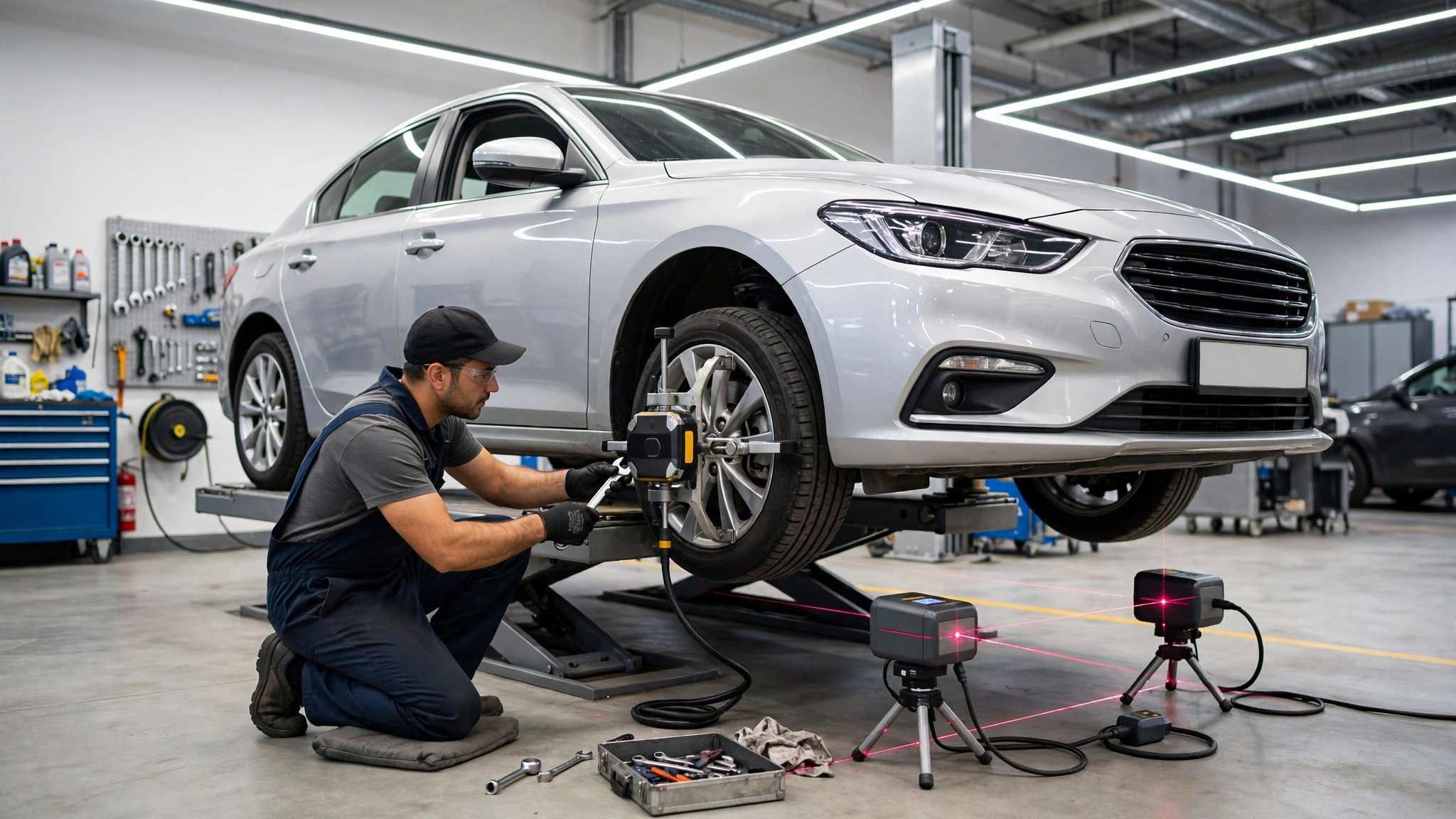
A good shop starts with the same cheap checks: tire pressure, tire condition, and a brake inspection. Then it puts the car on an alignment rack, measures the camber, caster, and toe against your car's factory specifications, and adjusts them. The whole job usually takes 30–60 minutes.
Ask for three things: the before-and-after printout (it shows the measured angles and proves what was actually out of spec); a brake check first if the pull is worse when braking (aligning a car with a sticking caliper wastes the alignment); and a written estimate before any part is replaced (an alignment is an adjustment, while a control arm, tie rod, or caliper is a repair with a parts cost).
One warning: an alignment only adjusts angles. It cannot fix a bent control arm, a bad tire, or a seized caliper. If a shop aligns the car and the pull is unchanged, the real cause was never the alignment — go back to the tire-swap test and the brake check.
When to Stop Driving
Most pulls are a "book a shop visit this week" problem, not an emergency. Stop driving and get help now if any of these are true:
- The pull is strong or sudden — you have to fight the wheel to stay in your lane.
- A wheel smells hot or burnt, or you see smoke near a wheel.
- You hear grinding when you brake (see our guide to grinding noises when braking).
- The steering feels loose, has obvious play, or does not return to center after a turn.
- The pull started immediately after a hard impact and the steering wheel is visibly off-center.
When in doubt, call a mobile mechanic or have the car towed — a steering or brake fault is not worth a test drive.
The Bottom Line
A car pulling to one side is usually telling you something simple: check the tire pressure first, because that is free and it is the most common cause. Then look at the tires themselves, do the flat-lot test, and try the tire swap. If the pull survives all of that, it is an alignment or a worn part — and you will walk into the shop with a clear story instead of a vague worry.
Do not ignore a pull for months. Even a gentle one scrubs your tires unevenly, costs you fuel, and wears out suspension parts faster. Ten minutes of checks today can save you a set of tires.
For more on the service itself, read wheel alignment vs balancing — they fix different problems, and knowing which one you need stops you paying for the wrong one. And if your tire pressure warning light keeps coming on, our guides to why the tire pressure light keeps coming on and how often to check your tire pressure will help you stay ahead of it. If you are unsure which shop to trust with the work, see how to find a trustworthy mechanic.
Sources: NHTSA — Tire Safety Month (monthly pressure checks, cold tires, placard pressure); AAA — Guide to Vehicle Wheel Alignment and Suspension (alignment signs, annual check).