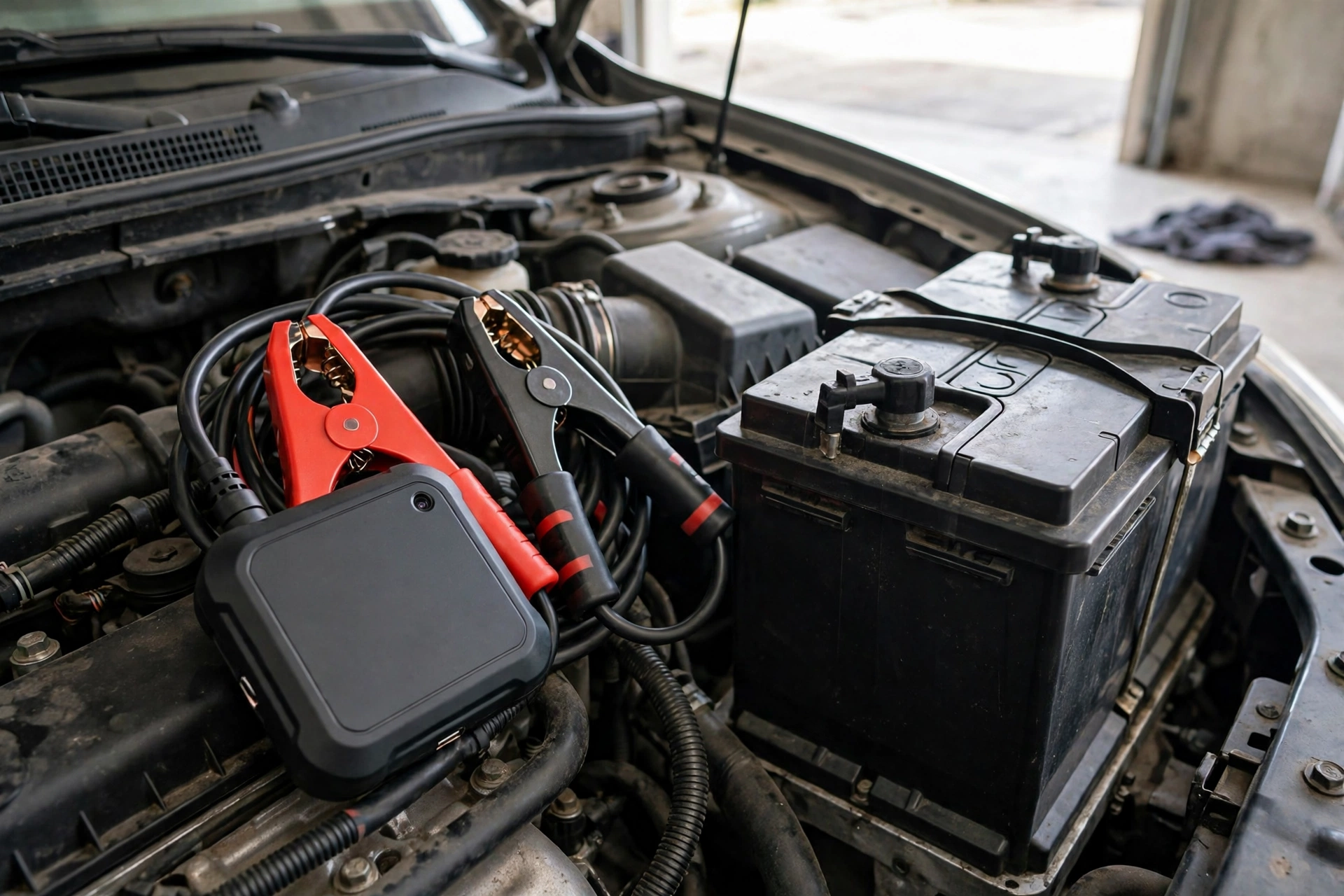


Picture this: a cold morning, you turn the key, and nothing happens — just a click. You reach for your jumper box, clamp it on… and it is dead too. A jumper box only rescues you if it is charged — and most sit in a trunk for months, slowly losing power.
This guide covers the three charging methods, how long each takes, how often to top the box up, and the mistakes that quietly kill these devices. If you have never used yours yet, start with our companion guide on how to use a portable jump starter.
Why Does a Jumper Box Go Flat?
A jumper box — also called a portable jump starter or jump pack — is a small battery pack with clamps that delivers a short, powerful burst of energy to start a car with a dead battery. It does not recharge your car battery; it just gives it the kick it needs, then your car's alternator takes over.
Inside the box is either a lithium-ion battery (most modern compact units) or a sealed lead-acid battery (older, heavier boxes). Both lose charge on their own even when unused — self-discharge. Lithium loses only about 2 to 5 percent per month; lead-acid loses charge much faster and can be permanently damaged if left flat. That is why a box that worked last winter can be useless this winter.
How to Charge a Jumper Box: The 3 Methods
Almost every jumper box charges through one of three routes. Use whichever fits your situation — but the wall outlet is the best default, every time.
Method 1: Wall Outlet (Best for Most People)
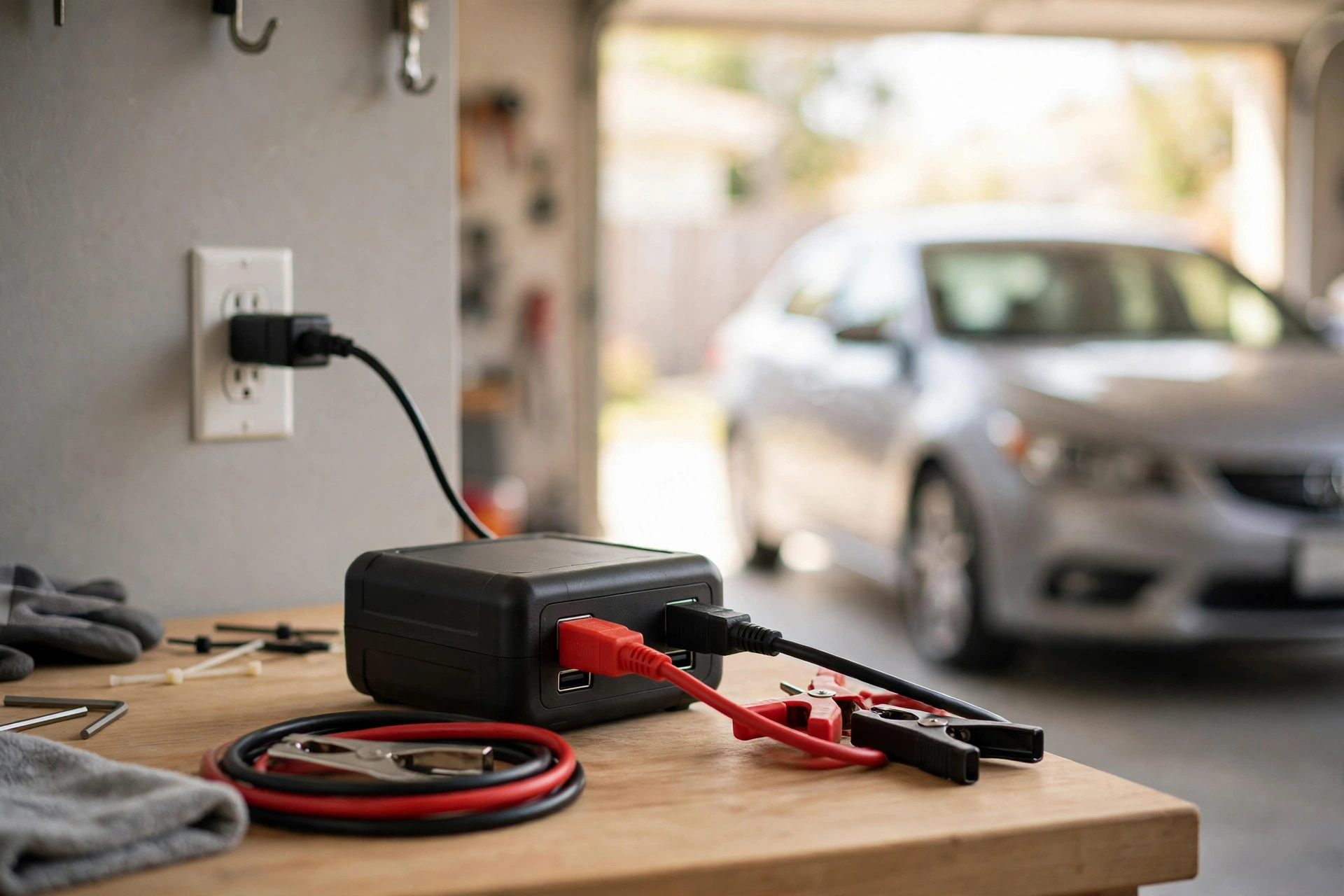
This is the simplest and fastest way to charge a jumper box, and the one manufacturers recommend.
- Use the charging cable that came with your box — usually USB, USB-C, or a small barrel plug with an AC adapter. A random phone charger may not deliver enough power.
- Plug it into the box's charging port (marked "IN" — not the USB "OUT" ports meant for charging your phone), then plug the other end into a wall outlet. If your box uses a USB cable, use a wall adapter rated at least 18W.
- Watch the indicator: most boxes show blinking lights, a percentage display, or a row of LEDs that fill up as it charges. When it shows full — steady green light, 100%, or all LEDs solid — unplug it.
Method 2: Your Car's 12V Outlet (Useful on the Road)
Most jumper boxes can also charge from your car's 12-volt socket using a car charger cable, often included in the box. Plug the car charger into the socket, connect the other end to the box's charging port, start the engine, and let it charge while you drive. The car must be running — a parked car with the engine off is not generating power.
One honest limitation: this method cannot save you in the emergency the box exists for. If your car battery is dead, there is no power in the socket to charge the box with.
Method 3: Solar (Slow, but Works Off-Grid)
Some boxes support solar charging, through a built-in panel or a separate portable solar charger. It works, but it is the slowest option by far — a flat solar charger can take up to 48 hours of sun to fill, and then another 4 to 8 hours to transfer that charge to the jumper box. Treat solar as a backup for camping trips.
How Long Does It Take to Charge a Jumper Box?
Charging time depends on the battery type inside the box, its size, and the charger you use:
| Jumper box type | Typical full-charge time |
|---|---|
| Small lithium jump starter | 2 to 4 hours |
| Mid- to high-capacity lithium jump starter | 4 to 8 hours |
| Heavy-duty lead-acid jump box | 12 to 24 hours |
| First charge of a brand-new unit | Up to 12 to 24 hours |
New jump starters usually arrive about 40 to 60 percent charged, so always fully charge a new box before you store it — the first charge can take longer than usual even if the indicator says "ready" sooner.
How to Tell When Your Jumper Box Is Fully Charged
Every box shows its charge differently, so check your manual — but these are the signals to look for:
- LED row: four lights that fill up one by one; all four solid means full.
- Percentage display: a small screen showing the exact charge.
- Colour change: a blinking red or amber light while charging, turning steady green when done.
How Often Should You Charge a Jumper Box?
This is the part most owners get wrong. A jumper box is not a "charge it once and forget it" device:
- After every use: recharge the box as soon as practical after each jump start. Wait about 30 minutes after a jump before plugging it in, so the unit can cool down.
- Every 3 months in storage: even if you never use it, top it up every three months — the schedule most manufacturers recommend.
- Before winter: cold weather is when car batteries fail and when jumper boxes are weakest. Charge the box fully in late autumn.
- Before a long trip: a five-minute check before a road trip beats discovering a flat box on a dark roadside.
Put a repeating reminder on your phone — "charge jumper box" every three months. For more, see our guide on how long car batteries last.
4 Mistakes That Kill a Jumper Box
1. Leaving it dead in the trunk. A lithium battery stored flat loses capacity permanently; a lead-acid battery left discharged can be ruined. The number one killer of jumper boxes is not use — it is neglect.
2. Storing it in extreme heat or cold. A car trunk in summer can pass 60°C (140°F). Heat ages the battery and speeds up self-discharge; cold weakens it. Store the box indoors, in a cool, dry place.
3. Using the wrong charger. A high-voltage charger on a box designed for USB-C, or a fast charger on an old lead-acid unit, can overheat the battery. Always use the charger and cable that came with the box.
4. Charging a damaged box. If the case is swollen, cracked, leaking, or gets hot while charging, stop immediately and do not use it. A damaged lithium battery is a fire risk — never open the box yourself; dispose of it through a battery recycling point.
What If Your Jumper Box Won't Charge?
Work through this checklist before you assume the box is dead:
- Try a different outlet and cable. The fault is often the wall adapter or the cable, not the box. Swap both.
- Check the port and use the right one. Many boxes have several USB ports — only one is the charging input. Look for dust or a bent pin, and clean it gently.
- Press the reset button. Some boxes have a small reset hole or button; hold it for a few seconds, then try charging again.
- Warm it up, then give it a full day. A lithium box left in a freezing car may refuse to charge until it warms to room temperature — bring it indoors for an hour first. A deeply discharged lead-acid box can look dead for hours, so leave it on the charger for a full 24 hours before giving up.
If none of that works and the box is more than three or four years old, the internal battery has probably reached the end of its life. A new box is usually the sensible answer — our roundup of the best portable jump starters for beginners explains what to look for.
Frequently Asked Questions
Can I charge a jumper box with a regular car battery charger?
It depends on the box. Some lead-acid jump boxes can take a battery charger if the voltage matches (usually 12 volts) — but many lithium boxes only charge through their own USB or AC adapter. Check your manual first; if it does not say it is allowed, do not do it.
Can I leave my jumper box plugged in all the time?
Most modern lithium boxes stop charging when full, so a day or two plugged in is harmless — but charge it to full, unplug it, and top it up every three months.
How long does a fully charged jumper box hold its charge?
A lithium box loses only 2 to 5 percent per month, so it can stay usable for many months — some makers claim up to 18 to 24 months of standby. A lead-acid box loses charge much faster.
Does a jumper box charge my car battery?
No. A jumper box delivers a short burst of power to start the engine — it does not refill a dead car battery. Once the engine is running, your car's alternator recharges the car battery as you drive.
The Bottom Line
Charging a jumper box is simple: plug it into a wall outlet with its own cable, wait 2 to 8 hours for a lithium box (12 to 24 for lead-acid), and unplug it when the indicator shows full. What matters is the routine — recharge it after every use, top it up every three months, and check it before winter.
Charge yours tonight and set a three-month reminder. For the other half of the story, read our guide on how to use a portable jump starter. For charging times in more depth, EngineerFix's guide to jump box charging times and ToolNerds' three charging methods are both worth a look.