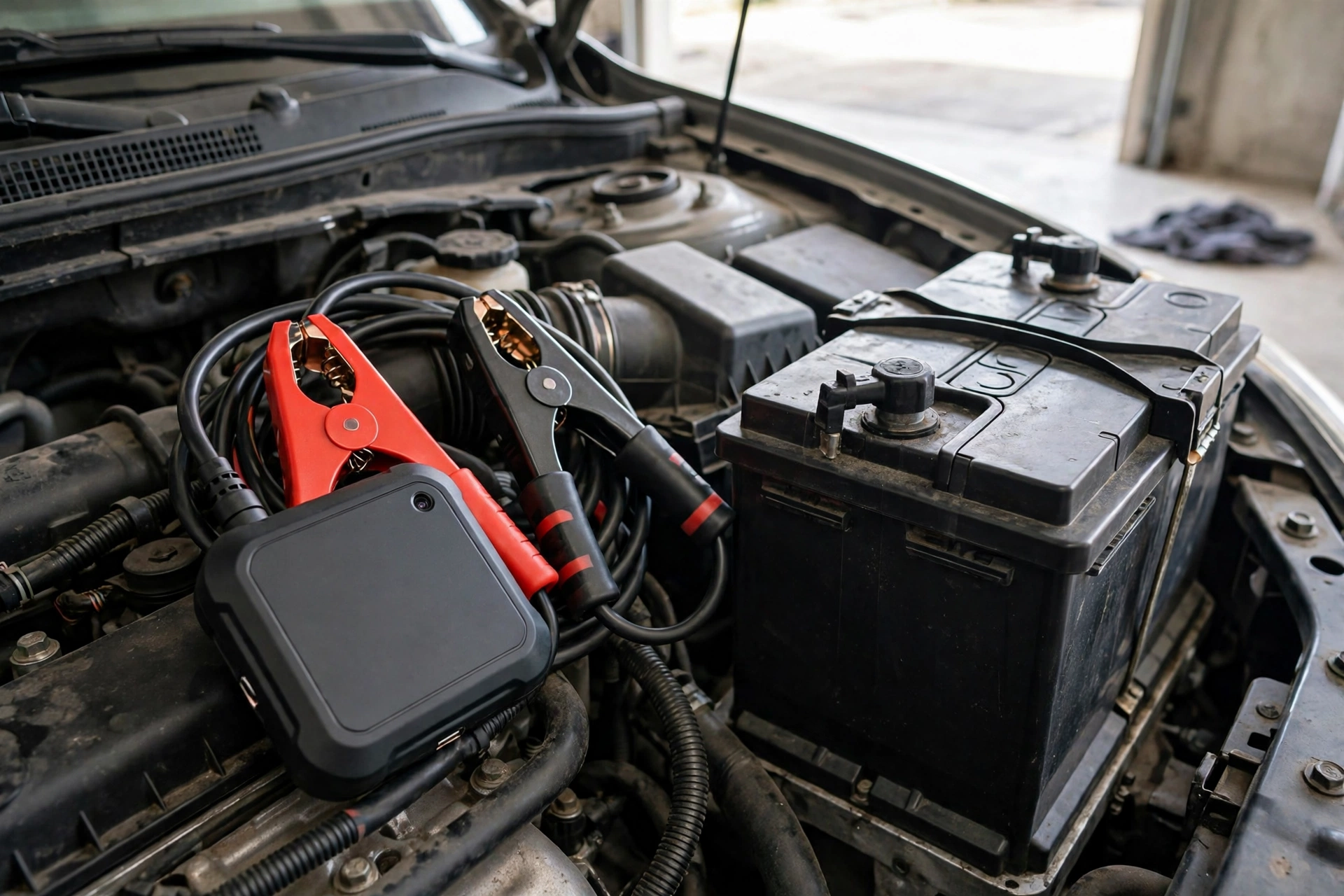
You turn the key, hear a slow click, and nothing happens. If you have a portable battery jump starter in the trunk, that click does not have to ruin your day. A jump starter is a small rechargeable battery pack with clamps that gives your car's dead battery one strong burst of power — no second car, no flagging down a stranger, no waiting for roadside help. This guide shows you exactly how to use one, in the order that matters, and clears up the point that confuses almost everyone: where the black clamp really goes.
Before you touch the clamps: the 60-second safety check
Jump starters are safe when used correctly, but a car battery is not a toy. Run through this checklist first, every time.
- Check the battery itself. Do not jump-start a battery that is cracked, leaking, swollen, frozen, or smells strongly of rotten eggs. In any of those cases, stop and call a mechanic or roadside service instead.
- Check your jump starter's charge. Most makers recommend at least 50% before a jump; a flat pack helps nobody.
- Turn everything in the car off — ignition, headlights, radio, heater — to protect the electronics and give the attempt its best chance.
- Park safely, set the parking brake, and switch on hazard lights if you are near traffic.
- Read your unit's manual once. Indicator lights, a boost button, and the clamp connection differ by model; your manual wins over any generic guide.
Throughout: never let the red and black clamps touch each other, and never touch both clamps at once once connected.
Step 1: Find the battery and identify the terminals
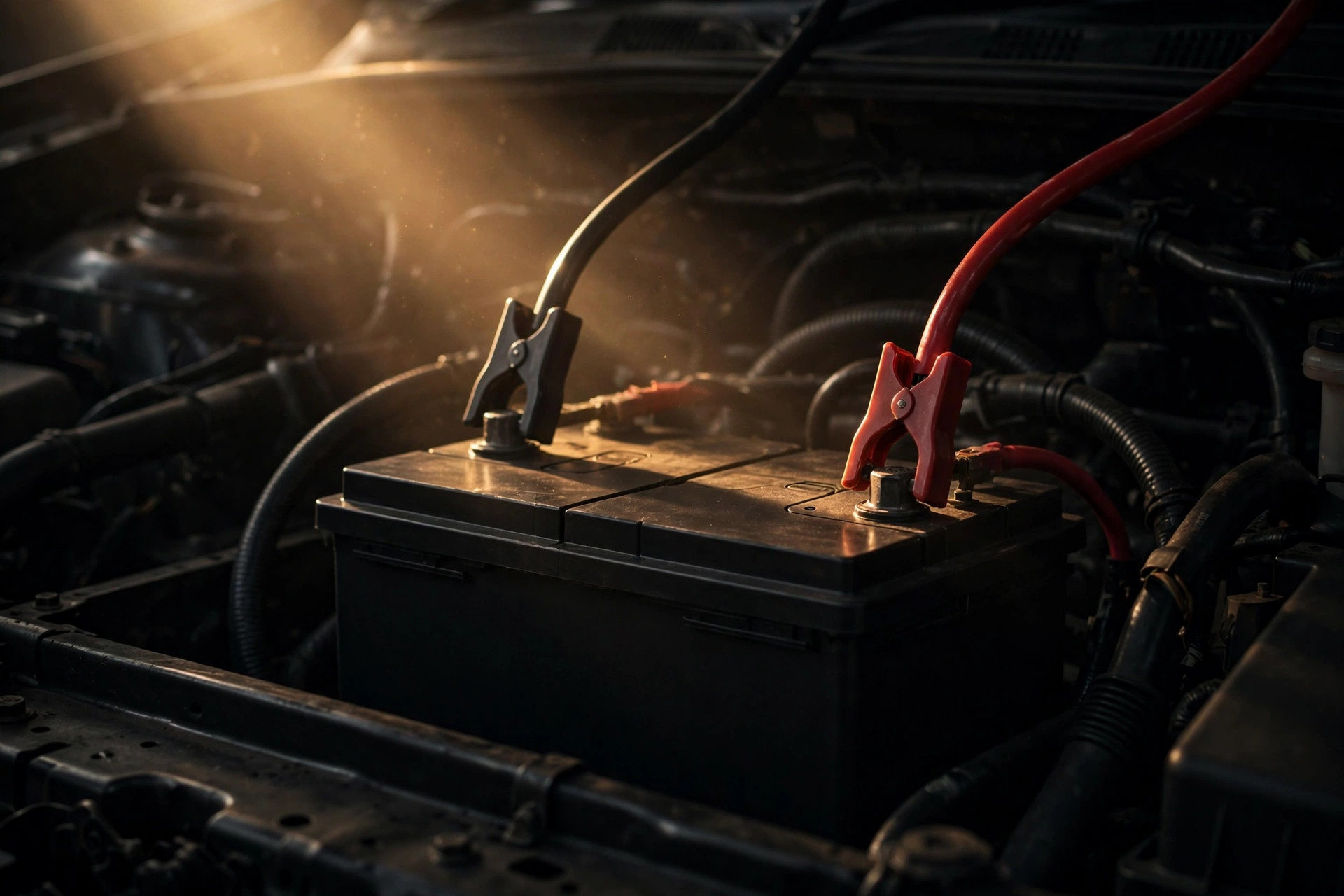
Pop the hood and find the battery — usually a rectangular box with two posts on top, often under a plastic cover. The positive terminal is marked with a plus sign (+) and usually has a red cap or cable; the negative is marked (−) with a black cable. If the terminals have white or green crust, wipe off only the loose crust with a dry cloth so the clamps can bite onto bare metal. If you cannot find the battery under the hood, check your owner's manual — some cars hide it in the trunk or under a seat, or provide remote jump-start terminals instead. Never guess: clamping onto the wrong part can damage the car.
Step 2: Connect the clamps in the right order
Keep the jump starter switched off while you connect. Plug the clamp cable firmly into the jump starter's output port first, if your model uses a separate cable.
- Red clamp first. Attach the red clamp to the positive (+) terminal of the car battery. Make sure it grips bare metal firmly and cannot slip off.
- Black clamp second. This is where guides disagree. Traditional advice says to attach it to clean, unpainted metal on the engine block or chassis, away from the battery, so any small spark happens away from battery gases. Many modern smart-clamp units, however, are designed to connect directly to the negative (−) terminal, with spark-proof and reverse-polarity protection built in. Both can be correct — it depends on your unit.
- Follow your manual on this one point. If it says to use a ground point, use a ground point. If it says to connect to the negative terminal, connect there. Do not mix advice from two different guides.
Once both clamps are on, switch the jump starter on. A green light or "READY" display means the connection is correct; a red light or "reverse connection" warning means the clamps are the wrong way round — switch off immediately, disconnect, and start again. Never power through a warning light.
Step 3: Start the car — and know when to stop cranking
With the green light showing, start the car normally, cranking for only a few seconds at a time. If it does not catch, wait at least 30 seconds, check the clamps are still firm, and try once more — two or three short attempts is the sensible limit. Repeated long cranking overheats the pack and the starter motor and rarely helps; if it still will not start, the problem is probably beyond a flat battery, so stop and get professional help.
Step 4: Disconnect in reverse order
As soon as the engine is running, switch the jump starter off first, then remove the clamps in reverse order: black off first, then red. Keep the clamps apart as you lift them away. Do not switch the car off again straight away — drive it for at least 20 to 30 minutes so the alternator can recharge the battery enough for the next start. A five-minute idle in the driveway is usually not enough, especially in cold weather.
What to do after the jump: the part most guides skip
Getting the car started is only half the job — a jump starter is a rescue tool, not a repair.
- Recharge the jump starter the same day. A used pack left flat in the trunk is useless next time. Recharge it fully, then top it up every few months even if you never use it.
- Get the battery tested soon. Most auto parts stores test batteries for free. If your battery is several years old, keeps dying, or needed a jump more than once, it is probably near the end of its life — see our guide on how long car batteries last and the signs yours is dying.
- Watch for a repeat failure. If the car dies again overnight, the cause may be a parasitic drain or a failing alternator rather than an old battery. Our guide on why a car battery keeps dying overnight walks through the likely causes.
- Store the pack sensibly. Keep it in the car, but out of extreme heat and cold where possible, and check its charge level with the seasons.
If it does not work: a quick troubleshooting checklist
- No lights on the jump starter at all: the pack itself is probably flat. Charge it and try again.
- Red or warning light: clamps are reversed or poorly seated. Switch off, disconnect, and reconnect carefully.
- Clicking but no start: the battery may be too far gone, the terminals corroded, or the pack too small for your engine. Clean the terminals, check the rating, try once more — then seek help.
- Car starts, then dies immediately: this points beyond the battery, possibly to the charging system. Do not keep jump-starting it; get it checked.
- Car cranks strongly but will not start: usually a fuel or ignition problem, not a battery problem. A jump starter will not fix it.
Portable jump starter vs jumper cables: which is easier for a beginner?
A portable pack wins for most beginners: no second car, no positioning two vehicles nose to nose, and smart clamps warn you about reversed connections. Traditional cables still make sense as a cheaper backup. For the cable method, see our guide on how to jump-start a car safely with cables; for choosing a pack, see the best portable jump starters for beginners.
Common beginner mistakes to avoid
- Connecting the clamps with the jump starter already switched on, or clamping onto painted metal or corroded terminals instead of bare metal.
- Cranking for 10 seconds or more, over and over, until something overheats.
- Switching the car off two minutes after the jump, or putting a used, uncharged pack back in the trunk "for next time."
- Jumping a swollen, cracked, leaking, or frozen battery instead of calling for help.
Frequently asked questions
How long does a portable jump starter take to start a car?
The start itself takes seconds; allow a few minutes in total for connecting, checking the indicator, and one or two short attempts. If it has not worked after a few careful tries, stop and investigate rather than forcing it.
Can a portable jump starter damage my car?
Used correctly, no — modern smart clamps include reverse-polarity and short-circuit protection. Damage usually comes from reversed clamps, clamps touching each other, or jumping a physically damaged battery.
Do I connect the black clamp to the negative terminal or to the ground?
Follow your unit's manual. Many modern smart-clamp packs are designed for the negative terminal; traditional guidance prefers an unpainted ground point away from the battery. Either is safe when it matches your model's instructions.
How often should I charge my jump starter?
Recharge it fully after every use, and top it up every two to three months even if unused. A pack at 20% may not have enough power for a cold-weather start.
Can I use a portable jump starter on any car?
Most packs suit ordinary petrol cars and many light trucks, but check the pack's engine-size rating first. Large diesels need a much more powerful unit, and some makers advise against jump-starting certain models — your owner's manual is the final word.
Conclusion
Using a portable jump starter comes down to a simple pattern: check the battery and the pack, red clamp to positive, black clamp where your manual says, watch for the green light, crank briefly, disconnect in reverse, then drive for half an hour and get the battery tested. Learn it once in your driveway, on a calm day, and the next dead battery becomes a ten-minute inconvenience instead of a ruined morning. A charged jump starter also belongs in our emergency kit every first-time driver should keep.
External sources: Interstate Batteries — How to Use a Jump Starter and EngineerFix — How to Use a Car Jumper Box Safely.