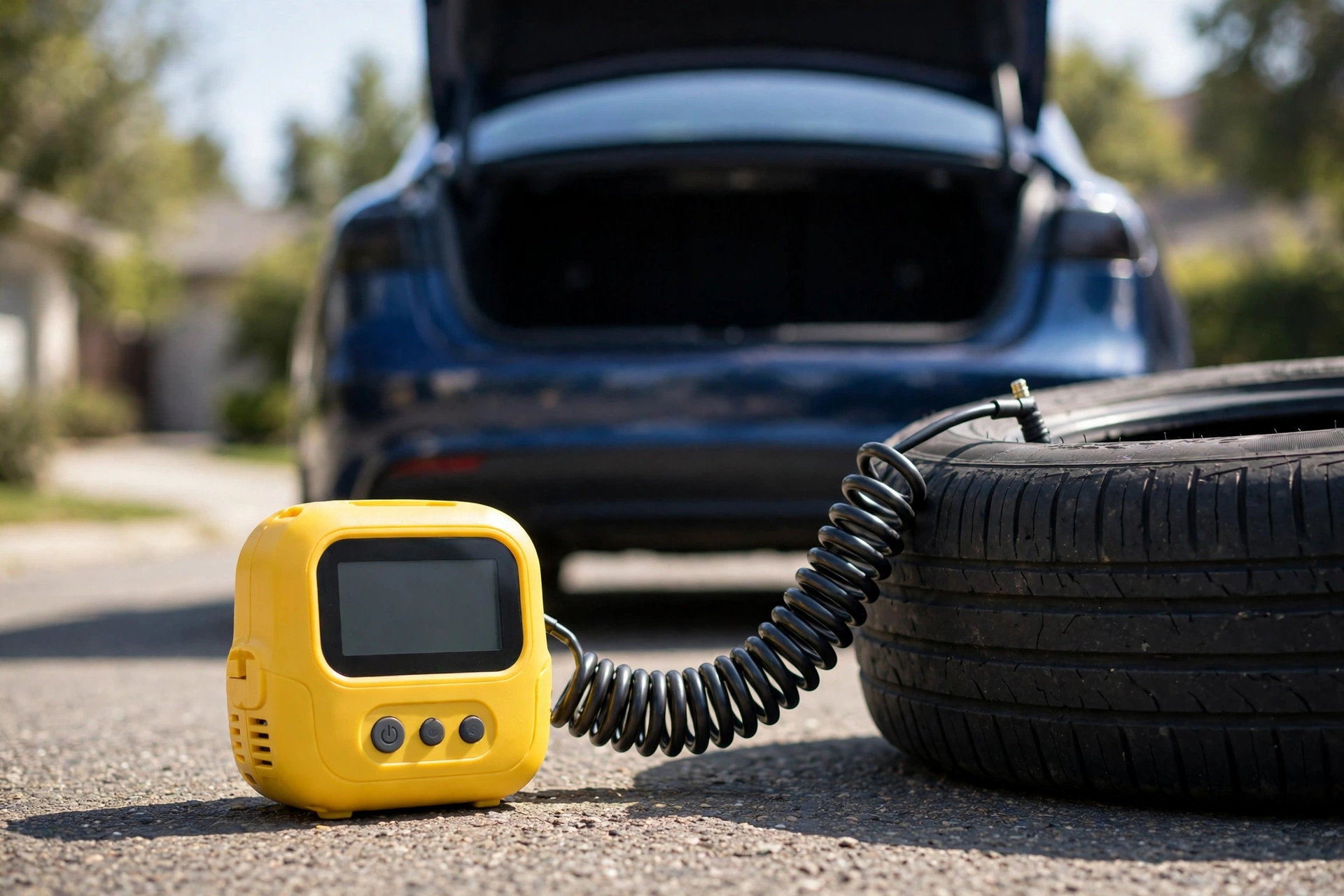
A low tire at 7 a.m. is the worst way to start a driving day. You are late, the tire looks soft, and the nearest gas station air pump is either broken or three miles away. That is the exact moment a small trunk inflator earns its keep — and the AstroAI AIRUN H is one of the most-bought ones on Amazon, with a 4.5-star average from over 100,000 buyers. But a big rating count does not automatically make it the right first inflator for a beginner. This review looks at what the AIRUN H actually does well, where it falls short, how to use it the first time without a mistake, and how it stacks up against two honest alternatives.
Disclosure: FirstCarCare is reader-supported. If you buy through a link on this page, we may earn a small commission from Amazon at no extra cost to you. It never changes what we recommend — every pick below is judged on its own merits, and every drawback is stated plainly.
At a glance — our top 3
- Best overall for beginners: AstroAI AIRUN H — digital preset + auto shut-off means you cannot over-inflate by accident.
- Best budget classic: EPAuto 12V — the same idea for less, with a simpler screen and a long track record.
- Best for bigger tires: VIAIR 88P — battery clamps and 120 PSI for SUVs and trucks, but no auto shut-off.
What the AstroAI AIRUN H actually is
The AIRUN H (model number CZK-3631) is a compact 12-volt tire inflator that plugs into your car's cigarette-lighter socket. It weighs about 2.2 pounds, fits in a glove box or under a trunk floor, and does one job: it adds air to a tire until the pressure you set is reached, then it stops by itself. Its 120-watt motor moves up to 35 litres of air per minute, and AstroAI says it can take a standard 195/65 R15 car tire from 30 to 36 PSI in under a minute under ideal conditions. The kit includes two air nozzles, a needle valve for sports balls, a Presta-to-Schrader adapter for road bikes, an extension hose and a spare fuse. The 9.8-foot power cord is long enough to reach all four tires without moving the unit, and a built-in LED flashlight helps at night or in a dim parking garage.
The headline feature is the digital preset. Three buttons and a large backlit LCD let you pick a target pressure in PSI, kPa, Bar or kg/cm², and the inflator switches itself off when it gets there. For a beginner, that matters more than raw speed: you do not have to watch a needle, guess when to stop, or keep checking with a separate gauge. The unit also has a 2-year limited warranty, a 15-amp fuse for electrical protection, and a thermal cut-off that stops the motor after 15 minutes of continuous use, with a 10-minute cool-down recommended before you start again.
Do not buy the wrong AstroAI
AstroAI sells several inflators with nearly identical names, and this is the single most common buyer mistake. Three models show up in search results side by side:
- The older AstroAI air compressor — the one Tom's Guide reviewed years ago. It is a 100 PSI unit that took 3 minutes 40 seconds to fill a test tire to 30 PSI, and the review notes it vibrates and wobbles a lot. It is a different, slower machine.
- The AIRUN H (this review) — model CZK-3631, the current 12-volt model with the digital preset, ToughUltra build and 2-year warranty. On Amazon its listing is ASIN B07QR4Q42L.
- The cordless AstroAI models (C2 / H2 Pro) — battery-powered inflators with up to 160 PSI. They cost more, need charging, and solve a different problem.
Before you buy, check the model number CZK-3631 on the listing and the ASIN B07QR4Q42L in the product URL. If the page you are looking at shows a battery or a 160 PSI headline, you are looking at a different inflator.
What the AIRUN H does well
1. The auto shut-off removes the beginner's biggest fear
Over-inflation is what most new drivers worry about, and it is the fear that keeps people driving on soft tires instead. Set 35 PSI, press start, and the unit stops at 35. Reviewers consistently report that the shut-off works accurately and that they have never recorded an over-inflation during use. You still need to know your car's correct pressure — it is printed on the sticker inside the driver's door jamb, not on the tire sidewall — but once you know the number, the machine handles the rest.
2. The screen is genuinely easy to read
The backlit LCD shows the live pressure and your preset target at the same time, in large numerals. That sounds minor until you are crouched beside a tire in a dark parking lot. The three-button control is simple enough to learn in one use, and the four unit choices (PSI, kPa, Bar, kg/cm²) mean you are not stuck converting numbers if your owner's manual uses a different unit.
3. It is fast enough for real life
A top-up of a few PSI takes well under a minute per tire in normal use, and inflating all four tires from 28 to 35 PSI takes roughly eight minutes in total according to one independent review. That is fast enough that topping up your tires stops being a chore you put off — and that is the whole point of owning one.
4. It covers more than your car
Motorcycle tires, bicycle tires (including Presta valves with the included adapter), sports balls and other small inflatables are all covered by the included nozzles. One tool in the trunk replaces a drawer of adapters.
5. It is built to survive the trunk
AstroAI markets its ToughUltra build — powder-metallurgy parts for the cylinder, gears and connecting rod — as a durability upgrade, and backs the unit with a 2-year warranty. At 2.2 pounds with a sturdy handle, it is light enough to carry to the tire and tough enough to live in a trunk without babying.
Where it falls short (the honest part)
The hose gets hot
This is the most consistent complaint across buyer feedback: after inflating a single tire, the inflation hose is hot enough to cause a minor burn if you grab it carelessly. Wait two to three minutes before disconnecting or packing the hose away. Treat it like a hot kettle handle, not a garden hose.
It is loud
At around 80 dB, the motor is clearly audible — about the level of a loud vacuum cleaner. It is not a defect, but do not expect to inflate a tire at 6 a.m. outside a sleeping neighbour's window without being noticed.
It only works from your car
The AIRUN H is corded and 12-volt only. There is no battery and no wall-plug option, so it cannot inflate anything away from a car, and it cannot help if your car's 12-volt socket is dead. If you want a unit that works in the garage without the car, you need a different model.
It has a 15-minute duty limit
The motor shuts itself off after 15 minutes of continuous use and needs a 10-minute cool-down. That is plenty for four car tires, but if you are topping up a whole fleet or a large air mattress, plan for a pause.
Not for heavy truck tires
With a 100 PSI maximum, the AIRUN H is made for cars, motorcycles and bicycles. Large truck or LT tires need more pressure and more airflow — that is the VIAIR 88P's territory below.
How to use it the first time (6 steps)
Read this once before your first use and the whole job takes about five minutes.
- Find your number first. Open the driver's door and read the tire-pressure sticker on the door jamb. That is your target — usually 32 to 36 PSI for a small car. Do not use the number moulded into the tire sidewall; that is the tire's maximum, not your car's setting.
- Check cold if you can. Pressure is most accurate when the tires are cold — before you have driven more than a mile or two. If you have just driven, add about 1 PSI to your target and re-check in the morning.
- Plug in and power up. Push the 12-volt plug firmly into the car's socket. On many cars the socket only works with the ignition on, so turn the key to accessory if the unit stays dark.
- Set the target. Use the + and − buttons to set your door-jamb number on the display. Double-check the unit reads PSI, not Bar or kPa — a 35 Bar setting would be a disaster, and the screen makes the unit obvious.
- Connect and start. Unscrew the valve cap (put it in your pocket, not on the ground), push the hose connector onto the valve stem and lock it. Press start and let the unit run until it stops itself.
- Check, cap, cool. The display shows the final pressure. Unscrew the hose, replace the valve cap, and let the hose cool for two to three minutes before coiling it away. Repeat for the other three tires.
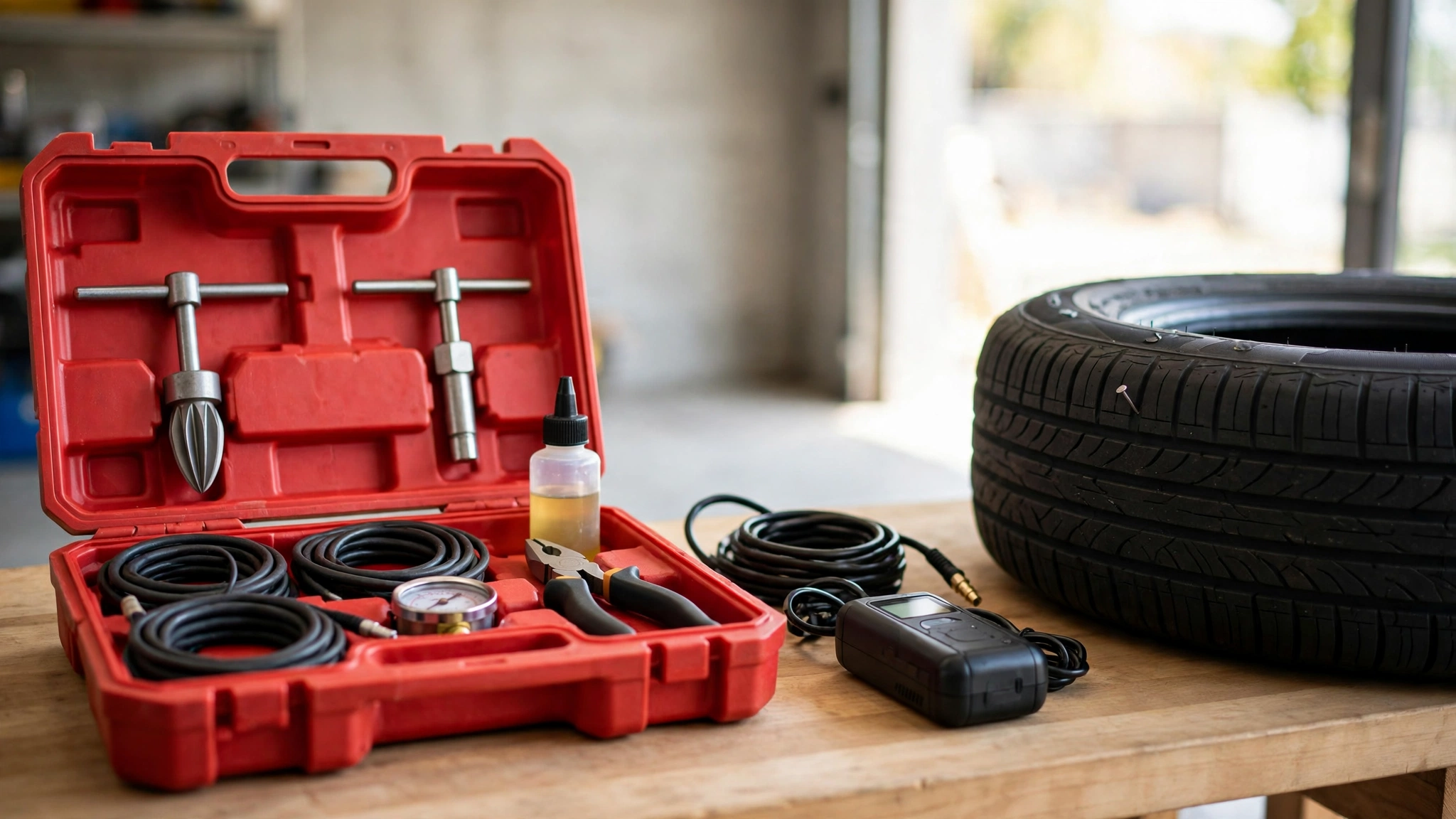
If the tire is completely flat — sitting on the rim — do not just inflate and drive. A fully flat tire may have sidewall damage you cannot see. Inflate it slowly, look for a nail or a cut, and if it holds air, drive gently and directly to a tire shop. If it will not hold air at all, fit the spare instead. Our guide to choosing a tire inflator explains the difference between a top-up and a rescue in more detail.
Who should buy it — and who should not
Buy it if: you are a new driver who wants the simplest possible way to keep tires at the right pressure; you drive a car, motorcycle or bicycle; you like the idea of setting a number and walking away; and you want one tool that also handles balls and bike tires.
Skip it if: you drive a heavy truck or tow a trailer with LT tires; you need an inflator that works away from a car; or you want a silent, battery-powered unit for the garage. In those cases the alternatives below are a better fit.
The 3 picks, side by side
1. AstroAI AIRUN H — Best overall for beginners
🏆 Best Overall
- Digital preset + auto shut-off — set your PSI and it stops itself
- 120W motor, up to 35 L/min — a standard tire from 30 to 36 PSI in under a minute
- Backlit LCD shows live and target pressure together; 4 pressure units
- 9.8 ft cord, LED flashlight, 2.2 lbs, 2-year warranty
Pros: easiest to use of the three; genuinely accurate shut-off; fast top-ups; covers bikes and balls too.
Cons: hose gets hot after one tire; loud at ~80 dB; 12V-only, no battery; 15-minute duty limit.
Best for: first-time car owners who want the most foolproof inflator. Check Price on Amazon
2. EPAuto 12V DC Portable Tire Inflator — Best budget classic
💰 Best Value
- 120W motor, 1.06 CFM, up to 100 PSI maximum working pressure
- Digital gauge with auto shut-off and LED flashlight
- 12V only — plugs into the cigarette-lighter socket
- Long-running budget favourite with a huge buyer base
Pros: the cheapest way to get digital preset + auto shut-off; proven over years; simple to use.
Cons: slower than the AstroAI on big top-ups; not for LT or truck tires; the screen is smaller and plainer.
Best for: buyers who want the same core features for less and do not mind a slower fill. Check Price on Amazon
3. VIAIR 88P Portable Air Compressor — Best for bigger tires
🛻 Best for SUVs & Trucks
- 120 PSI maximum, 1.47 CFM — handles up to 33-inch tires
- Connects straight to the battery with clamps, not the lighter socket
- 25-year track record with truck and off-road drivers
- Heavy-duty build, no auto shut-off — you watch the gauge
Pros: the only one here that genuinely suits SUVs and light trucks; battery clamps avoid socket fuse limits; very durable.
Cons: no auto shut-off, so you must stop it yourself; heavier and bulkier; overkill for a small hatchback.
Best for: SUV, truck and off-road drivers, or anyone who regularly fills larger tires. Check Price on Amazon
| Inflator | Max PSI | Auto shut-off | Power | Best for |
|---|---|---|---|---|
| AstroAI AIRUN H | 100 | Yes | 12V socket | Beginners, cars & bikes |
| EPAuto 12V | 100 | Yes | 12V socket | Budget buyers |
| VIAIR 88P | 120 | No | Battery clamps | SUVs & trucks |
5 mistakes beginners make with a tire inflator
- Using the sidewall number. The number on the tire is its maximum, not your car's setting. Your target is on the door-jamb sticker — check it before every top-up season.
- Inflating hot tires to the cold number. Driving warms tires and raises pressure by 1–2 PSI. A reading taken after a motorway run will look high; check cold in the morning for the true number. Our guide on how often to check tire pressure explains the routine.
- Losing the valve cap. A missing cap lets dirt and moisture into the valve, which can cause a slow leak. Pocket the cap every single time.
- Grabbing the hot hose. The inflation hose heats up during use. Give it two to three minutes to cool before you coil it away, or you will learn this lesson the painful way.
- Running it past its duty cycle. Fifteen minutes of continuous running is the limit. If you are doing all four tires plus a bike, let it rest for ten minutes in the middle — the thermal cut-off will enforce it anyway, but a planned pause is kinder to the motor.
Frequently asked questions
Is the AstroAI AIRUN H good for a complete beginner?
Yes — it is the most beginner-friendly of the three picks here. You set the target pressure on a backlit screen, press start, and it stops itself. The only things you need to know are your car's correct pressure (door-jamb sticker) and how to screw the hose onto the valve. If you can do those two things, you can use this inflator.
What is the maximum PSI of the AstroAI AIRUN H?
The AIRUN H (model CZK-3631) is listed at 100 PSI maximum working pressure — plenty for cars, motorcycles and bicycles, but not for heavy truck tires. Be careful: some AstroAI listings show higher figures for different models, so confirm the model number CZK-3631 before you buy.
Does the auto shut-off really stop at the right pressure?
Yes, according to both the manufacturer and independent reviewers — the unit stops at the preset and reviewers report no over-inflation during testing. It is still good practice to double-check with a separate tire pressure gauge the first few times, until you trust the reading.
Can it inflate a completely flat tire?
It can add air to a flat tire, but a tire that has gone completely flat may have sidewall damage from sitting on the rim. Inflate it slowly, check for nails or cuts, and if it holds air, drive gently and directly to a tire shop. If it will not hold air, fit the spare — see our best tire inflators roundup for what belongs in a proper emergency kit.
How long can I run it before it needs a rest?
The motor shuts itself off after 15 minutes of continuous use, and the manufacturer recommends a 10-minute cool-down before starting again. In practice, four car tires take well under 15 minutes, so the limit rarely gets in the way — but the hose will be hot, so let it cool for two to three minutes before packing it away.
Verdict
The AstroAI AIRUN H earns its bestseller status for a simple reason: it removes the two things that stop beginners from checking their tires — fear of over-inflating and not knowing the pressure. The digital preset and auto shut-off do the hard part, the screen is readable in the dark, and it is fast enough that a four-tire top-up stops feeling like a chore. It is not perfect: the hose gets hot, it is loud, and it only works from your car's 12-volt socket. But for a first car owner who wants one foolproof tool in the trunk, it is the pick we would buy first. If your budget is tighter, the EPAuto gives you the same core idea for less; if you drive an SUV or truck, the VIAIR 88P is the only one of the three built for the job. Whichever you choose, pair it with a portable jump starter and your trunk is ready for the two most common roadside problems a beginner will ever face.
Sources: AstroAI AIRUN H product listing and specifications (Amazon, model CZK-3631); Tom's Guide AstroAI air compressor review; CarAccessorySpot AstroAI AIRUN H review. Ratings are the Amazon listing averages at the time of writing and change over time.