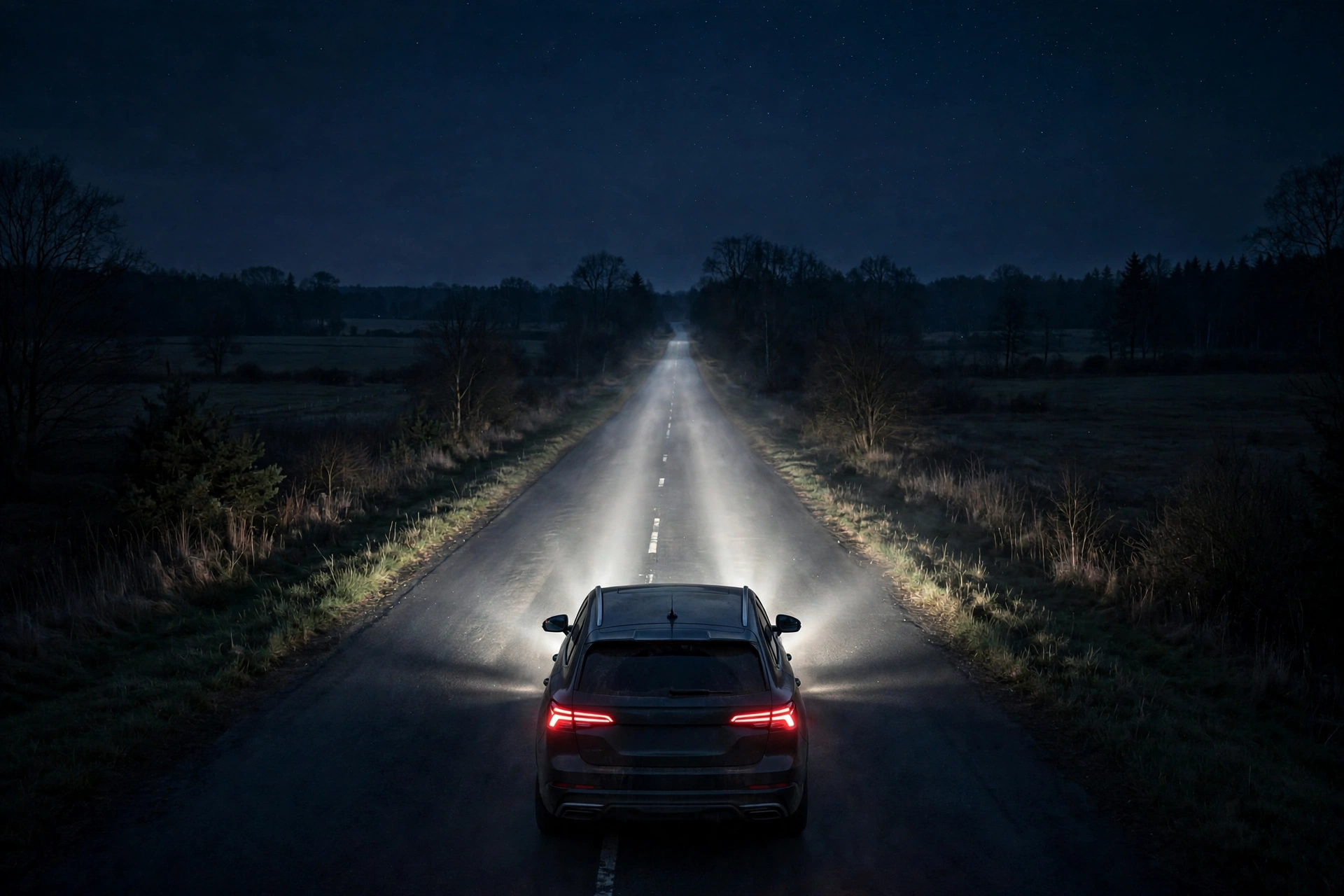
Every new driver has the same moment: you are driving at night, you flick a stalk you barely understand, and suddenly the road ahead is either brilliantly lit or suspiciously dark. High beams and low beams look like a small detail, but using the wrong one at the wrong time is one of the easiest ways to endanger yourself and everyone around you. High beams left on too long can blind an oncoming driver for several seconds. Low beams on a dark country road can leave you driving faster than you can see.
The good news is that the whole system runs on one simple rule: low beams are your default, high beams are a tool for dark, empty roads. This guide explains the difference, the exact distances the law expects, the fog mistake almost every beginner makes, and how to switch beams without thinking twice.
High Beams vs Low Beams: The Quick Difference
Both settings use the same headlights. The difference is where the light goes and how far it reaches.
- Low beams point down and slightly toward the edge of the road. They light up roughly 160 to 250 feet ahead of you — enough for city speeds — without shining into other drivers' eyes.
- High beams point straight ahead with no cut-off. They reach roughly 350 to 500 feet, which is why they are so useful on dark roads — and so dangerous when another driver is in the way.
Think of it this way: low beams show you the road you are on, high beams show you the road that is coming. At 60 mph you cover about 88 feet every second, so on a dark rural road your low beams barely show you further than your stopping distance. That is exactly the situation high beams exist for.
Your dashboard helps you keep track: a blue headlight symbol means your high beams are on. If you see that blue light and there is traffic around you, you are probably blinding someone.
When to Use Low Beams
Low beams are your everyday setting. Use them in all of these situations:
- City and suburban driving. Streetlights already light the road, so high beams add glare, not useful range.
- When there is oncoming traffic. Even a car far away can be dazzled by your high beams.
- When you are following another vehicle. Your high beams fill their mirrors and blind the driver whose braking you depend on.
- In fog, heavy rain, or snow. This is the big one, explained in detail below.
- At dawn and dusk. Your eyes are adjusting, other drivers are adjusting, and low beams keep you visible without adding glare.
- In tunnels, parking lots, and residential streets. Anywhere people, parked cars, and tight turns are close by.
- Whenever your wipers are on. In a growing majority of US states, wipers-on means headlights-on by law, and low beams are the right setting.
If you remember nothing else from this guide, remember this: when in doubt, use low beams. A slightly shorter view is a small inconvenience. Blinding another driver is a real hazard.
When to Use High Beams
High beams have exactly one job: helping you see further on dark roads when nobody else is affected. Use them when all of these are true:
- The road is dark with no streetlights — a rural road, an open highway stretch at night, a country lane.
- There is no oncoming traffic.
- There is no vehicle close ahead of you in your lane.
- You need the extra range: higher speeds, curves, hills, or places where animals, debris, or potholes could appear suddenly.
Here is something most beginners get backwards: drivers actually under-use their high beams. Observational research has found that on dark rural stretches, drivers switch their high beams on only a fraction of the time conditions call for them. On an empty dark road, high beams should be your default, not the exception — just dip them the moment another vehicle appears.
The 500-Foot Rule (and the 300-Foot Following Rule)
Most US states write the same two distances into law, and they are worth memorizing:
- 500 feet: switch to low beams when you are within 500 feet of an oncoming vehicle. That is about one and a half football fields — much further away than most beginners expect. If you can see the other car's headlights clearly, you are probably already inside 500 feet.
- 200 to 300 feet: switch to low beams when you are within 200 to 300 feet of a vehicle you are following. Your high beams bounce straight off their rearview and side mirrors into their eyes.
The exact numbers vary a little by state, and some states specify slightly different distances, so check your own state's driver handbook. But the 500/300 habit works everywhere: dip early, not late. Glare recovery for the other driver can take several seconds of functional blindness — at highway speed, that is hundreds of feet travelled blind.
The legal baseline for having headlights on at all is usually 30 minutes after sunset to 30 minutes before sunrise, and whenever visibility drops below 500 to 1,000 feet. Treat that as a floor, not a rule. If you are wondering whether your lights should be on, they should be on.
The One Mistake That Makes Things Worse: High Beams in Fog, Rain, and Snow
This is the mistake almost every new driver makes, because it feels like the opposite of logic: when visibility drops, your instinct is to turn on the brightest light you have. In fog, heavy rain, or snow, that makes you see less, not more.
High beams throw light straight ahead, where millions of tiny water droplets or snowflakes are floating. The light bounces off them and comes straight back into your eyes, turning the road ahead into a glowing white wall. Low beams point downward, under the worst of the precipitation, so you can still see the road surface and its edges.
So in fog, heavy rain, or snow: low beams only, never high beams. Slow down, increase your following distance, and use your fog lights if your car has them — they are mounted low and aimed wide specifically for this. If visibility drops so far that you cannot see the road edges, pull over somewhere safe and wait it out. No light setting fixes fog you cannot see through.
How to Switch Between High and Low Beams
On almost every car, the same stalk controls both beams. Here is how it works:
- Find the stalk. It is usually the lever on the left side of the steering column, the same one that operates your turn signals.
- Turn your headlights on first. Twist the end of the stalk (or use the dashboard dial) to the headlight position. Low beams are the default when the lights come on.
- Push the stalk away from you to switch to high beams. You will usually feel a click, and the blue high-beam symbol will light up on your dashboard.
- Pull the stalk toward you to dip back to low beams. The blue symbol goes out.
- Flash to signal: a quick pull-and-release toward you flashes the high beams briefly without leaving them on. Drivers use this to warn of a hazard ahead or to signal another driver — never to express anger.
Before your first night drive, sit in your parked car and practice this five times. It takes two minutes, and it means you will not be fumbling with an unfamiliar stalk at 60 mph on a dark road. Our guide to checking all your car's lights in 5 minutes is a good companion for this — it walks you through confirming every light works before you need it.
What to Do When Someone Blinds You With Their High Beams
Sooner or later, an oncoming driver will forget to dip their lights, and it will feel like staring into the sun. Do not stare back, and do not flash your own high beams in revenge — that just leaves two blinded drivers. Instead:
- Look down and to the right, at the white edge line of the road. It keeps you in your lane without staring into the glare.
- Slow down slightly until the car has passed and your vision recovers.
- Do not swerve. Hold your lane and your speed steady while you look at the edge line.
- One quick flash of your own high beams is the polite way to remind the other driver — once, briefly, then back to low.
If the car behind you is the problem, adjust your rearview mirror to its night setting (the small tab underneath flips it) and your side mirrors slightly outward until the glare drops out of them.
Auto High Beams and Adaptive Headlights: Helpful, but Supervise Them
Many newer cars have automatic high beams: a camera watches the road and dips the lights for you when it detects another vehicle. Some newer models go further with adaptive driving beams, which shape the light pattern in real time — full brightness everywhere except the exact slice of road where another driver's eyes are. Adaptive beams were federally approved for US vehicles in 2022.
These systems help, but they are not perfect. They can be slow to react to pedestrians, cyclists, and motorcycles, which are harder for the camera to spot than a car's headlights. They can also be fooled by sharp curves and hills. So even with auto high beams, keep your hand near the stalk and override early: if you can see another road user before the system reacts, dip the lights yourself. The driver is still responsible, not the camera.
High-Beam Etiquette: The Unwritten Rules
Most of headlight etiquette is not written in any handbook. It is just what considerate drivers do:
- Dip the moment you see another vehicle's lights, even far away. It takes one second.
- Do not use high beams in residential areas at night, even if the street is empty — the light pours into people's windows.
- At a junction or when turning, dip to low so you do not blind drivers waiting to pull out.
- Never flash your high beams at someone out of anger. A single flash to warn or remind is fine; a sustained blast is aggressive and dangerous.
- Keep your headlights clean and aimed properly. Dirty or yellowed lenses scatter light and reduce your range, and badly aimed headlights can dazzle oncoming drivers even on low beam. If your lights seem dim, our guide to changing a headlight bulb yourself covers the basics.
Frequently Asked Questions
Can I drive with my high beams on in the city?
Legally, you can on most roads, but you should not. Streetlights already light city roads, so high beams add glare without adding useful range, and you will dazzle every driver and pedestrian around you. Use low beams in the city.
Is it illegal to leave your high beams on?
In most US states, yes — driving with high beams within 500 feet of oncoming traffic or within 200 to 300 feet of a vehicle ahead is a traffic violation, and it can be a reason for a traffic stop and a fine. The exact distances vary by state, so check your local rules.
Should I use high beams or low beams in the rain?
Low beams. In heavy rain, high beams bounce off the raindrops and back into your eyes, making visibility worse — the same effect as in fog. Turn your low beams on whenever your wipers are on.
What does the blue light on my dashboard mean?
The blue headlight symbol means your high beams are on. If you see it while driving in traffic, dip to low beams right away. Low beams have no dashboard warning symbol, because they are the normal setting.
Do high beams use more battery or fuel?
High beams draw a little more electrical power than low beams, but the difference is tiny and has no noticeable effect on fuel use or battery life. Choose your beam for safety, not for saving power.
Conclusion
High beams and low beams are not two equal options — they are a default and a tool. Low beams are for almost everything: cities, traffic, rain, fog, and any time another driver is near. High beams are for dark, empty roads, where they should be your default, dipped the moment another vehicle appears within 500 feet. Learn the stalk before your first night drive, watch for the blue dashboard symbol, and never let bright lights tempt you in fog.
Get this one habit right and night driving gets calmer for you and safer for everyone sharing the road. For a full night-driving routine — pre-drive checks, glare, speed, and fatigue — read our companion guide to driving at night for the first time.
Sources: visibility distances and the 500/300-foot rules are drawn from the RideSafeTeam headlights guide and the AutoZone high-beam vs low-beam guide; state rules vary, so confirm the exact distances in your state's driver handbook.