Your first roundabout feels like a trick question. Cars are coming from everywhere and there is no traffic light telling you when to go. Relax: a roundabout runs on exactly one rule, and once you know it, every roundabout in the country works the same way.
Roundabouts are also much safer than the intersections they replace. The Federal Highway Administration reports that converting a signalized intersection to a roundabout cuts injury crashes by 72 to 80 percent and fatal crashes by about 90 percent. An Insurance Institute for Highway Safety study of 24 US intersections found 39 percent fewer crashes overall and 90 percent fewer fatal or incapacitating crashes after conversion.
What a Roundabout Actually Is
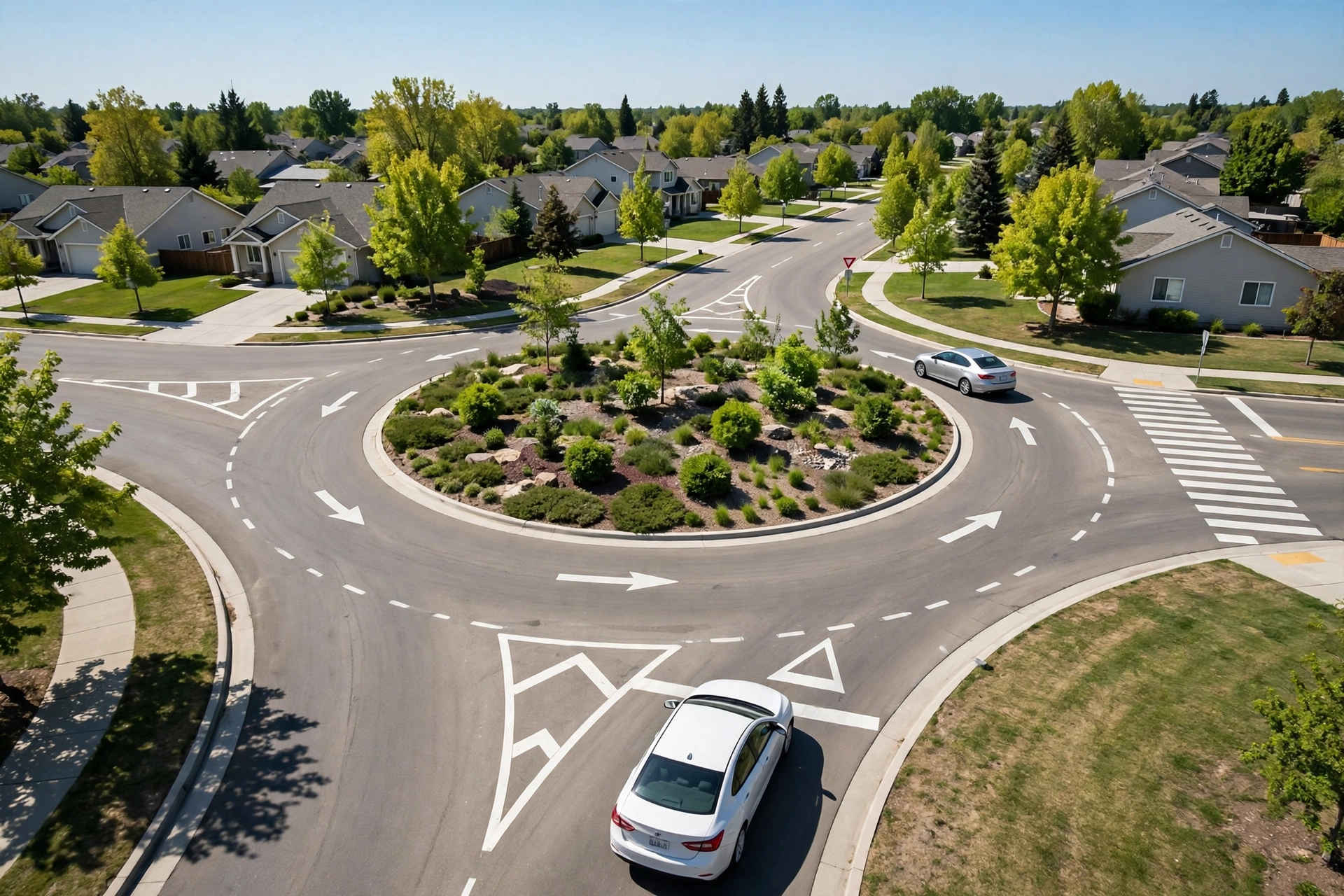
A modern roundabout is a circular intersection where traffic flows in one direction — counterclockwise in the United States — around a central island. There are no traffic lights and no stop signs inside it. Instead, every entrance has a yield sign: you slow down, check for traffic already in the circle, and enter when there is a safe gap. Speeds inside are low by design, usually 15 to 25 mph.
Do not confuse a modern roundabout with an older traffic circle or rotary. Some older circles, mostly in Massachusetts, Connecticut, and parts of New Jersey, were built before modern rules and can work differently — in a few, entering traffic historically had the right of way. Everything in this guide applies to modern roundabouts, which is what your state DMV handbook teaches and your road test will use.
The One Rule: Who Yields in a Roundabout?
Traffic already inside the roundabout always has the right of way. If a car is circulating and you are waiting at the yield line, they go first — even if you arrived first. You yield until there is a gap, then you go.
Because US roundabouts flow counterclockwise, the circulating traffic that matters to you comes from your left. That is the whole rule. Two things beginners get wrong: a yield sign is not a stop sign — if the circle is empty, slow down, look left, and roll in — and nobody inside the circle will stop for you, so do not creep forward hoping to be waved in.
How to Drive Through a Roundabout: 6 Steps
Use the same sequence every time. A fixed routine means you never have to improvise at the yield line.
Step 1: Slow down on approach
Drop to 15 to 20 mph well before the yield line, as soon as you see the roundabout warning sign (a yellow diamond with a circular arrow). Slowing early gives you time to read the signs and the traffic.
Step 2: Read the signs and pick your lane
Overhead signs and arrows painted on the road tell you which lane goes to which exit. In a single-lane roundabout there is nothing to choose. In a multi-lane roundabout, pick your lane before you enter — right lane for the first exit or straight ahead, left lane for a left turn or a U-turn — and stay in it. Never change lanes inside a roundabout.
Step 3: Look left and judge the gap
Scan two car lengths into the circle. You want a gap of roughly 3 to 4 seconds of clear space. If a car is approaching from your left, wait. If the circle is empty, keep rolling.
Step 4: Yield, then enter
Stop only if you have to. A roundabout works best when you roll through a gap without a full stop, but never force your way in. Waiting ten seconds costs you nothing.
Step 5: Stay in your lane and keep moving
Once you are in, follow the curve at a steady speed. Do not stop inside the circle unless an emergency vehicle approaches. Do not change lanes, and do not try to pass anyone inside a roundabout.
Step 6: Signal right and exit
Turn on your right blinker as you pass the exit before yours, then take your exit. Watch for pedestrians in the crosswalk just past the exit — drivers leaving a roundabout must yield to them, the same as at any other intersection.
Which Lane Do I Need?
Lane choice is where most beginners go wrong. For a four-exit roundabout:
- Turning right (first exit): right lane. Enter, take the first exit.
- Going straight (second exit): right lane in most cases — follow the painted arrows.
- Turning left (third exit): left lane. Travel most of the way around the island.
- U-turn (fourth exit): left lane. Go all the way around and leave by the road you came in on.
The rule that never changes: the arrows on the road beat any general rule. If the painted arrow in your lane points somewhere different from what you expected, follow the arrow. And if you realise you are in the wrong lane, do not swerve — follow your lane to its exit and turn around. Missing your exit is a minor delay; cutting across a lane is a crash.
How to Signal in a Roundabout
Signalling confuses beginners because the answer changes by state. The practice most US states teach is: in a single-lane roundabout, signal right only as you approach your exit, not on entry; if you are turning left or going more than halfway around, some states teach a left signal on entry. Always signal right before you leave, so the driver waiting at the next entrance knows you are exiting.
Check your own state's driver handbook for the entry-signal rule — it is one of the few things that genuinely varies. What does not vary anywhere: never signal left while you are exiting, and never signal on entry when you are going straight.
What If You Miss Your Exit?
Go around again. A roundabout is a loop — your exit will come around again in a few seconds. Do not stop inside the circle, do not reverse, and do not cut across lanes to reach the exit you wanted. On a road test, going around again is a small, forgivable error. Stopping or reversing inside the circle is a fail.
5 Mistakes Beginners Make in Roundabouts
- Treating the yield sign as a stop sign. Stopping when the circle is empty confuses the drivers behind you. Slow, look, and roll in when it is clear.
- Entering into too small a gap. If the car already circulating has to brake for you, the gap was too small. Wait for a 3 to 4 second gap.
- Changing lanes inside the circle. Pick your lane before you enter and stay in it. If you are in the wrong lane, take the exit it leads to.
- Driving beside a truck or bus. Large vehicles swing wide and their trailers cut the corner. Hang back and let a truck clear the circle first.
- Forgetting the exit crosswalk. Pedestrians cross just past each exit. Check the crosswalk before you accelerate away.
Special Cases to Know
Multi-lane roundabouts: choose your lane before entry and hold it. A driver in the wrong lane may drift into yours on exit, so leave space and be ready to slow down. Pedestrians and cyclists: crosswalks sit just before the entry and just after the exit — yield to anyone in one, and never try to pass a cyclist inside the circle. Emergency vehicles: do not stop in the circle; continue to your exit, pull over past it, and let them through. If you have not entered yet, stay at the yield line. Rain or night driving: painted arrows are harder to see when wet, and glare makes gap judging harder — slow down more and give yourself a bigger gap.
Frequently Asked Questions
Who has the right of way in a roundabout?
Traffic already circulating inside the roundabout. Entering drivers always yield, in every US state. Pedestrians in the crosswalks have priority over everyone.
Do I have to stop before entering a roundabout?
No. A yield sign means slow down, look left, and enter when there is a safe gap. You only stop if traffic is circulating and there is no gap.
Which way do you go around a roundabout in the US?
Counterclockwise, always. Traffic enters from the right side of the circle and flows around the central island to the left.
Do I signal when entering a roundabout?
In a single-lane roundabout, no entry signal is needed — signal right as you approach your exit. If you are turning left or going more than halfway around, some states teach a left signal on entry; check your state handbook.
What should I do if I miss my exit in a roundabout?
Go around again. Never stop, reverse, or cut across lanes inside the circle. Your exit comes back around in a few seconds.
Conclusion
A roundabout is one rule plus a routine: yield to the traffic already in the circle, and follow the same six steps every time. Slow down early, read the lane arrows, look left for a 3 to 4 second gap, stay in your lane, signal right before your exit, and check the crosswalk on the way out. If you miss your exit, just go around again.
Once roundabouts feel comfortable, the same calm routine helps at every other tricky intersection — including merging onto the highway and changing lanes safely. And if you are preparing for your road test, our driving test tips cover the roundabout mistakes examiners watch for most.
Sources: Federal Highway Administration, Roundabouts safety guidance; Insurance Institute for Highway Safety, roundabout crash research. For a second beginner walkthrough, see the Wheelingo roundabout guide. Rules vary slightly by state — always confirm the entry-signal rule in your own state driver handbook.