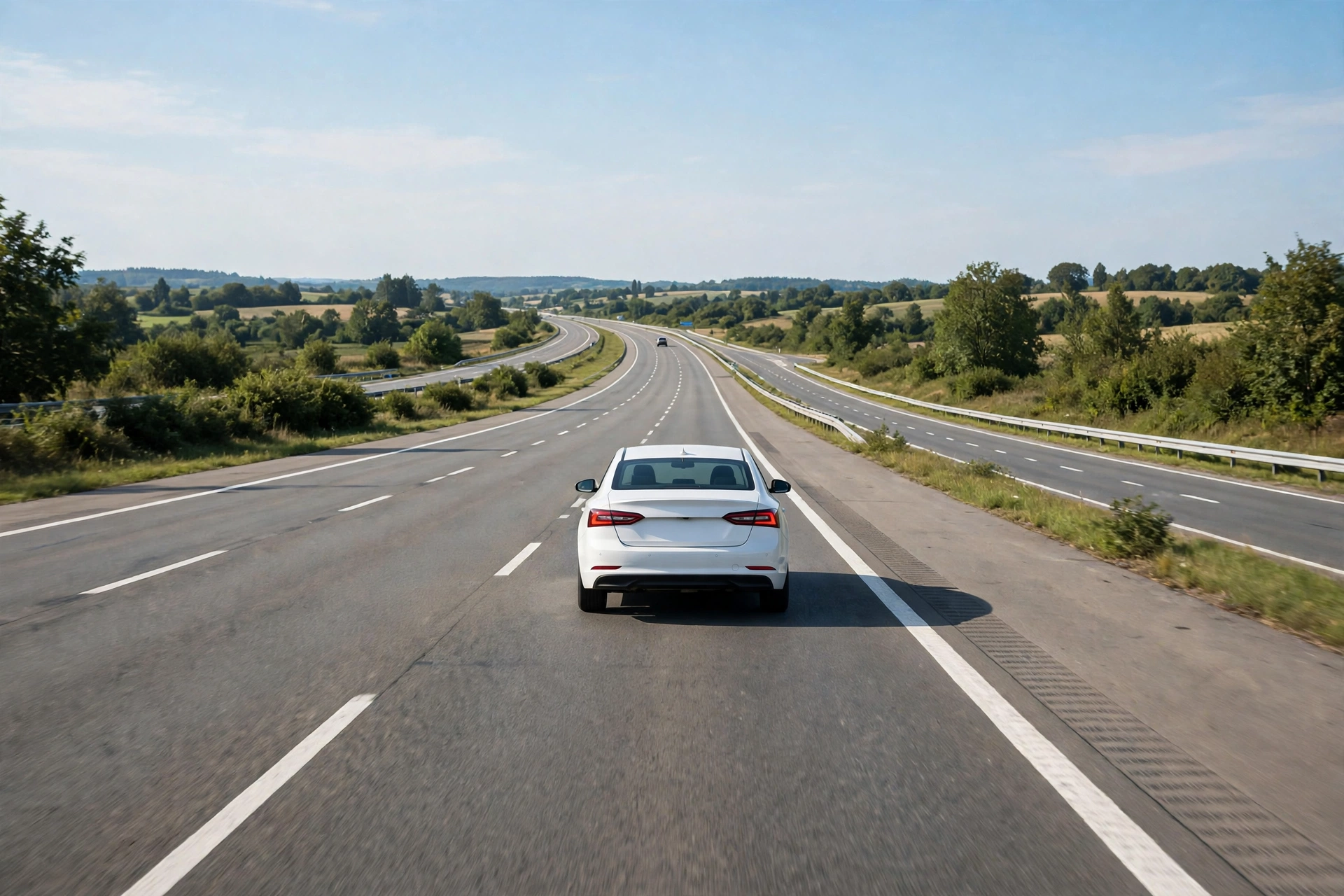
You are driving along when you glance in the rear-view mirror — and there it is. A car so close behind you that you can barely see its headlights. Your shoulders tense, your hands grip the wheel tighter, and one thought runs through your head: what do I do now?
Being tailgated is one of the most stressful things a new driver faces, and it is genuinely dangerous. Rear-end collisions are the most common crash type in the United States — about 29% of all reported crashes, according to NHTSA data — and following too closely is cited in roughly 23% of them. Handling a tailgater is a skill, not a talent — here are the exact steps for every kind of road.
Why Tailgating Is So Dangerous
Tailgating removes the one thing that keeps a small mistake from becoming a crash: time. At 60 mph, your car travels about 88 feet every second. A safe following distance gives the driver behind you roughly 3 seconds — about 264 feet — to see your brake lights, react, and stop. A tailgater one car length back has less than one second.
That is why a tailgater turns ordinary moments into emergencies: if the car ahead brakes for a yellow light or a turning car, you brake, and the tailgater has almost no room to avoid hitting you. The AAA Foundation for Traffic Safety found aggressive driving played a role in 56% of fatal crashes in a study of crashes from 2003 through 2007. It also hurts you: stress narrows your attention, and a nervous driver stares at the mirror instead of the road ahead.
First, a Quick Self-Check: Are You the Slow Car?
Before you blame the driver behind you, take one honest second to check yourself. It is the fastest way to end most tailgating situations.
- Are you in the left lane on a highway? The left lane is for passing. If faster traffic is stacking up behind you, move right when it is safe. Slower traffic keeps right — the law in most states, and the expectation everywhere.
- Are you driving well below the flow of traffic? If everyone is doing 65 mph and you are doing 50 for no reason, cars behind you will bunch up. Match the flow when conditions allow, or move to the rightmost lane.
- Are you driving far under the limit out of nerves? Understandable — but it invites tailgaters. The limit is a maximum, not a target, yet driving far below it on a clear road creates its own hazard.
The 5-Step Response That Works Every Time
The same five steps work on any road. Practice them in order until they feel automatic.
- Stay calm and keep your eyes forward. Take a slow breath. Check the mirror once, then look back at the road ahead. A calm driver makes good decisions; a panicked one does not.
- Check your speed, then hold it steady. If you are below the limit, ease up to it gently, then hold a constant, predictable speed — a tailgater needs to know what you will do next.
- Create more space in front of you. The step most guides skip, and the one that matters most. Double your following distance — from 3 seconds to 5 or 6 — so you can brake gently if you must, giving the tailgater time to react.
- Move right and let them pass. On a multi-lane road, signal, check mirrors and blind spot, and change lanes when safe. Letting an impatient driver go is not losing — it is the fastest way to end the danger. Our guide on how to change lanes safely covers the mirror-signal-manoeuvre sequence.
- If there is no passing lane, pull over briefly. On a single-lane road, use the next safe shoulder, turnout, or parking lot. Signal early, slow down gradually, and let them go. Thirty seconds, risk gone.
What to Do on Different Roads
The right move depends on where you are:
| Where you are | Best move |
|---|---|
| Multi-lane highway | Signal and move right as soon as it is safe. Let them pass. See our guide on how to merge onto the highway safely. |
| Single-lane road | Hold a steady speed, double the gap ahead, and pull into the next safe turnout or parking lot. |
| Residential street | Keep to the limit — children and parked cars make sudden stops likely. If they will not back off, pull over at a driveway or side street. |
| At night or in rain | Double your gap to at least 6 seconds, keep speed steady, and avoid sudden braking. Dim the rear-view mirror if it has a night setting. |
| Heavy traffic, nowhere to go | Stay in your lane, keep your distance ahead, and wait it out. Do not let yourself be rushed into a mistake. |
What NOT to Do When Someone Tailgates You
Your instincts in the moment are often the worst advice. Each of these reactions makes things more dangerous:
- Do not brake-check. Tapping or slamming your brakes to scare the tailgater turns tension into a confirmed rear-end crash — and in many states, brake-checking can shift some fault onto you.
- Do not speed up to escape. Driving faster than you are comfortable with, or above the limit, means you are now speeding and being tailgated. Double the risk, not less.
- Do not gesture, honk back, or make eye contact. Gestures and angry stares escalate road rage. The driver may already be aggressive — do not give them a reason to get worse.
- Do not flash your lights or slow down on purpose. Slowing deliberately to annoy the driver behind you can trigger the confrontation you want to avoid.
- Do not stare in the rear-view mirror. Glance, then look forward. The danger that can hurt you is almost always in front of your car, not behind it.
If the Tailgater Hits You
Even when you do everything right, a tailgater can still hit you. If it happens, stay calm and work through these steps:
- Check yourself and your passengers first. If anyone is hurt, call emergency services immediately.
- Pull over somewhere safe. Hazards on, move to the shoulder or a parking lot. Never stand between the cars or in moving traffic.
- Call the police. Even for a minor bump, a report protects you later if the other driver changes their story.
- Exchange information. Names, phone numbers, insurance details, licence plates, and the make, model, and colour of both cars.
- Take photos. Both cars, the damage, the road, the licence plates, and the position of the vehicles.
- Do not admit fault or argue. Stick to the facts. Let the police and the insurers decide what happened.
- Get your car checked. A rear-end hit can damage the bumper, exhaust, or frame in ways you cannot see. Our guide on what to do after a minor car accident covers the full checklist.
How to Make Sure You Are Never the Tailgater
The other half of this skill is not being the tailgater. It is easy to slip into without noticing — you are late, traffic is slow, and suddenly you are closer to the car ahead than you think. Use the 3-second rule: pick a fixed point ahead, and when the car in front passes it, count "one-thousand-one, one-thousand-two, one-thousand-three." Reach the point before you finish, and you are too close — ease off until the gap grows. Double it to 6 seconds in rain, snow, or at night, and leave more room behind large trucks. If highway driving still makes you nervous, our guide to driving on the highway for the first time walks through it step by step.
Frequently Asked Questions
Is tailgating illegal?
Yes — in every US state, following too closely is a traffic offence, usually cited as careless or reckless driving. Fines and licence points are typical; the exact law varies by state, so check your state DMV handbook.
Should I speed up when someone is tailgating me?
No. Speeding up to escape means driving faster than you are comfortable with, and you may start tailgating the car in front. Hold a steady speed at or below the limit, create space ahead, and let them pass when safe.
Is it ever okay to brake-check a tailgater?
No. Deliberately braking hard in front of a tailgater is dangerous and can be treated as aggressive driving. It is a common cause of rear-end crashes, and in many states it can shift some fault onto you.
What if a tailgater follows me aggressively and will not pass?
Stay calm, keep driving normally, and do not engage. If you feel threatened, drive to a well-lit public place — a petrol station or police station — rather than pulling over on a quiet road. If you feel unsafe, call emergency services.
How far behind the car in front should I drive?
Use the 3-second rule in clear, dry conditions: pick a fixed point, count three seconds after the car ahead passes it, and make sure you have not reached it yet. Double the gap to 6 seconds in rain, snow, or at night. The AAA guide to dealing with a tailgater safely gives the same advice, and Firestone's guide to tailgaters explains the same steps from a service-centre perspective.
The Bottom Line
Tailgaters are a fact of driving life, and new drivers meet them most. You cannot control the driver behind you, but you can control the space around your car — and that is what keeps you safe. Stay calm, check your lane and speed, double the gap ahead, and let them pass. Ten seconds, zero cost, and one of the scariest moments on the road becomes routine. The driver who lets the tailgater go is not the weaker driver. They are the smarter one.