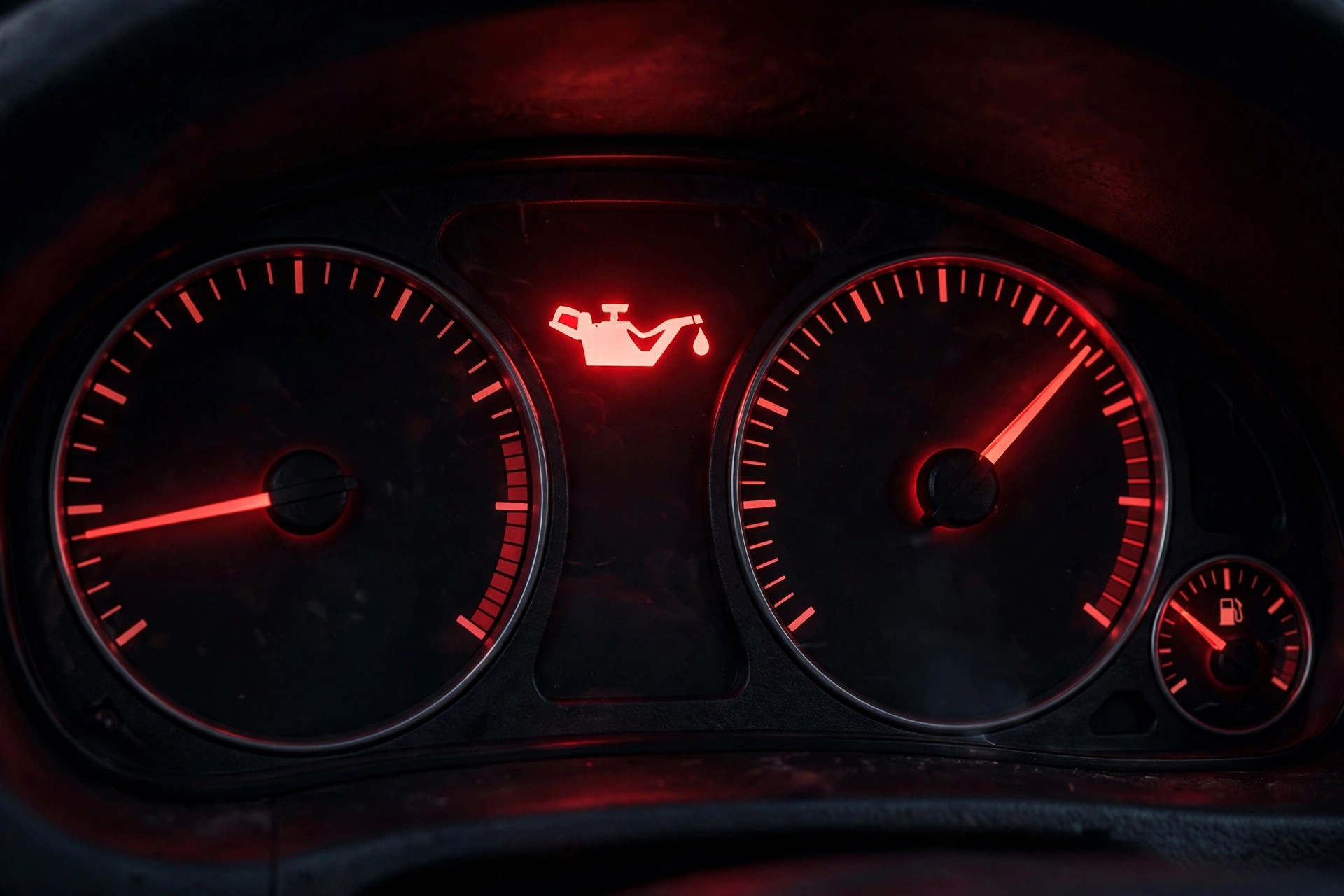
Picture this: you're driving, everything feels normal, and suddenly a small red oil can symbol lights up on your dashboard. Of all the warning lights in your car, this is one of the few that genuinely means "stop the car right now." In this guide, you'll learn exactly what the oil pressure warning light means, why driving even a few more minutes can destroy your engine, and the step-by-step response every beginner should know.
What the Oil Pressure Warning Light Actually Means
The oil pressure light looks like an old-fashioned oil can with a drip falling from its spout, and it almost always glows red. It turns on when a sensor detects that oil pressure inside your engine has dropped below the minimum level the engine needs to survive.
Here's the part many beginners miss: this light is about pressure, not just how much oil is in the engine. Your engine's moving parts — bearings, pistons, the camshaft — ride on a thin film of pressurized oil. Without enough pressure, metal grinds against metal. So even if your dipstick shows a full oil level, a failed oil pump or a blocked oil passage can still trigger this light.
Some cars also carry a separate low-oil-level indicator (often yellow). That one is about quantity. The red oil pressure light is about circulation — and it's far more urgent.
Why You Must Stop Immediately
An engine can run for a few seconds without oil pressure before damage starts. Past that, things go bad fast: bearings overheat and seize, pistons score the cylinder walls, and the engine can lock up completely — sometimes within minutes.
The money difference is stark. A faulty oil pressure sensor might cost very little to replace at a garage. An engine that has seized from oil starvation can cost thousands to rebuild or replace — often more than an older first car is worth. Treat the red oil pressure light like a fire alarm: the cheapest fix is always the one that happens before the fire.
Manufacturers agree. Owner's manuals consistently list the red oil pressure light as a stop-the-vehicle warning, not a "drive carefully to the garage" warning. Driving on to see if it goes away is the single most expensive decision a beginner can make with this light.
What to Do If the Light Comes On — Step by Step
- Stay calm and pull over safely. Put your hazard lights on, slow down smoothly, and pull off the road to the shoulder, a parking area, or the nearest safe spot. Don't brake hard or swerve.
- Turn the engine off. Once stopped, switch the engine off completely. Do not leave it idling — idling without oil pressure still damages the engine.
- Wait at least 10 minutes. Oil needs time to drain back into the sump so you get an accurate dipstick reading. Popping the bonnet open can help it cool a little faster.
- Check the oil level with the dipstick. Pull the dipstick out, wipe it clean, reinsert it fully, then pull it out again. If the level is below the minimum mark, top up with the correct grade of oil for your car (check your owner's manual or the filler cap). Our guide on how to check your engine oil level walks you through this in detail.
- Look for leaks. Glance under the car for fresh oil spots or drips, and look around the oil filter and sump plug area if you can see them safely.
- Decide whether to restart. If the level was low and topping up turns the light off when you restart, you may drive cautiously — but get the car checked soon, because oil had to go somewhere. If the level is normal and the light is still on, or the light returns, do not keep driving. Call roadside assistance or a mechanic.
- Listen and smell. Knocking, ticking, or rattling sounds, or the smell of burning oil, all point to damage already happening. Switch off immediately and call for help.
The 5 Most Common Causes of Low Oil Pressure
1. Low engine oil level
The most common cause by far. Oil gets consumed between services, leaks from aging gaskets, or simply wasn't topped up. Regular monthly dipstick checks prevent this entirely.
2. A worn or failed oil pump
The pump pushes oil through the engine. When it weakens with age or fails outright, pressure collapses — even with a full sump of oil. This one needs a garage.
3. Clogged oil filter or pickup
A dirty filter restricts flow, and the oil pickup tube in the sump can get blocked by sludge if oil changes are skipped. This is why sticking to your oil change schedule matters.
4. Wrong oil grade or degraded oil
Oil that's too thin for your engine — or old oil that has broken down from heat and mileage — can't hold pressure. Always use the grade your owner's manual specifies, not whatever is cheapest on the shelf.
5. A faulty oil pressure sensor
Sometimes the sensor or its wiring is the only problem, and the engine is actually fine. There's no safe way to tell the difference yourself, so treat it as real until a mechanic confirms otherwise. Driving on a "maybe it's just the sensor" assumption is how engines get destroyed.
What NOT to Do When the Oil Light Comes On
- Don't "just drive to the next exit" — engine damage doesn't wait for a convenient stopping place.
- Don't rev the engine to see if the light goes out — higher revs with no pressure do more damage, faster.
- Don't top up with the wrong oil grade just because it's what's in the boot. The wrong viscosity can make pressure problems worse.
- Don't assume it's a false alarm and carry on with your day. Hope is not a diagnostic tool.
When Is It Safe to Drive Again?
You can consider driving again only if all of these are true: the oil level was low, topping up brought it to the correct range, the light stays off after restarting, and the engine sounds and runs completely normally. Even then, drive gently and book a service check soon to find out where the oil went. If the light came on with a normal oil level, or it comes back, the car needs professional diagnosis before it's driven again. The RAC's guide to oil warning lights gives the same advice: pull over, switch off, and call for assistance if the light persists.
Frequently Asked Questions
Q: Can I drive a short distance with the oil pressure light on?
A: No — not even a short distance. Unlike some yellow warnings that can wait until tomorrow, the red oil pressure light means damage is happening now. Stop as soon as it's safe.
Q: My oil level is fine, but the light is still on. What does that mean?
A: Pressure can drop with a full sump. The usual suspects are a failed oil pump, a blocked pickup or filter, worn engine bearings, or a faulty sensor. Don't drive it — get it towed to a garage.
Q: The light flickers at idle but goes off when I rev the engine. Is that okay?
A: No, that's a classic early warning. Pressure is borderline at low revs, which usually means the oil level is low, the oil is worn out, or the pump is struggling. Check the oil immediately and book a service.
Q: Does the oil pressure light mean I need an oil change?
A: Not directly — it means pressure is too low right now. But overdue oil changes cause sludge and wear that lead to low pressure, so if your last change was a long time ago, that's a clue. Check the dipstick first, change the oil on schedule.
Q: Will the car warn me before the light comes on?
A: Usually not. The light itself is the warning, and it appears only when pressure is already below the safe minimum. That's why monthly oil checks are the best prevention — read our beginner's guide to dashboard warning lights to know every symbol before it surprises you.
Conclusion
The oil pressure warning light is one of the most serious red lights on your dashboard — a genuine stop-the-car warning, not a suggestion. Pull over safely, switch off, check the oil after ten minutes, and never drive on with a normal oil level and the light still on. A five-minute stop today can save you from a five-thousand bill tomorrow. Make monthly oil checks part of your routine, and this is one light you'll rarely meet again. For more symbols that can save your engine, see our guides to the ABS warning light and the check engine light.