First, What "Normal" Looks Like
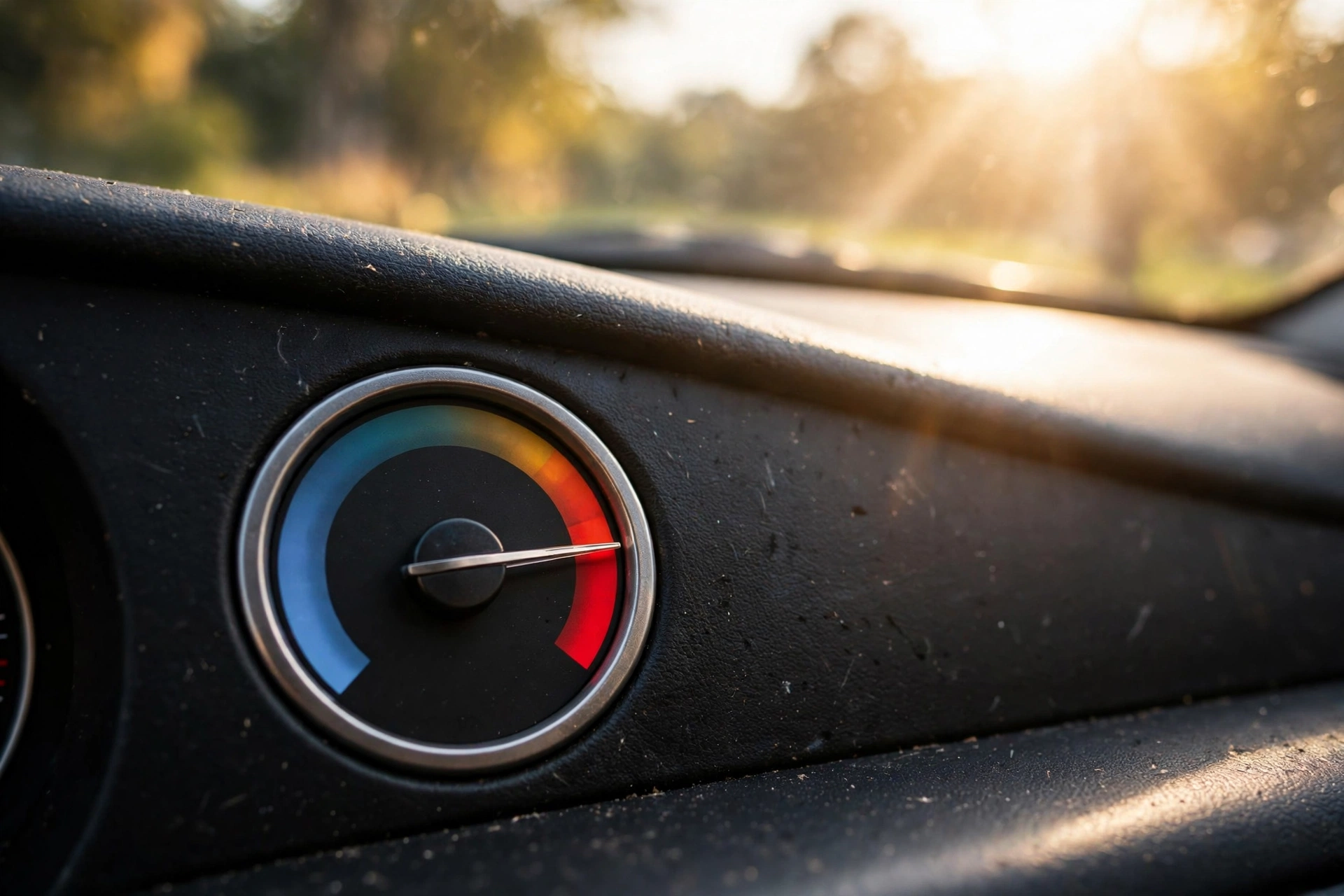
When your engine is fully warmed up, the temperature gauge needle should sit steady — usually just below or right at the middle of the dial — and stay there for the whole drive. Most engines are designed to run between about 195°F and 220°F (90°C to 105°C), and the gauge is deliberately damped, meaning it is designed to park in the middle across a wide range of real temperatures so small changes do not worry you.
That damping is exactly why a swinging needle matters. If you can see the needle moving up and down, the real coolant temperature is swinging by 20°F or more. This is not a quirk to ignore. A steady climb toward hot is one problem; a needle that rises, drops, then rises again is a different one — it means something in the cooling system is unstable, and the pattern of the movement is your best clue to what it is.
The good news: you do not need tools or mechanical experience to narrow it down. The timing of the swings — when they happen and what else changes at the same time — points to a short list of causes. This guide walks you through that pattern test, the seven most common causes, a safe five-minute check you can do yourself, and the exact words to use with your mechanic.
The Pattern Test: Read the Timing Before You Guess the Cause
Every cause of a swinging gauge has a signature pattern. Before you open the hood, watch the gauge for one drive and note when it moves. Match what you see to this table:
| What the needle does | Most likely cause | Your next check |
|---|---|---|
| Rises, then suddenly drops, then rises again — in a repeating cycle | Thermostat sticking | Feel the upper radiator hose (carefully — see the check below) |
| Swings at random and the heater blows hot, then cold, then hot | Low coolant or a trapped air pocket | Check the coolant level in the overflow tank when the engine is cold |
| Climbs at every stop or in traffic, drops within a minute of moving above 30 mph | Cooling fan not coming on | Watch whether the fan runs when the engine is warm and the A/C is on |
| Jumps to hot and back within seconds, with nothing else wrong | Faulty temperature sensor, wiring, or gauge | Compare with an OBD2 scanner reading if you can borrow one |
| Swings and the coolant level keeps dropping with no puddle under the car | Early head gasket trouble | See a mechanic promptly — do not keep topping up and driving |
| Sits below normal most of the time and the heater is lukewarm | Thermostat stuck open | Note the slow warm-up and lukewarm heater for your mechanic |
One exception worth knowing: on some trucks and larger vehicles with electric fans, a small rise in stop-and-go traffic followed by a drop on the highway can be normal fan cycling — provided the swing is small and the needle stays out of the top third of the gauge. If the swing is large, or the needle ever reaches the red zone, treat it as a fault, not a quirk.
7 Causes of a Temperature Gauge Going Up and Down
1. A sticking thermostat (the most common cause)
The thermostat is a small temperature-sensitive valve — inside it is a wax pellet that melts at a set temperature and opens the valve — that controls how much coolant flows from the engine to the radiator. When the engine is cold it stays closed so the engine warms up quickly; once the engine reaches operating temperature it opens and lets coolant circulate through the radiator to shed heat.
When a thermostat starts sticking, it opens late or only partly. The engine keeps heating because coolant cannot reach the radiator, the needle climbs, and then the heat finally forces the valve open. A rush of cool coolant from the radiator floods the engine, the needle drops sharply, and the cycle repeats. That rise-drop-rise rhythm is the classic thermostat signature.
A thermostat can also stick open, which is the opposite problem: the engine never fully warms up, the needle sits below normal, the heater blows lukewarm, and your fuel economy drops because the engine computer keeps the fuel mixture rich for a "cold" engine. Either way, a thermostat is a wear item — age, corrosion, and old coolant all make it stick — and replacing it is one of the more affordable cooling-system repairs.
2. Low coolant level
The temperature sensor (called the engine coolant temperature sensor, or ECT sensor) is designed to sit submerged in liquid coolant. When the coolant level drops — because of a leak, a worn hose, or a failing radiator cap — the sensor can be exposed to air or steam instead of liquid. Air and steam do not conduct heat the way liquid does, so the sensor's reading jumps wildly: it spikes when a pocket of hot steam touches it, then drops when liquid sloshes back over it.
The giveaway is your heater. The heater core sits high in the cooling system, so it loses flow first. If the heater blows hot, then cold, then hot again at idle while the gauge swings, low coolant or trapped air is the prime suspect. Low coolant always has a reason — coolant does not evaporate out of a healthy sealed system — so topping up without finding the leak only buys time.
3. A trapped air pocket
Air pockets are most common right after cooling-system work: a coolant flush, a hose replacement, or a thermostat change that was not properly bled afterwards. Air is compressible and lighter than coolant, so it collects at the highest points of the system — often right where the sensor sits. As a bubble passes the sensor, the reading dives; when liquid returns, it spikes.
An air pocket behaves almost exactly like low coolant, and the two often go together: a small leak lets air in as coolant escapes. The fix is a proper bleed (sometimes called "burping" the system), which lets trapped air escape while the system is refilled. This is a job for a mechanic unless your owner's manual describes a bleed procedure for your exact model — never open a cooling-system cap on a hot engine.
4. A cooling fan that does not come on
Below roughly 25–30 mph there is not enough air moving through the radiator on its own, so the electric cooling fan does the work. Above that speed, air rushing through the grille — ram air — does the job instead. So if the fan fails, the pattern is unmistakable: the needle climbs at every red light and in traffic, then drops within a minute of getting above 30 mph.
The fan itself may be fine while its relay, fuse, or temperature switch has failed, so this is often a cheaper fix than people expect. One quick check: with the engine warm, turn the air conditioning on — on most cars the fan is commanded to run whenever the A/C is on. If the fan stays silent with the A/C running, the fan circuit is a strong suspect. If you are not sure what the fan sounds like, listen for it on a warm day after a drive; it is a noticeable hum from behind the grille.
5. A faulty temperature sensor or wiring
Sometimes the engine temperature is perfectly stable and the gauge is lying. The ECT sensor works by changing its electrical resistance as temperature changes. When the sensor fails internally, or its connector pins corrode, or a wire chafes through and shorts intermittently, the signal to the gauge jumps around — and the needle follows.
The signature here is speed: the needle jumps to hot and back within seconds, with no change in how the engine sounds or feels, and often with no other symptom at all. A mechanic can confirm this in minutes by plugging in an OBD2 scanner and reading the live coolant temperature: if the scan reading sits steady around normal while the dashboard gauge swings, the problem is in the sensor, the wiring, or the instrument cluster — not in the cooling system. If you want to understand the tool before you borrow one, our guide on how to use an OBD2 scanner for the first time explains the process step by step.
6. A failing water pump or a partially blocked radiator
The water pump circulates coolant through the engine; the radiator sheds the heat. If the pump's impeller is corroded or a drive belt is slipping, coolant flow becomes weak and uneven — the engine heats up under load (a long uphill, for example) and recovers on flat ground. A radiator partly blocked by internal deposits or externally clogged with bugs and debris behaves the same way: it cannot shed heat fast enough when demand is high.
This pattern — climbs on a long uphill, recovers on the flat — is the clue. Unlike a thermostat problem, the swings here follow engine load rather than a repeating cycle. Both are mechanic jobs, and both get worse if ignored: poor circulation turns into real overheating.
7. Early head gasket trouble (the one not to ignore)
The head gasket seals the engine block to the cylinder head, keeping combustion gases, coolant, and oil in their separate passages. When it starts to fail, combustion gases can leak into the cooling system. Those gas bubbles behave like air pockets — the gauge swings, the heater goes cold, and the coolant level keeps dropping with no puddle under the car, because the coolant is being pushed out of the overflow or burned away.
Other warning signs include white smoke from the exhaust that smells sweet, a milky residue under the oil cap, bubbles in the coolant overflow tank while the engine runs, and an engine that overheats under load but seems fine at idle. If you see the gauge swinging and the coolant disappearing, do not keep topping up and driving — get the car to a mechanic promptly. Catching a head gasket early is the difference between a repair and an engine replacement.
The 5-Minute Beginner Check (Do This Before You Drive Again)
Do this check with the engine completely cold — parked overnight, or at least three hours after driving. Never open a radiator cap or a coolant reservoir cap on a hot or warm engine: the system is pressurized and hot coolant can spray out and cause serious burns.
- Check the coolant level. Find the translucent overflow (expansion) tank under the hood — your owner's manual shows its location. The coolant should sit between the MIN and MAX lines. If it is below MIN, the level is low. If you need to top up, use the coolant type listed in your owner's manual (the color matters — green, orange, and pink coolants are different formulas). Our guide on how to check your coolant level walks through this with photos of what to look for.
- Look for leaks. Check the ground under the car for dried green, orange, or pink stains, and look at the hoses for wet spots, cracks, or white crusty deposits around the clamps. A sweet smell under the hood is another leak clue.
- Check the radiator cap. The cooling system needs pressure to raise the coolant's boiling point. A weak or damaged cap lets pressure escape early, which causes boil-over, air pockets, and fluctuating temperatures. If the cap's rubber seal looks cracked or the spring feels loose, mention it to your mechanic — it is a cheap part.
- Start the engine and watch the warm-up. The needle should climb steadily to the middle in about 5–10 minutes of driving, then stay there. If it takes much longer and the heater stays lukewarm, the thermostat may be stuck open. If it climbs fast and then suddenly drops, the thermostat may be sticking closed and opening late.
- Listen for the fan. After a drive, with the engine warm, turn the A/C on and listen for the fan behind the grille. Silence points to the fan circuit. If the fan runs but the gauge still swings, the problem is elsewhere in the list above.
Write down what you found — the pattern, the coolant level, and anything that looked or smelled wrong. That note saves you money at the shop, because it points the mechanic straight at the likely cause instead of paying for an open-ended diagnosis.
Red Flags: Stop Driving Now
A swinging gauge is a warning, but these signs mean the engine is in immediate danger. Pull over safely and switch the engine off:
- The needle enters the red zone or the temperature warning light comes on — even if it drops back down a minute later.
- Steam or a sweet smell coming from under the hood.
- The heater suddenly blows cold while the gauge is high.
- Any grinding, knocking, or rattling sound that starts with the temperature problem.
- Coolant visibly leaking or pooling under the car.
Overheating can warp a cylinder head, damage the head gasket, or seize an engine — damage that happens in minutes, not hours. If any red flag appears, do not try to "make it home." Stop, let the engine cool completely, and call for a tow or roadside help. If you want the full stop-and-wait procedure, our guide on what to do when your car overheats covers it step by step.
What NOT to Do With a Swinging Gauge
- Do not just keep topping up the coolant. Coolant does not disappear from a healthy system. Repeated top-ups without finding the leak hide the real problem until it becomes expensive.
- Do not open the radiator cap on a hot engine. Wait until the engine is completely cold. This is the single most dangerous beginner mistake in cooling-system work.
- Do not ignore it because the needle comes back down. A gauge that drops back to normal is not a gauge that fixed itself — it is a system cycling between overheating and cooling, and each hot cycle stresses the head gasket.
- Do not pour cold water into a hot radiator. The sudden temperature shock can crack engine components.
- Do not use a "stop leak" additive as your only fix. It can clog the heater core and radiator passages and turn a simple repair into a bigger one. Treat it as an emergency measure at most, and tell your mechanic you used it.
What to Tell Your Mechanic (So You Are Not Overcharged)
A clear description gets you a faster, cheaper diagnosis. Say something like this:
"My temperature gauge goes up and down while I drive. It climbs [in traffic / on hills / in a cycle], then drops when [I get above 30 mph / the thermostat opens]. The heater [blows hot then cold / stays lukewarm]. The coolant level was [normal / below MIN] when I checked it cold, and [I did / did not] see any leaks or puddles. It has been happening for [how long]."
Then ask two questions before approving any work: "Can you show me the live coolant temperature on the scanner while the gauge swings?" and "What is the diagnosis fee if I decide not to go ahead with the repair?" The first question separates a real cooling fault from a bad sensor in minutes; the second keeps the bill predictable. If you have never picked a shop before, our guide on how to find a trustworthy mechanic explains the test-job approach and the red flags to watch for.
Frequently Asked Questions
Is it safe to drive with a temperature gauge going up and down?
Only for a short, careful trip to a mechanic — and only if the needle stays out of the red zone, there is no steam, no warning light, and the heater still works. If the needle reaches the red zone at any point, or you see steam or smell coolant, stop driving. A swinging gauge means the cooling system is unstable, and an unstable system can tip into full overheating without much warning.
Why does my temperature gauge go up when I stop and down when I drive?
That pattern almost always points to the cooling fan. Below about 30 mph the fan is what pushes air through the radiator; above that speed, air rushing through the grille does the job. If the fan is not coming on — a failed relay, fuse, or temperature switch is the usual cause — the engine heats up in traffic and cools down as soon as you get moving.
Can low coolant make the temperature gauge fluctuate?
Yes — it is one of the two most common causes. The temperature sensor must sit submerged in liquid coolant to read correctly. When the level is low, the sensor is alternately exposed to hot steam and liquid coolant, so the gauge spikes and drops as fluid sloshes around. Check the level in the overflow tank with the engine completely cold, and remember that low coolant always has a cause: look for the leak.
Why does my temperature gauge drop while driving on the highway?
A needle that drops below normal on the highway and a lukewarm heater usually mean the thermostat is stuck open — coolant is circulating through the radiator all the time, so the engine never reaches its proper temperature. It is less urgent than overheating, but it wastes fuel, increases engine wear, and can trigger a check engine light, so it still needs fixing.
How much does it cost to fix a fluctuating temperature gauge?
It depends entirely on the cause, which is why the pattern test matters. A radiator cap or a coolant top-up and bleed is inexpensive; a thermostat replacement is a moderate job; a sensor or fan relay is usually affordable; a water pump or head gasket is a major repair. Get the diagnosis first — ideally a live scanner reading — before approving parts, and get the quote in writing.
The Bottom Line
A temperature gauge that goes up and down is your cooling system telling you something is unstable — and the pattern is the message. A repeating rise-and-drop cycle points to the thermostat; swings with a heater that goes hot and cold point to low coolant or trapped air; climbing in traffic and dropping at speed points to the fan; and instant jumps with no other symptoms point to the sensor or its wiring. Do the five-minute cold-engine check, note the pattern, and take that note to your mechanic. And if the needle ever reaches the red zone, or you see steam, stop driving — that is the one rule with no exceptions.
If this helped, keep learning your car the same way: your owner's manual has the exact coolant type, capacities, and warning-light meanings for your specific model, and it is the single most useful document a first-time owner can read.
Sources: Engineer Fix — Why Is My Temperature Gauge Going Up and Down?; Steer — Temperature Gauge Going Up and Down: Causes. Gauge behavior and operating-temperature ranges as described in those guides and standard service references.